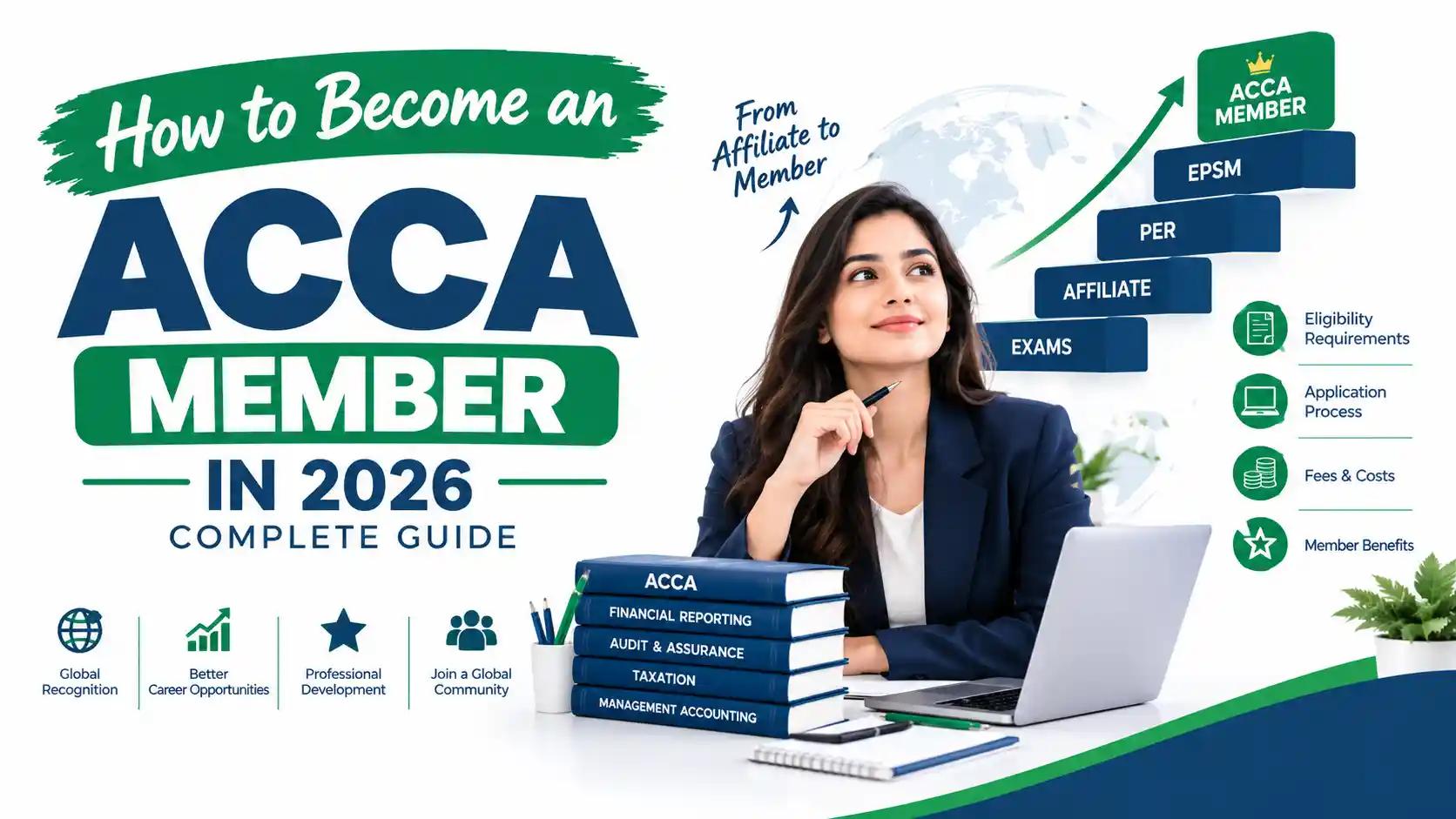
Quick Answer
To become an ACCA member, you must pass all 13 ACCA exams, complete the Ethics and Professional Skills Module (EPSM), and finish the Practical Experience Requirement (PER). The PER means 36 months of relevant, supervised work experience plus nine signed-off performance objectives. You then apply for membership through myACCA. Check your starting point with the ACCA eligibility criteria in Pakistan guide first.
Introduction
Many students believe they become ACCA qualified the day they pass the last exam. That is the most common misunderstanding about ACCA membership, and it costs people jobs, promotions and time. Passing 13 exams is a huge achievement, but full membership needs two more things: an ethics module and three years of supervised, relevant work experience.
At ICT Business School, we meet students every year who are confused about the gap between “I passed my exams” and “I am an ACCA member.” This guide closes that gap. You will see exactly what ACCA requires, what it costs, how long it takes and how to avoid delays. If you are still planning your studies, start with the ACCA subjects explained guide, then compare costs in our ACCA fees in Pakistan article. You can also browse all ACCA and professional courses before you decide.
This article is written for Pakistani students and professionals in Islamabad, Rawalpindi, Lahore, Karachi and beyond. It focuses on practical steps rather than theory.
Key Takeaways
- ACCA membership has three parts: exams, ethics (EPSM) and practical experience (PER). Passing exams alone makes you an ACCA Affiliate, not a member.
- PER needs 36 months of relevant work experience and nine performance objectives (five Essential, four Technical), signed off by a supervisor.
- Only full members can use “ACCA” after their name and the title Chartered Certified Accountant. Affiliates cannot.
- In 2026, ACCA’s published annual subscription is £326 for members and £163 for affiliates (for up to three years). Both are due on 1 January each year.
- Members must complete CPD every year: 40 units, with at least 21 verifiable, on the standard route.
- ACCA is redesigning its qualification from September 2027, and EPSM is being replaced. Finishing EPSM before the July 2027 cut-off can save you a longer module later.
- You can gain PER experience before, during or after your exams, so working while you study can shorten your journey.
What Is ACCA Membership?
ACCA membership is the status you earn after completing the ACCA exams, the ethics module and the Practical Experience Requirement. It gives you the title Chartered Certified Accountant and the right to use “ACCA” after your name. ACCA stands for the Association of Chartered Certified Accountants, a global professional body based in the UK.
Think of it like a driving licence. The exams are the theory test, and PER is your supervised driving hours. You only get the full licence when both are complete.
ACCA has several stages: student, affiliate, member and fellow. Each stage has different rights and annual fees. If you are new to the body itself, read what is ACCA before continuing.
Who Can Become an ACCA Member?
Anyone who completes the ACCA Qualification, the EPSM and PER can become an ACCA member. There is no age limit, and you do not need to live in the UK. Your work experience can be gained in any country, as long as it is relevant and properly supervised.
Entry into the ACCA exams depends on your education. ACCA has different entry routes for school leavers and graduates, and Pakistani students often start after intermediate, A-Levels or a commerce degree. Our guide to ACCA eligibility criteria in Pakistan covers each route in detail.
Degree holders may also qualify for exam exemptions. Use the ACCA exemption calculator guide to estimate how many papers you could skip. Exemptions reduce the number of exams you sit, but they do not reduce the PER requirement.
How to Become an ACCA Member: Step-by-Step Guide
To become an ACCA member, register with ACCA, pass all exams, complete EPSM, finish 36 months of PER, then apply through myACCA. Here is the full journey in order.
Step 1: Check your eligibility and register as an ACCA student
Confirm your entry route, create your myACCA account and pay the one-off registration fee. Your ACCA login and account guide shows how to set it up correctly.
Step 2: Claim any exemptions
If your degree or earlier qualification qualifies, apply for exemptions early. This can save both money and months of study.
Step 3: Pass the Applied Knowledge, Applied Skills and Strategic Professional exams
In total you need 13 exams, including exemptions where granted. Check session timing in our ACCA exam dates and deadlines guide.
Step 4: Complete the Ethics and Professional Skills Module (EPSM)
It is completed online through myACCA. Do not leave it to the end.
Step 5: Start and record your PER
Register your employer, nominate your supervisor and log your experience in the My Experience tool from your first relevant job.
Step 6: Get your experience and objectives signed off
Your supervisor must confirm your time and your performance objectives.
Step 7: Receive your invitation and submit your membership application
ACCA tracks your progress and invites you to apply once you are ready. You then complete the membership application and pay the one-time admission fee.
Step 8: Receive your certificate and start your CPD
After approval, you become a fully qualified Chartered Certified Accountant and ACCA member.
ACCA Membership Requirements at a Glance
| Requirement | What You Need |
|---|---|
| Exams | All 13 ACCA exams (or exemptions where granted) |
| Ethics | Ethics and Professional Skills Module (EPSM) |
| Practical experience | 36 months in a relevant accounting or finance role |
| Performance objectives | 9 in total: 5 Essential and 4 Technical (or the Approved Employer route) |
| Supervisor sign-off | All experience signed off by your practical experience supervisor |
| Application | Membership application through myACCA plus one-time admission fee |
The 13 ACCA Exams You Must Pass
The ACCA Qualification has three levels, and you need to pass 13 exams across them. The level and paper structure below applies to the current qualification, which runs until the redesign begins in September 2027.
| Level | Papers | Learn More |
|---|---|---|
| Applied Knowledge | Business and Technology (BT), Management Accounting (MA), Financial Accounting (FA) | Applied Knowledge guide, Financial Accounting, Management Accounting |
| Applied Skills | Corporate and Business Law (LW), Performance Management (PM), Taxation (TX), Financial Reporting (FR), Audit and Assurance (AA), Financial Management (FM) | Law, Performance Management, Taxation, Financial Reporting, Audit and Assurance, Financial Management |
| Strategic Professional | Essentials: Strategic Business Leader (SBL), Strategic Business Reporting (SBR). Plus two options, such as Advanced Financial Management (AFM) or Advanced Performance Management (APM) | SBL, SBR, APM, AFM |
For a deeper paper-by-paper breakdown, read our ACCA papers guide with exam structure and success tips and the ACCA Strategic Professional level overview.
Ready to start preparing? Explore the Course options and pick the papers that match your next exam session.
Ethics and Professional Skills Module (EPSM)
The EPSM is an online ethics and professional skills module that every ACCA member must complete before applying for membership. According to ACCA, it comprises ten units and takes roughly 20 hours. It covers communication, commercial awareness, innovation, analysis and evaluation skills, and it is completed through myACCA.
Many students ask whether EPSM is compulsory. For membership, yes. Some sources describe affiliate status differently, so always check how your own status displays in myACCA. As a rule, do EPSM before your final Strategic Professional exam. That way you are not scrambling after your results arrive.
The module also carries a fee, which was around £83 in 2026 according to published summaries. Confirm the latest amount on ACCA Global before paying.
An important change is coming. ACCA has announced that EPSM will be withdrawn as part of its 2027 qualification redesign. Affiliates who have not completed EPSM by July 2027 will need to complete a new Ethical, Sustainable Leadership module as part of the membership requirements. Third-party guidance says this module is expected to take around 60 hours and be chargeable, with full credit for those who finish EPSM earlier. If you are close to qualification, completing EPSM now is a practical way to avoid the longer route.
Practical Experience Requirement (PER) Explained
PER is ACCA’s work-experience requirement: 36 months of supervised experience in a relevant accounting or finance role, plus nine performance objectives. You record your progress online in My Experience, and your practical experience supervisor signs it off.
The nine performance objectives
You must achieve five Essential objectives and four Technical objectives.
The five Essential objectives cover:
- Ethics and professionalism
- Stakeholder relationship management
- Strategy and innovation
- Governance, risk and control
- Leadership and management
The four Technical objectives are chosen from a list that reflects the work you actually do. Examples include areas such as financial reporting, audit, tax and management accounting. Choose the ones your daily duties naturally support, not the ones that merely sound impressive.
Who can be your supervisor?
To sign off your objectives, your supervisor should be a qualified accountant recognised by law in your country and/or a member of an IFAC body. If your line manager is not qualified, they can still confirm your time. You then nominate a qualified second supervisor for the objectives.
What about ACCA Approved Employers?
If your employer holds the relevant ACCA Approved Employer status, you may be able to claim an exemption from documenting the performance objectives. You still need the 36 months of experience recorded.
Where can Pakistani students gain PER?
Typical routes include audit and assurance firms, corporate finance and accounts departments, banks, taxation and advisory teams, and internal audit functions. Your role must have real accounting or finance content. A job title alone is not enough, because ACCA assesses the work, not the label.
Our ACCA scope in Pakistan article lists common employer types, and our career page shows how we help students move toward practical roles.
Can I Become an ACCA Member Without Work Experience?
No. You cannot become a full ACCA member without completing the 36-month Practical Experience Requirement. You can, however, finish all exams and hold affiliate status while you gain that experience.
If you do not have a job yet, you have three realistic options:
- Look for entry-level roles in accounts, audit or tax, and start logging PER immediately.
- Consider internships or training roles, as long as the work is relevant and your supervisor can verify it.
- Complete exams first, then build experience. Work done before, during or after your exams counts.
Whichever route you choose, confirm with ACCA that your role qualifies before you rely on it.
ACCA Student vs Affiliate vs Member vs Fellow
An ACCA Affiliate has passed the exams but not yet finished PER, while a member has completed everything. A fellow is a member with five years of continuous membership. Here is how the four stages compare.
| Feature | Student | Affiliate | Member | Fellow (FCCA) |
|---|---|---|---|---|
| Exams | In progress | Completed | Completed | Completed |
| EPSM | In progress | Needed for membership | Completed | Completed |
| PER (36 months) | Can start anytime | Not yet complete | Completed | Completed |
| Use “ACCA” after name | No | No | Yes | Yes (as FCCA) |
| Title | ACCA Student | ACCA Affiliate | Chartered Certified Accountant | Chartered Certified Accountant (Fellow) |
| 2026 annual subscription* | £140 | £163 for up to 3 years, then £326 | £326 | Confirm on ACCA fees page |
*Rates in GBP as published for 2026. Confirm on ACCA Global before paying.
A practical note on language: if you are an affiliate, say “I am an ACCA Affiliate” or “I have passed all ACCA exams.” Avoid saying “I am ACCA qualified” on your CV, because employers and verifiers read that as full membership.
How to Apply for ACCA Membership After Completing PER
Once your exams, EPSM and PER are complete and signed off, ACCA invites you to apply, and you submit your membership application through myACCA. The process is simple if your records are clean.
. Keep My Experience updated. ACCA tracks your progress and emails an invitation when you are ready. An outdated record delays this.
. Update your contact details. Your email address matters, because the invitation goes there.
. Complete the membership application on myACCA.
. Pay the one-time admission fee. It is separate from the annual subscription. If ACCA finds you are not fully ready, it explains why and refunds your payment.
. Respond to any queries. ACCA may contact you through your portal if it needs more information.
. Receive approval. Your digital certificate appears in your portal under Documents, and a physical copy is posted to your address.
Processing time depends on how complete your records are. ACCA does not publish a fixed approval window, so avoid relying on third-party promises.
How Long Does It Take to Become an ACCA Member?
Most students take roughly three to five years, depending on exam attempts, exemptions and when they start working. The minimum on the work side is 36 months, but you can complete that while studying.
| Scenario | Typical Outcome |
|---|---|
| Full-time study, then job search | Longest route: exams first, then 36 months of PER afterward |
| Study while working in a relevant role | Fastest route: PER overlaps with exams |
| Degree with several exemptions | Fewer exams, but PER time is unchanged |
| Several exam resits | Delays affiliate status, not necessarily PER |
The main time risk is not the exams. It is poor PER planning: late logging, an unavailable supervisor or experience that ACCA does not accept as relevant. Our guide on why students fail CA and ACCA exams explains how to avoid the exam-side delays.
ACCA Membership Fees and Costs in 2026
ACCA’s published 2026 subscription is £326 for members and £163 for affiliates for up to three years. Subscriptions are due on 1 January each year. The figures below are approximate, based on ACCA’s published 2026 rates, so confirm them on ACCA Global before paying.
| Fee | Approximate 2026 Amount (GBP) | Notes |
|---|---|---|
| Student registration (one-off) | £89 | Paid once when you register |
| Student annual subscription | £140 | Paid each year while you are a student |
| EPSM | About £83 | Check current price on ACCA Global |
| Affiliate subscription | £163 | Up to three years, then £326 |
| Membership admission fee | Shown on ACCA’s fees page | One-time, paid when you apply |
| Member annual subscription | £326 | Standard rate |
| Reduced rate (extended leave) | £73 | Only in certain circumstances |
| Reduced rate (subscription assistance) | £163 | Only in certain circumstances |
| Readmission after removal | £326, or £163 in some cases | Plus current-year subscription and CPD declaration |
Exam fees, exemption fees and tuition are separate, and they vary by paper and location. For the full cost picture in Pakistan, see our ACCA fee structure and registration total cost, the ACCA total cost in Pakistan 2026 breakdown, and local tuition guidance in ACCA course fees in Islamabad.
How to Maintain Your ACCA Membership
Members keep their status by paying the annual subscription on time and completing CPD every year. Missing either can lead to removal from the register.
Annual subscription. It is due on 1 January. If it stays unpaid, ACCA’s rules allow removal from the register after three months, and removal means you can no longer use the designation. Readmission costs more than paying on time.
CPD (Continuing Professional Development). On the standard unit route, members complete 40 units a year, with at least 21 verifiable units and up to 19 non-verifiable units. One unit equals one hour of learning. You make an annual declaration through myACCA, and ACCA reviews a sample of records each year, so keep your evidence.
Ethics and conduct. Members must follow the ACCA Code of Ethics and Conduct and the ACCA Rulebook. These documents are on ACCA Global, and they are worth reading once a year.
ACCA Member Benefits
ACCA membership gives you a recognised professional title, global credibility, career progression options and access to a worldwide network. Here is how the benefits show up in practice.
- Professional title and letters. You can use the Chartered Certified Accountant title and “ACCA” after your name.
- Employer trust. Many employers prefer or require full membership for senior finance, audit and leadership positions.
- International mobility. ACCA operates globally, which supports career moves into the Gulf, the UK and other markets, subject to local rules.
- Networking and events. Members access ACCA communities, webinars and CPD resources.
- Career flexibility. The qualification covers audit, tax, reporting, management accounting and finance, so you can change direction.
- Higher-level opportunities. Fellowship after five years of continuous membership adds seniority.
Studying with an approved partner can also help with exam support and resources. Our article on the benefits of studying with an ACCA Approved Learning Partner explains how.
Disadvantages and Limitations
ACCA membership takes real time and money, and it does not guarantee a job or a specific salary. A balanced decision needs both sides.
| Pros | Cons |
|---|---|
| Globally recognised title | Takes several years to complete |
| Flexible: study and work together | PER needs a qualified, willing supervisor |
| Wide career options | Annual subscription and CPD continue for life |
| Fellowship route after five years | Exam costs and resits add up |
| Online records and digital certificate | Rules and fees change, so you must keep checking |
One important limitation is local practice rights. In Pakistan, statutory audit and some regulated roles follow local law and the rules of bodies such as ICAP and SECP. If your goal is to sign statutory audits of Pakistani companies, check the current legal position with ICAP before choosing your route. ACCA members commonly build careers in industry, banking, advisory, internal audit and international roles.
ACCA Membership Career Scope and Salary in Pakistan
ACCA members in Pakistan commonly work in finance, audit, taxation, advisory and corporate roles, but salary depends on experience, employer and city. There is no single guaranteed figure.
Roles often include accounts officer, financial analyst, internal auditor, tax consultant, finance manager and, over time, CFO-track positions. Members and fellows typically have stronger prospects for senior roles than candidates who stop at the exam stage, although results vary widely.
For current figures, read our ACCA salary in Pakistan guide and the ACCA salary in the UK comparison. Our future scope of accounting jobs in Pakistan article covers demand trends, and our list of the highest-salary accounting courses in Pakistan helps you compare alternatives.
Please treat any salary number you see online as indicative. Always check the date and source.
ACCA vs CA vs CMA vs CIA: Path to Full Membership
Each qualification has its own route to full status, and none is universally better. The right choice depends on your goals, location and budget.
| Qualification | Route to Full Status | Best Suited For |
|---|---|---|
| ACCA | 13 exams + EPSM + 36 months PER | Global finance and audit careers, flexible study |
| CA (ICAP) | Staged exams + articleship | Statutory audit and local regulated roles in Pakistan |
| CMA USA | Part 1 and Part 2 + experience requirement | Management accounting and corporate finance |
| CIA | Three parts + experience requirement | Internal audit and risk careers |
Read the detailed comparisons: CA vs ACCA, CMA vs ACCA, CIA vs ACCA, and the three-way CA vs ACCA vs CMA in Pakistan guide. For the Pakistani CA route, see the chartered accountancy Pakistan guide and the CA articleship Pakistan article. For a salary comparison across all three, see ACCA vs CMA vs CA salary in Pakistan.
Is ACCA Membership Worth It in Pakistan?
For most students aiming at international, corporate or audit-support careers, ACCA membership is worth it, provided you can commit to the exams and the 36-month PER. It is less suitable if your only goal is Pakistan’s regulated statutory audit practice.
Ask yourself these questions:
- Do I want a globally portable qualification?
- Can I find relevant work and a qualified supervisor?
- Can I afford exams, tuition and long-term subscriptions?
- Do I understand the local regulatory limits for my target career?
If most answers are yes, membership is a strong investment. If not, compare options in our guide to the best career options in finance and business and the overview of top finance certifications for high-paying careers.
Common Mistakes to Avoid
- Treating exam completion as membership. Affiliates cannot use “ACCA” after their name.
- Delaying PER. Start logging experience in your first relevant job.
- Choosing a weak supervisor. Make sure yours is qualified and available.
- Forgetting EPSM. Finish it before your last exam, and before the July 2027 cut-off if relevant.
- Vague performance objectives. Write specific, evidence-based statements about what you actually did.
- Not keeping employment records. ACCA may audit PER, so keep contracts and letters.
- Missing 1 January. Pay subscriptions and make CPD declarations on time.
- Relying on outdated blogs. Fees and rules change, and the 2027 redesign matters.
Expert Tips and Best Practices
- Start PER early. Register your employer and supervisor in the first month of a relevant job.
- Log monthly. A five-minute update each month beats a stressful backfill at the end.
- Match objectives to real work. Pick Technical objectives your daily duties already support.
- Use a simple evidence file. Save task examples, reports, and emails that show your contribution.
- Plan study around work. Use a structured routine from our ACCA study hub guide and the best ACCA practice platforms.
- Check the portal every quarter. Confirm your status, exemptions and EPSM progress.
- Re-check fees each year. ACCA reviews them annually.
Quick checklist before you apply
- All exams passed or exempted
- EPSM completed
- 36 months logged and signed off
- Nine performance objectives approved
- Contact details updated in myACCA
- Admission fee ready
Latest Updates: ACCA Qualification Changes 2026–2027
ACCA has announced a qualification redesign starting in September 2027, and it directly affects EPSM. ACCA’s own page states that EPSM is being withdrawn and that affiliates who have not completed it by July 2027 will need to complete the Ethical, Sustainable Leadership Essential Employability Module as part of the membership requirements.
Third-party summaries also describe the redesign as moving from 13 exams to 11 and renaming Applied Skills to Expertise. These details are not all confirmed in the sources used for this article, so verify them on ACCA Global before you plan around them. The practical message for students is simple:
- If you are close to finishing, complete EPSM before the cut-off.
- If you are early in your journey, keep checking ACCA’s transition guidance, because paper mapping and exemptions are being clarified.
- The 2026 subscription rates in this guide are published 2026 rates and may change for 2027.
We recommend reviewing fee-sensitive and exam-sensitive content every six months. For session updates, see the ACCA exam dates and deadlines and ACCA results 2026 Pakistan pages.
How to Check Your ACCA Membership Status
Log in to myACCA to see whether you appear as a student, affiliate or member, and to access your certificate and records. Our complete guide to ACCA portal features walks through each section.
- Status: shown in your myACCA profile.
- Application progress: check your portal messages for queries from ACCA.
- Certificate: after approval, your digital certificate appears under Documents, and a printed copy is posted.
- Employer verification: employers can verify membership through ACCA’s official verification service on ACCA Global.
- Status not updating? Contact ACCA through the support options in your portal once a reasonable time has passed.
Where Should Pakistani Students Start?
Start by matching your current education level to the right ACCA entry route, then plan study and work together.
- After intermediate or FSc commerce: compare your options in best career after FSc commerce and best career courses after intermediate.
- Building accounting basics first: the FIA foundation in accountancy explained guide shows a stepping-stone route.
- Looking for a UK pathway alongside professional study: see the HND business qualification overview.
- Choosing where to study: compare options in best ACCA institutes in Islamabad, best ACCA institutes in Rawalpindi and best CA and ACCA institutes in Pakistan.
Not sure which route fits you? Visit our admission page for a clear start.
Why Choose ICT Business School for ACCA Membership Guidance and ACCA Preparation in Islamabad and Rawalpindi?
Choosing where you study affects how smoothly you move from student to member. ICT Business School is an ACCA Approved Learning Partner serving students across the twin cities of Islamabad and Rawalpindi, and you can verify current approval status in the approved learning partner directory on ACCA Global. We also teach other professional pathways, including CA, CMA, CIA, FIA, BTEC and HND, so students can compare routes honestly before committing. You can read about our approach on the About page, meet the teaching team on our faculty page, and see how we guide students beyond exams toward real work experience. Our goal is not just exam success but a clear plan to PER and full ACCA membership. Enroll Now to speak with our counsellors about your route.
FAQs
How do I become an ACCA member?
Pass all 13 ACCA exams, complete EPSM, finish 36 months of relevant supervised experience with nine performance objectives, then apply through myACCA. You become a member once ACCA approves your application.
Can I become an ACCA member without work experience?
No. Full membership requires the 36-month Practical Experience Requirement. You can hold affiliate status after the exams while you gain the experience.
How long does it take to become an ACCA member?
Most students take roughly three to five years. The fastest route is working in a relevant role while studying, so PER overlaps with your exams.
How much does ACCA membership cost?
In 2026, ACCA’s published member subscription is £326 a year, and the affiliate rate is £163 for up to three years. A one-time admission fee also applies when you join, and exam fees are separate. Always confirm current rates on ACCA Global.
What is the difference between an ACCA affiliate and an ACCA member?
An affiliate has passed the exams but has not completed PER, while a member has completed everything. Only members can use “ACCA” after their name.
Is EPSM compulsory for ACCA membership?
Yes, EPSM must be completed before you can become a member. ACCA is replacing it from 2027, so finishing it before the July 2027 cut-off is a practical choice.
Can I use ACCA after my name as an affiliate?
No. Only full members can use “ACCA” after their name. Affiliates should describe themselves as ACCA Affiliates.
How do I check my ACCA membership status?
Log in to myACCA and check your profile, portal messages and documents. Your certificate appears there after approval.
Do I have to pay ACCA membership fees every year?
Yes. The annual subscription is due on 1 January each year. Unpaid subscriptions can lead to removal from the register after three months.
When can I become an ACCA fellow (FCCA)?
Fellowship generally requires five years of continuous membership. ACCA does not publish a separate fellowship fee, so check ACCA’s fees page.
Conclusion
ACCA membership is not one exam or one certificate. It is a three-part journey: exams, ethics and practical experience. The most important idea in this guide is simple: passing 13 exams makes you an affiliate, and finishing EPSM plus 36 months of signed-off PER makes you a member. Plan your work experience early, keep your records current, pay your subscription on time and keep up with CPD.
Our key recommendation is to start PER as soon as you are in a relevant role and to complete EPSM before the 2027 changes. Your logical next step is to check your eligibility, confirm any exemptions and choose a study plan that fits your work schedule. To compare options, browse the ACCA courses and read our blog for more guides.
If you want personal guidance on your exact route, Book a Seat with ICT Business School today.
Last Updated: October 2026 (updated for 2026 subscription rates, PER requirements and the 2027 EPSM withdrawal). We recommend reviewing this article every six months because ACCA fees and exam rules change.