Quick Answer: The best finance certifications for high-paying careers include CFA (investment management), CPA (accounting), FRM (risk management), CFP (financial planning), CMA (corporate finance), and ACCA (global accounting). Your ideal choice depends on your career goal — CFA for investment banking and asset management, CPA/ACCA for accounting and audit, and FRM for risk roles at banks like JP Morgan or Goldman Sachs.
Finance certifications open doors to careers in banking, investment management, corporate finance, and accounting. Whether you're a fresh graduate or a working professional, the right finance certification can boost your salary, credibility, and career growth significantly.
This guide breaks down the top finance certifications, their costs, duration, and which one suits your career path best.
Why Finance Certifications Matter for Your Career?

Employers at firms like PwC, Deloitte, EY, KPMG, Morgan Stanley, and BlackRock actively look for candidates with recognized credentials. A certification proves you understand financial modeling, valuation techniques, risk management, and financial reporting standards like IFRS and GAAP.
Certified professionals typically earn more, get faster promotions, and have better access to global finance jobs — including remote and international roles.
Best Finance Certifications for High-Paying Careers
1. CFA (Chartered Financial Analyst)
The CFA is one of the most respected credentials in investment management, portfolio management, and equity research. It's ideal for careers at investment banks, asset management firms, and hedge funds.
- Duration: 2–4 years (3 exam levels)
- Focus: Investment analysis, portfolio management, equity research
- Best for: Investment banking, asset management, wealth management
2. CPA (Certified Public Accountant)
CPA is the gold standard for accounting professionals in the USA, Canada, and Australia. It covers financial reporting, auditing, tax planning, and compliance.
- Duration: 12–18 months
- Focus: Accounting, audit, tax, financial reporting
- Best for: Public accounting, corporate finance, audit firms
3. ACCA (Association of Chartered Certified Accountants)
ACCA is a globally recognized accounting certification, especially popular in the UK, Pakistan, and the Middle East. It covers financial accounting, corporate finance, and business strategy.
- Duration: 2–3 years (13–14 papers, with exemptions available)
- Focus: Financial accounting, audit, taxation, corporate reporting
- Best for: Accounting careers across UK, UAE, and Pakistan
4. FRM (Financial Risk Manager)
FRM is designed for professionals who want to specialize in financial risk analysis and risk management. Banks like JP Morgan and Morgan Stanley hire FRM holders for risk desks.
- Duration: 1–2 years (2 parts)
- Focus: Risk management, credit analysis, market risk
- Best for: Risk analyst and treasury management roles
5. CFP (Certified Financial Planner)
CFP focuses on personal wealth management, retirement planning, and tax planning. It's ideal for professionals who want to work directly with individual clients.
- Duration: 6–18 months
- Focus: Financial planning, wealth management, tax planning
- Best for: Financial advisory and wealth management careers
6. CMA (Certified Management Accountant)
CMA is focused on corporate finance and management accounting — budgeting, financial strategy, and internal decision-making.
- Duration: 1–2 years
- Focus: Corporate finance, budgeting, financial strategy
- Best for: Corporate finance and management accounting roles
7. FMVA (Financial Modeling & Valuation Analyst)
FMVA is a practical, skills-based certification focused on financial modeling and valuation techniques — useful for analysts who need hands-on Excel and modeling skills.
- Duration: 3–6 months (self-paced)
- Focus: Financial modeling, valuation, forecasting
- Best for: Financial analyst and corporate finance roles
8. CAIA (Chartered Alternative Investment Analyst)
CAIA is a niche certification for professionals interested in alternative investments — private equity, hedge funds, and real assets.
- Duration: 1 year
- Focus: Alternative investments, portfolio management
- Best for: Private equity and hedge fund careers
Comparison Table: Top Finance Certifications
| Certification | Duration | Focus Area | Average Global Recognition | Best For |
|---|---|---|---|---|
| CFA (Chartered Financial Analyst) | 2–4 Years | Investment & Portfolio Management | Very High | Investment Banking, Asset Management, Equity Research |
| CPA (Certified Public Accountant) | 12–18 Months | Accounting & Auditing | High (USA-Focused) | Public Accounting, Corporate Finance, Taxation |
| ACCA (Association of Chartered Certified Accountants | 2–3 Years | Accounting & Financial Reporting | Very High (Global) | Accounting, Audit, Finance Management |
| FRM (Financial Risk Manager) | 1–2 Years | Risk Management | High | Risk Analysis, Banking, Financial Risk Consulting |
| CFP (Certified Financial Planner) | 6–18 Months | Financial Planning | Moderate | Wealth Management, Financial Advisory |
| CMA (Certified Management Accountant) | 1–2 Years | Corporate Finance & Management Accounting | High | Management Accounting, FP&A, Corporate Finance |
| FMVA (Financial Modeling & Valuation Analyst) | 3–6 Months | Financial Modeling & Valuation | Growing | Financial Analyst, Investment Analysis, Corporate Finance |
CFA vs CPA vs ACCA vs FRM: Which One Should You Choose?
- CFA vs CPA: CFA is better for investment and portfolio careers; CPA is better for accounting and audit careers.
- FRM vs CFA: FRM specializes in risk management; CFA covers broader investment analysis.
- ACCA vs CPA: ACCA has wider global recognition, especially in the UK and Pakistan; CPA is stronger in the USA.
- CMA vs CFA: CMA suits corporate finance roles; CFA suits investment and asset management roles.
There's no single "best" certification — it depends on whether you want to work in investment banking, accounting, risk management, or corporate finance.
Expert Guidance
Choosing a finance certification shouldn't be based on trends alone. Here's practical advice:
- Match the certification to your target job, not the other way around. If you want investment banking, CFA carries more weight than CMA.
- Start with a strong academic foundation. Programs like the HND (Higher National Diploma) or Level 7 Extended Diploma build the accounting and finance fundamentals that make certifications like ACCA or CFA easier to pass.
- Don't rush multiple certifications at once. Complete one before starting another — employers value depth over a long list of half-finished credentials.
- Factor in cost and ROI. CFA and FRM require higher upfront investment but offer strong long-term salary growth in investment banking and risk roles.
- Use self-paced online options if you're working full-time — most certifications now offer flexible, remote-friendly study formats.
Key Facts
- CFA has three exam levels and typically takes 2–4 years to complete.
- CPA is recognized primarily in the USA, Canada, and Australia.
- ACCA offers exemptions for students with prior accounting qualifications, reducing total papers required.
- FRM is a two-part exam focused entirely on financial risk analysis.
- Most finance certifications now offer 100% online, self-paced study options.
- Employers such as Deloitte, EY, KPMG, and PwC actively recruit CFA, CPA, and ACCA holders.
- Finance certifications can be pursued with or without a prior finance degree, depending on eligibility rules.
- FMVA is one of the fastest certifications to complete, often within 3–6 months.
Best Finance Certifications for Career Goal
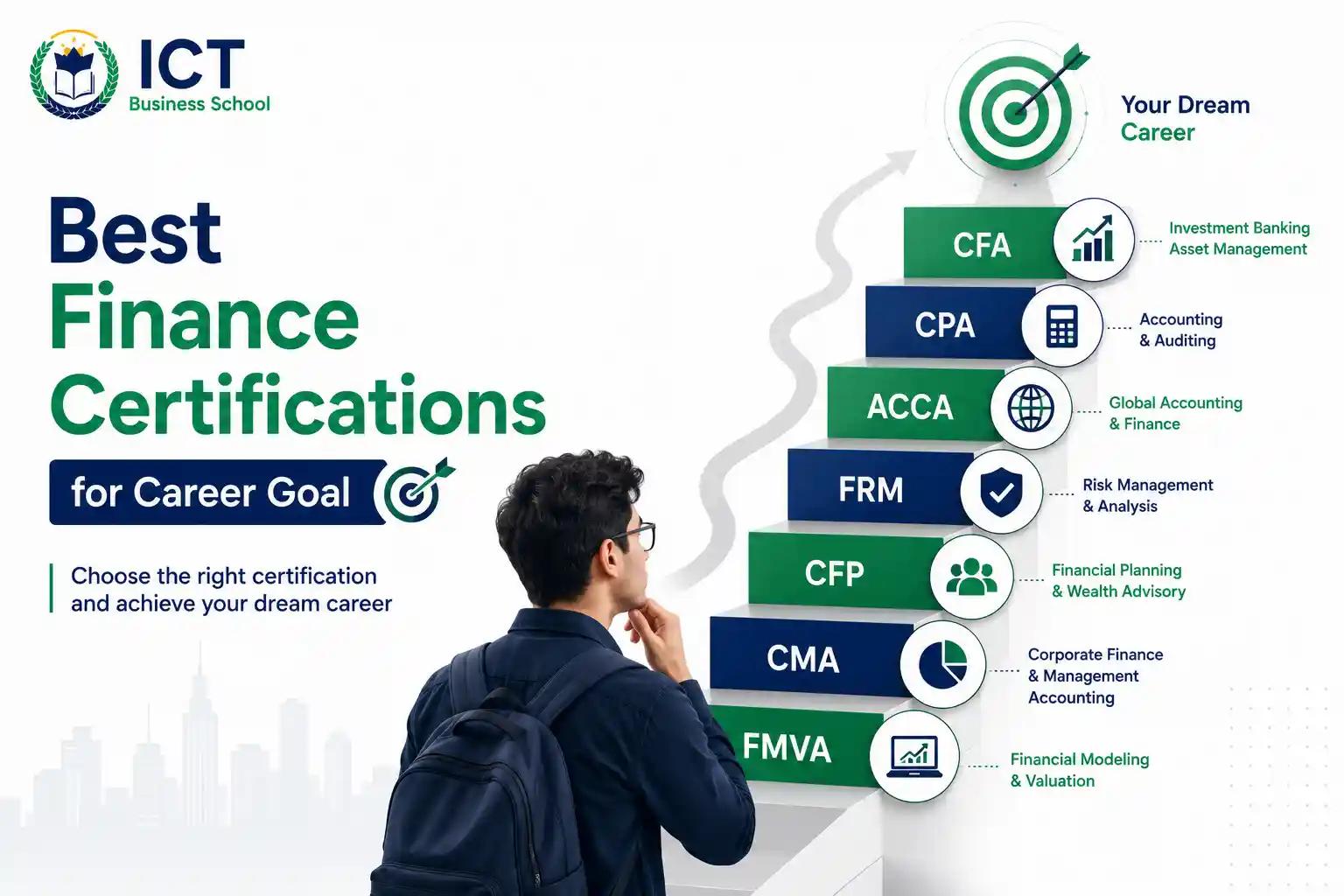
- Investment Banking: CFA, FMVA
- Corporate Finance: CMA, FMVA
- Accounting & Audit: CPA, ACCA
- Risk Management: FRM
- Financial Planning & Wealth Management: CFP
- Alternative Investments (Private Equity/Hedge Funds): CAIA
Finance Certifications by Region
- USA: CFA and CPA are the most valued credentials for finance and accounting careers.
- UK: ACCA and CIMA dominate the accounting and finance job market.
- Pakistan: ACCA is extremely popular, alongside ICAP qualifications, for accounting careers.
- UAE & Dubai: CFA and ACCA holders are in high demand across banking and corporate finance sectors.
- Canada & Australia: CPA is the leading certification for accounting professionals.
If you're starting your finance journey from Pakistan, building a strong base through structured programs — such as those offered through ICT Business School's course catalog — can make certifications like ACCA or CFA significantly more manageable.
Why Choose ICT Business School
Before jumping into a finance certification, having the right academic foundation matters. Why choose ICT Business School comes down to structured learning pathways that align with globally recognized finance and accounting qualifications.
Students exploring accounting and finance careers can also explore advanced corporate and taxation courses at ICT to build practical skills alongside certification study. For those earlier in their academic journey, the O-Level Program and Pearson BTEC Level 3 provide strong groundwork before pursuing professional finance certifications.
You can also review faculty expertise on the ICT Business School faculty page or read more finance career insights on the ICT Business School blog.
For additional academic pathways, ICT.edu.pk's course listings and IDT Pakistan's course offerings are also worth exploring alongside professional certification planning.
FAQs
Which finance certification has the highest salary? CFA and FRM holders typically earn the highest salaries, especially in investment banking, asset management, and risk roles at global firms.
What is the best finance certification for beginners? FMVA or CFP are good starting points due to shorter duration and practical, skills-based content.
Is CFA better than CPA? Neither is universally "better" — CFA suits investment careers, while CPA suits accounting and audit careers.
Which finance certification is globally recognized? CFA and ACCA are among the most globally recognized finance and accounting certifications.
How much does a finance certification cost? Costs vary widely — from a few hundred dollars for FMVA to several thousand dollars for CFA, including exam and study material fees.
Can I complete finance certifications online? Yes, most certifications including CFA, FRM, CMA, and FMVA offer self-paced, fully online study options.
Which finance certification is best after an MBA? CFA or FRM pair well with an MBA for investment banking or risk management roles.
Are finance certifications worth it in 2026? Yes — with growing demand in FinTech, ESG investing, and data-driven finance roles, certified professionals have a strong competitive edge.
Ready to Start Your Finance Career?
Choosing the right finance certification is a career-defining decision. Build your foundation with the right academic programs, then pursue the certification that matches your career goals — whether that's investment banking, accounting, or corporate finance.
Explore structured finance and business programs at ICT Business School or get in touch through the contact page to plan your certification pathway today.