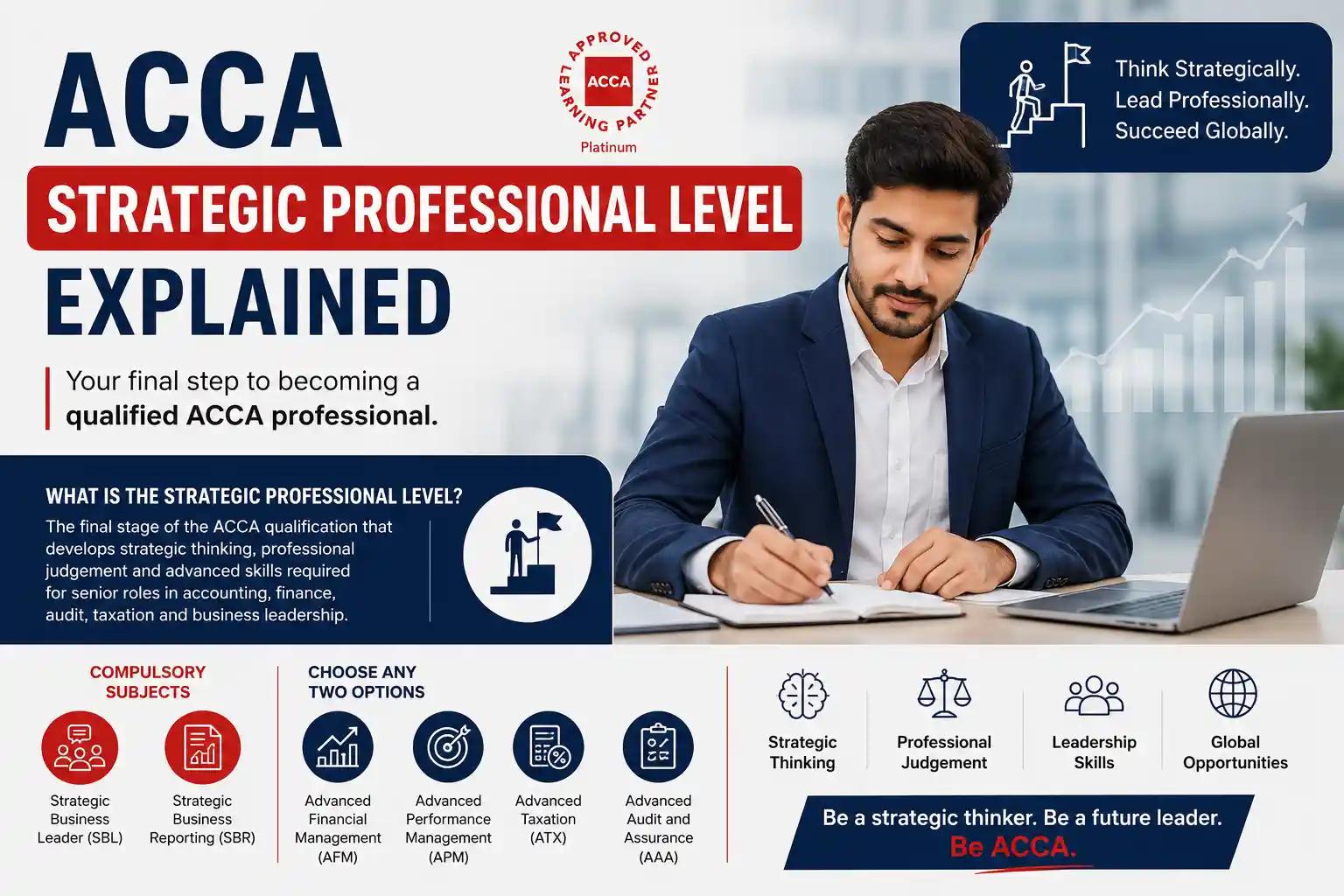
The ACCA Strategic Professional Level is the stage that transforms students into future business leaders and finance professionals. Unlike the earlier stages of the ACCA qualification, these exams focus on strategic thinking, professional judgement, leadership, and solving complex business challenges. Understanding the exam structure, choosing the right optional papers, and preparing with an effective study strategy can significantly improve your chances of success. In this guide, you'll learn everything you need to know about the ACCA Strategic Professional Level, including its subjects, syllabus, exam pattern, and career opportunities.
Quick Answer
The ACCA Strategic Professional Level is the final and most advanced stage of the ACCA qualification. It consists of four papers—two compulsory papers (Strategic Business Leader (SBL) and Strategic Business Reporting (SBR)) and two optional papers selected from Advanced Financial Management (AFM), Advanced Performance Management (APM), Advanced Taxation (ATX), and Advanced Audit and Assurance (AAA). To become a fully qualified ACCA member, students must also complete the Ethics and Professional Skills Module (EPSM) and the Practical Experience Requirement (PER).
If you have successfully completed the ACCA Applied Knowledge and Applied Skills levels, you are now ready to enter the most advanced stage of the ACCA qualification. The Strategic Professional level moves beyond technical accounting knowledge and focuses on developing strategic thinking, leadership, professional judgement, and decision-making skills expected from senior finance professionals.
At this stage, students learn to analyse complex business situations, apply International Financial Reporting Standards (IFRS), understand corporate governance, manage business risks, and make strategic financial decisions. These are the skills valued by employers in Pakistan and across international job markets.
This guide explains everything you need to know about the ACCA Strategic Professional Level, including its subjects, exam structure, optional papers, study approach, and career opportunities after completion.
Strategic Professional Level Overview
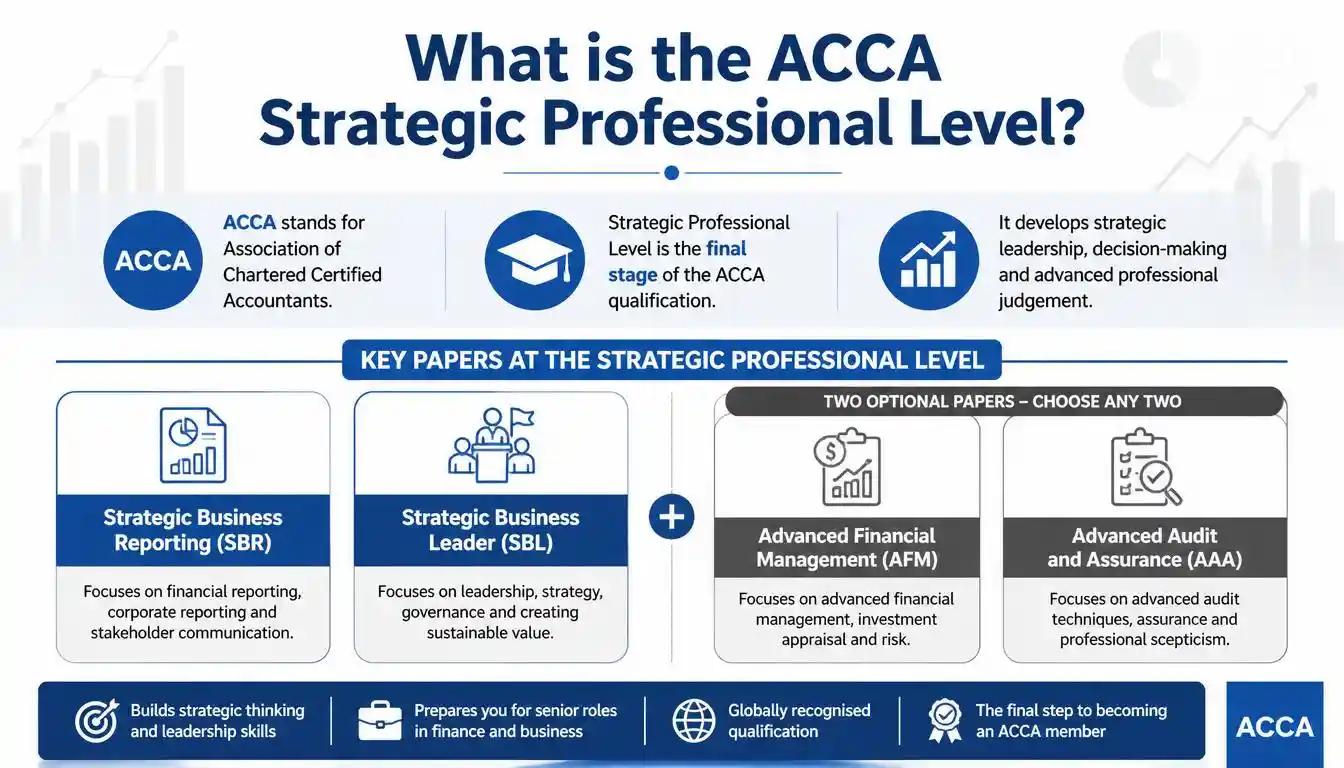
The ACCA Strategic Professional Level is the final stage of the ACCA qualification and is designed to prepare students for senior leadership and strategic decision-making roles in accounting, finance, and business. Building on the knowledge gained in the Applied Knowledge and Applied Skills levels, this stage focuses on applying technical expertise, professional judgement, and strategic thinking to solve complex business challenges.
At this level, students develop advanced skills in financial reporting, corporate governance, business leadership, risk management, and strategic financial decision-making. Rather than testing theoretical knowledge alone, the Strategic Professional Level evaluates your ability to analyse real-world business scenarios, provide professional recommendations, and communicate solutions expected from qualified finance professionals.
The Strategic Professional Level consists of compulsory and optional papers, allowing students to develop specialist knowledge based on their career goals. The following section explains each paper and the overall exam structure in detail.
Key Facts — ACCA Strategic Professional Level
- Final level of the ACCA professional accounting qualification
- Consists of 4 papers total: 2 compulsory + 2 optional
- Compulsory papers: Strategic Business Leader (SBL) and Strategic Business Reporting (SBR)
- Optional papers: Choose 2 from AFM, APM, ATX, and AAA
- Ethics and Professional Skills Module (EPSM) must also be completed
- Pass mark for all papers: 50%
- Exams held quarterly: March, June, September, December
- Completing this level + 3 years PER (Practical Experience Requirement) = full ACCA membership
- Recognized globally in 180+ countries by top employers and regulators
- ACCA Strategic level pass rates are the lowest of all three ACCA level
What is in ACCA Strategic Professional Level?
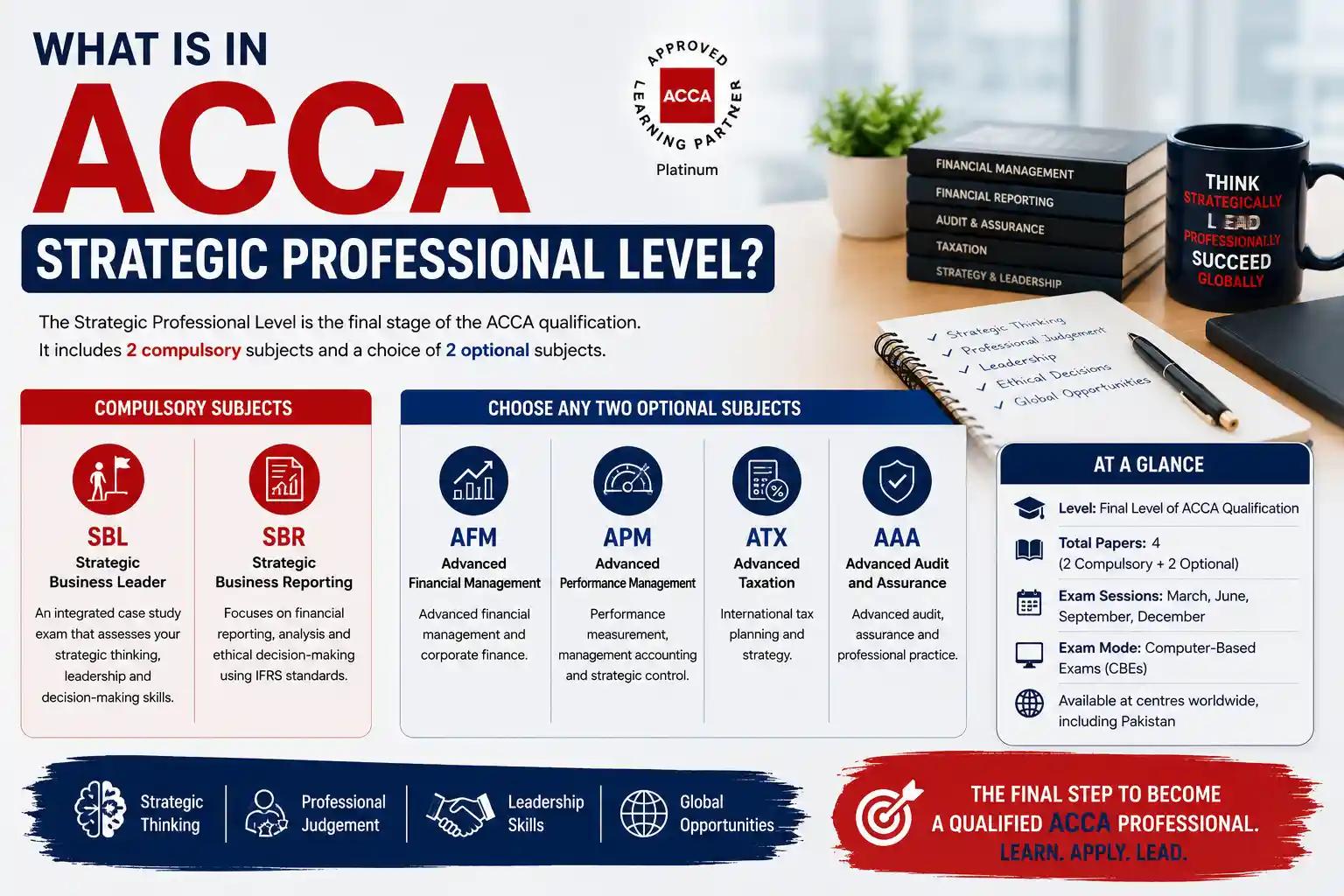
The ACCA Strategic Professional Level is the third and final stage of the ACCA qualification. It follows the Applied Knowledge and Applied Skills levels and represents the most advanced part of the ACCA journey. At this stage, students are expected to apply their technical knowledge, professional judgement, and strategic thinking to solve complex business and financial challenges.
The Strategic Professional Level focuses on developing leadership, corporate governance, strategic financial management, professional ethics, and advanced financial reporting skills. Rather than testing theoretical knowledge alone, the exams assess your ability to analyse real-world business scenarios, make informed decisions, and communicate professional recommendations effectively.
Successfully completing this level demonstrates that you have developed the knowledge and practical skills expected of senior finance professionals and brings you one step closer to becoming a fully qualified ACCA member.
ACCA Strategic Professional Level — Complete Overview Table
| Component | Type | Details |
|---|---|---|
| Strategic Business Leader (SBL) | Compulsory | Business leadership, governance, ethics, strategy |
| Strategic Business Reporting | Compulsory | Advanced IFRS financial reporting for groups |
| Advanced Financial Management (AFM) | Optional | Financial strategy, risk, investment decisions |
| Advanced Performance Management (APM) | Optional | Strategic performance frameworks, decision models |
| Advanced Taxation (ATX) | Optional | Complex tax planning, compliance, and advisory |
| Advanced Audit and Assurance (AAA) | Optional | Audit strategy, risk, ethics, and assurance frameworks |
| Ethics and Professional Skills Module (EPSM) | Compulsory Module | Online module covering professional values and ethics |
| Practical Experience Requirement (PER) | Work-based | 3 years of relevant accounting/finance work experience |
You must pass SBL, SBR, and any two optional papers. You must also complete the EPSM and meet the PER requirement before you can claim full ACCA membership.
ACCA Strategic Professional Level Subjects
Core Papers (SBL and SBR)
The ACCA Strategic Professional Level includes two compulsory papers that every student must complete. These papers focus on strategic leadership, advanced financial reporting, professional judgement, and decision-making skills required for senior finance and business roles. Unlike earlier stages of the ACCA qualification, exemptions are not available for these compulsory papers.
SBL — Strategic Business Leader
Strategic Business Leader (SBL) is one of the most distinctive papers in the ACCA qualification. It is a case-study-based exam that combines knowledge from different areas of the ACCA syllabus, including strategy, leadership, corporate governance, ethics, risk management, and technology. Rather than testing theoretical knowledge alone, SBL evaluates your ability to analyse complex business situations, solve problems, and communicate professional recommendations in a real-world business environment.
The exam is designed to develop the strategic thinking and leadership skills expected from senior finance professionals and future business leaders.
Key topics include:
- Corporate governance, professional ethics, and organisational leadership
- Business strategy, strategic planning, and competitive analysis
- Enterprise risk management and internal control frameworks
- Leadership, change management, and organisational behaviour
- Digital transformation, innovation, and the use of technology in business
- Professional skills, including communication, analysis, evaluation, and professional scepticism
SBR — Strategic Business Reporting
Strategic Business Reporting (SBR) is one of the most technically advanced papers in the ACCA Strategic Professional Level. Building on the knowledge gained in the Financial Reporting (FR) paper at the Applied Skills level, SBR develops your ability to prepare, analyse, and interpret complex financial statements in accordance with International Financial Reporting Standards (IFRS).
The paper focuses on applying professional judgement to real-world financial reporting issues, evaluating complex business transactions, and understanding the ethical responsibilities of accountants when preparing and presenting financial information. It prepares students to handle the financial reporting challenges faced by senior finance professionals in multinational organisations and global business environments.
Key topics include:
- Application of International Financial Reporting Standards (IFRS) in complex business scenarios
- Preparation and interpretation of group financial statements, including subsidiaries, associates, and joint ventures
- Professional ethics and ethical decision-making in financial reporting
- Current developments and emerging issues in global financial reporting standards
- Corporate reporting, sustainability reporting, and integrated reporting frameworks
Optional Papers (AFM, AAA, ATX, APM)
After completing the compulsory papers, students must choose any two papers from the following four optional subjects. The best combination depends on your career goals, areas of interest, and the type of finance or accounting role you want to pursue after qualifying.
AFM — Advanced Financial Management
Advanced Financial Management (AFM) develops the strategic financial decision-making skills required by senior finance professionals. The paper covers advanced investment appraisal, corporate finance, business valuation, mergers and acquisitions, treasury management, and financial risk management. It is an excellent choice for students who want to build careers in corporate finance, investment banking, financial consultancy, or senior financial management.
Key Topics Covered
- Advanced investment appraisal and capital budgeting
- Financial risk management and hedging strategies
- Business valuation, mergers, and acquisitions
- Treasury management and working capital strategy
- International financial management and global finance
APM — Advanced Performance Management
Advanced Performance Management (APM) focuses on improving organisational performance through strategic planning, performance measurement, and management reporting. The paper develops the skills needed to evaluate business performance, design effective performance management systems, and support senior management in making informed strategic decisions. It is well suited for students interested in business strategy, performance management, financial planning, and management consultancy.
Key Topics Covered
- Strategic performance measurement models, including the Balanced Scorecard
- Business performance evaluation and management reporting
- Strategic budgeting, forecasting, and financial planning
- Performance management in public sector and not-for-profit organisations
- Managing risk, uncertainty, and strategic decision-making
ATX — Advanced Taxation
Advanced Taxation (ATX) builds on the knowledge gained in the Taxation (TX) paper at the Applied Skills level. The paper develops advanced skills in personal and corporate tax planning, international taxation, and professional tax advisory services. It also emphasises ethical decision-making and the application of tax legislation in complex business scenarios. ATX is an excellent choice for students planning careers in taxation, tax consultancy, accounting firms, financial advisory, and corporate tax management.
Key Topics Covered
- Advanced personal and corporate tax planning
- International taxation and cross-border tax considerations
- Taxation of groups, companies, and business reorganisations
- VAT, inheritance tax, stamp duties, and other applicable taxes
- Professional ethics and responsibilities in tax planning
- Business structuring for tax efficiency and compliance
AAA — Advanced Audit and Assurance
Advanced Audit and Assurance (AAA) builds on the knowledge gained in the Audit and Assurance (AA) paper at the Applied Skills level. The paper develops advanced auditing, assurance, and professional judgement skills required to plan, evaluate, and manage complex audit engagements. It also focuses on professional ethics, quality management, risk assessment, and assurance services in different business environments. AAA is an excellent choice for students planning careers in audit firms, the Big Four, regulatory authorities, and corporate assurance functions.
Key Topics Covered
- Advanced audit and assurance principles
- Risk-based audit planning and audit execution
- Quality management and professional standards in audit firms
- Professional ethics, independence, and professional scepticism
- Specialised audit and assurance engagements across different industries
- Evaluation of internal controls and audit evidence
: Skills Developed At The ACCA Strategic Professional
The ACCA Strategic Professional Level is designed to prepare students for senior finance, leadership, and strategic business roles. By completing this stage of the ACCA qualification, you develop the technical expertise, professional judgement, and leadership capabilities expected from qualified accounting professionals worldwide.
Key Skills You Will Develop
- Strategic financial management and business leadership
- Advanced financial reporting in accordance with International Financial Reporting Standards (IFRS)
- Corporate governance, business ethics, and professional decision-making
- Risk assessment, strategic performance management, and business advisory skills
- Advanced taxation planning and regulatory compliance
- Audit strategy, quality management, and assurance expertise
- Professional communication, critical analysis, and problem-solving under pressure
- The ability to advise senior management and business leaders on complex financial and strategic decisions
These are the core competencies that distinguish ACCA-qualified professionals from traditional accountants. They are highly valued by employers across Pakistan and international job markets, particularly in audit firms, multinational companies, financial institutions, and corporate finance departments.
ACCA Strategic Professional Level Syllabus
The ACCA Strategic Professional Level syllabus is designed to prepare students for senior leadership, strategic decision-making, and professional practice in accounting and finance. Rather than focusing only on technical knowledge, the syllabus develops the ability to analyse complex business situations, apply professional judgement, and provide strategic recommendations in real-world environments.
Each subject follows an official study guide published by ACCA Global, which is reviewed and updated regularly to reflect changes in International Financial Reporting Standards (IFRS), professional ethics, business practices, and regulatory developments.
SBL Syllabus Highlights:
Strategic leadership and business governance
- Corporate strategy and organisational performance
- Risk management and business resilience
- Digital transformation and technology
- Professional ethics and leadership skills
SBR Syllabus Highlights:
Group financial reporting
Corporate reporting and financial statement analysis
Professional ethics in financial reporting
Emerging developments in global reporting standards
AFM Syllabus Highlights:
- Treasury management and financial strategy
- Mergers and acquisitions
- Financial risk management
- International finance
APM Syllabus Highlights:
- Performance evaluation models
- Strategic budgeting and planning
- Public sector and not-for-profit performance
- Business performance improvement.
ATX Syllabus Highlights:
- International and cross-border taxation
- Tax planning and compliance
- Business restructuring for tax efficiency
- Professional ethics in taxation
AAA Syllabus Highlights:
- Risk assessment and internal controls
- Quality management in audit engagements
- Professional ethics and independence
- Specialised assurance services
Students preparing in Pakistan can access the official ACCA syllabus PDFs through the ACCA Study Hub, and supplement their preparation with free tools at MegaFreeTools (https://megafreetools.com/) and career advisory services at BACO Consultants (https://bacoconsultants.com/).
ACCA Strategic Professional Level Exam Pattern
Exam Format and Structure
All ACCA Strategic Professional exams are session-based Computer-Based Exams (CBEs) conducted four times a year—in March, June, September, and December. Students can take their exams at approved ACCA examination centres located across the world, including Pakistan. The exam format is designed to assess technical knowledge, professional judgement, strategic thinking, and the ability to solve complex business problems in real-world scenarios.m centres worldwide — including centres in Karachi, Lahore, and Islamabad.
SBL Format:
- One integrated case study based on a real-world business scenario
- Pre-seen material released before the examination
- Multiple tasks linked to the same business case
- Assessment of strategic thinking, communication, analysis, and professional judgement
- Exam Duration: 4 hours (including reading and planning time)
SBR, AFM, APM, ATX, AAA Format:
- Strategic Business Reporting (SBR)
- Advanced Financial Management (AFM)
- Advanced Performance Management (APM)
- Advanced Taxation (ATX)
- Advanced Audit and Assurance (AAA)
Duration and Marking Scheme
| Paper | Exam Duration | Total Marks | Pass Mark |
|---|---|---|---|
| SBL | 4 hours | 100 marks | 50 marks (50%) |
| SBR | 3 hours 15 minutes | 100 marks | 50 marks (50%) |
| AFM | 3 hours 15 minutes | 100 marks | 50 marks (50%) |
| APM | 3 hours 15 minutes | 100 marks | 50 marks (50%) |
| ATX | 3 hours 15 minutes | 100 marks | 50 marks (50%) |
| AAA | 3 hours 15 minutes | 100 marks | 50 marks (50%) |
Professional marks are awarded in SBL for communication, analysis, scepticism, and evaluation skills. These professional marks are a significant component of the SBL paper and require deliberate preparation.
Difficulty Level and Question Style
The ACCA Strategic Professional Level is widely regarded as the most difficult stage of the ACCA qualification — and the pass rate data confirms this.
ACCA Strategic Level Pass Rates (Approximate)
| Paper | Average Pass Rate |
|---|---|
| SBL | 48–52% |
| SBR | 45–50% |
| AFM | 35–42% |
| APM | 35–40% |
| ATX | 42–48% |
| AAA | 38–44% |
Why Is the ACCA Strategic Professional Level Challenging?
The ACCA Strategic Professional Level is widely regarded as the most challenging stage of the ACCA qualification. Success at this level depends not only on technical knowledge but also on your ability to analyse complex business situations, apply professional judgement, and communicate well-structured solutions under exam conditions.
Why Students Find It Challenging
- Questions assess professional judgement and practical application rather than simple memorisation.
- The Strategic Business Leader (SBL) paper requires integrated thinking across multiple business disciplines within a single case study.
- Strategic Business Reporting (SBR) demands an advanced understanding of International Financial Reporting Standards (IFRS) and ethical decision-making.
- Advanced Financial Management (AFM) and Advanced Performance Management (APM) require strong analytical, calculation, and strategic writing skills.
- Time management is critical, as students must analyse lengthy business scenarios and produce professional responses within strict time limits.
- Marking focuses on the quality of analysis, professional communication, logical structure, and well-supported recommendations rather than simply reaching the correct answer.
The Strategic Professional Level cannot be passed through memorisation alone. A structured study plan, regular practice with ACCA past papers, mock exams, and guidance from experienced tutors are essential for success.
This is not a level you can pass on memorization alone. Structured coaching, consistent practice with ACCA past papers, and expert guidance are essential.
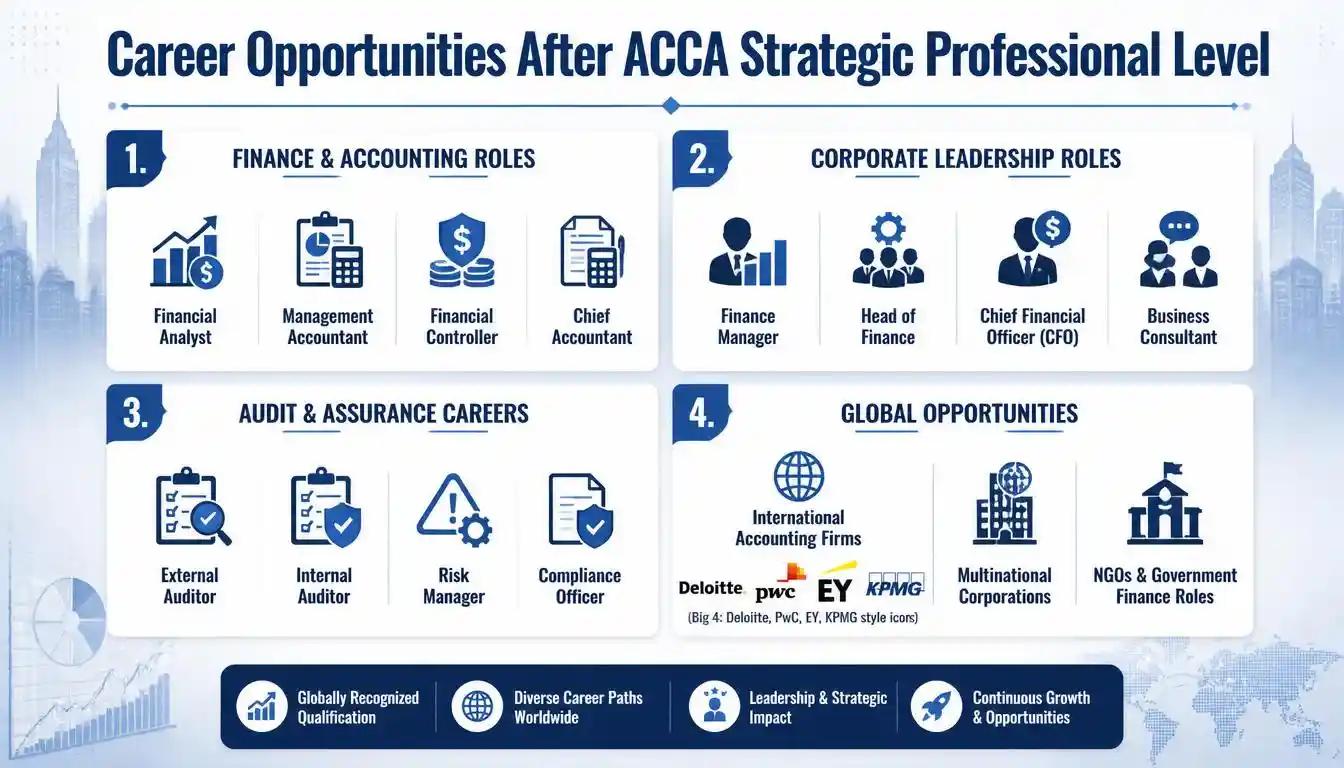
Career Opportunities After ACCA Strategic Professional Level
Completing the ACCA Strategic Professional Level is the final academic milestone of the ACCA qualification. After successfully completing the Strategic Professional exams, the Ethics and Professional Skills Module (EPSM), and the Practical Experience Requirement (PER), you become eligible to apply for ACCA membership. This globally recognised qualification prepares you for senior roles in accounting, finance, audit, taxation, and business leadership across Pakistan and international markets.
The table below highlights some of the most common career opportunities available to ACCA-qualified professionals after completing the Strategic Professional Level.
| Role | Industry | Avg. Monthly Salary (PKR) |
|---|---|---|
| Chief Financial Officer (CFO) | Any sector | 500,000 – 1,500,000+ |
| Finance Director | Corporate, Banking | 400,000 – 1,000,000+ |
| Senior Audit Manager | Big 4, Audit Firms | 250,000 – 600,000+ |
| Tax Director / Senior Advisor | Tax Consultancy | 200,000 – 500,000+ |
| Financial Controller | Manufacturing, FMCG | 200,000 – 450,000+ |
| Management Accountant (Senior) | Telecom, Banking | 150,000 – 350,000+ |
| Investment Analyst | Investment Banking | 180,000 – 400,000+ |
| ACCA Lecturer / Academic | Education sector | 120,000 – 250,000+ |
ACCA career opportunities in Pakistan are rapidly expanding — particularly in banking, fintech, FMCG multinationals, oil and gas, and the public sector. For ACCA careers in the Middle East, qualified ACCA members are among the most in-demand finance professionals in the UAE, Saudi Arabia, and Qatar.
The ACCA qualification salary in the UK for a fully qualified member typically ranges from £45,000 to £90,000+ depending on the role, sector, and experience level.
Expert Guidance from ICT Business School
Based on our experience of guiding ACCA students, one of the most important decisions at the Strategic Professional Level is selecting the right optional papers. We always recommend choosing papers that align with your long-term career goals rather than those that simply appear easier. For example, students interested in audit and assurance should consider Advanced Audit and Assurance (AAA), while those planning careers in corporate finance or investment should consider Advanced Financial Management (AFM). Choosing the right combination strengthens both your knowledge and your career profile.
Our faculty also advises students to begin preparing for the Strategic Business Leader (SBL) paper well before the exam. The pre-seen material provides valuable insight into the case study and gives students time to understand the organisation, its industry, business risks, governance structure, and strategic challenges. Students who make effective use of the pre-seen material are generally better prepared for the examination.
For Strategic Business Reporting (SBR), success depends on more than memorising IFRS standards. Students should focus on applying accounting standards to practical business scenarios, exercising professional judgement, identifying ethical issues, and presenting well-structured recommendations. Regular practice with past papers and timed mock exams is one of the most effective ways to improve performance.
Finally, we encourage students to take the Ethics and Professional Skills Module (EPSM) seriously. The professional judgement, communication, commercial awareness, and ethical decision-making skills developed through EPSM support success not only in the Strategic Professional exams but also throughout an ACCA member's professional career.
For structured ACCA coaching and a complete study plan for the Strategic Professional level, explore the expert faculty and course resources at ICT Business School Faculty (https://www.ictbusinessschool.com/faculty) and stay updated via the ICT Business School Blog (https://www.ictbusinessschool.com/blog).
Study ACCA Strategic Professional at ICT Business School
Reaching the ACCA Strategic Professional Level requires more than textbooks — it requires structured mentoring, real exam practice, and an institute that understands both the global standards and the local context of students in Pakistan.
ICT Business School (https://www.ictbusinessschool.com/) is one of Pakistan's most trusted professional education institutes, offering complete ACCA coaching from Applied Knowledge through to Strategic Professional. Based in Islamabad with online options available across Pakistan, ICT provides:
- Full ACCA pathway coaching — Knowledge, Skills, and Strategic Professional levels
- CA (ICAP Pathway) — for students pursuing chartered accountancy in Pakistan
- CIA (Certified Internal Auditor) — specialist internal audit qualification
- CMA (Certified Management Accountant) — management accounting and strategy
- O Level and A Level Programs (https://www.ictbusinessschool.com/courses/o-level-program) — foundational academic preparation
- HND Higher National Diploma in Business (https://www.ictbusinessschool.com/courses/hnd-higher-national-diploma) — Pearson-accredited business qualification
- Pearson BTEC Level 3 (https://www.ictbusinessschool.com/courses/pearson-btec-level-3) — UK-recognized professional credential
- Pearson BTEC Level 7 Extended Diploma (https://www.ictbusinessschool.com/courses/level-7-extended-diploma) — Masters-level business education
Why choose ICT Business School? (https://www.ictbusinessschool.com/about) ICT combines internationally aligned ACCA curricula with a deep understanding of what Pakistani students need — local exam centre access, expert faculty with professional experience, competitive ACCA fees in Pakistan, and post-qualification career guidance.
Explore advanced corporate and taxation courses at ICT through the full courses listing at ICT Business School Courses (https://www.ictbusinessschool.com/courses), or visit the ICT Education Portal (https://ict.edu.pk) for enrollment details.
Frequently Asked Questions (FAQs)
Q: What is ACCA Strategic Professional Level? A: The ACCA Strategic Professional Level is the final stage of the ACCA qualification. It consists of two compulsory papers (SBL and SBR), two optional papers chosen from AFM, APM, ATX, and AAA, and a compulsory Ethics and Professional Skills Module (EPSM). Completing this level alongside three years of practical experience qualifies you as a full ACCA member.
Q: How many papers are in ACCA Strategic level? A: There are 4 examination papers in the ACCA Strategic Professional Level — 2 compulsory (SBL and SBR) and 2 optional chosen from AFM, APM, ATX, and AAA. You must also complete the EPSM module, which is non-exam based.
Q: Which is the hardest paper in ACCA Strategic level? A: AFM (Advanced Financial Management) and APM (Advanced Performance Management) consistently have the lowest pass rates — averaging 35–42%. However, SBL is considered the most unique and challenging in terms of exam format, as it requires integrated thinking, professional judgment, and case-study application under significant time pressure.
Q: Is ACCA Strategic level difficult? A: Yes. The ACCA Strategic Professional Level is significantly harder than the Applied Knowledge and Applied Skills levels. Pass rates for most papers sit between 38–52%, and the exams require real application, professional judgment, and strategic thinking — not just technical knowledge. Structured coaching and consistent past paper practice are essential.
Q: How long does it take to complete ACCA Strategic level? A: Most students complete the ACCA Strategic Professional Level in 12 to 24 months. This depends on how many papers are attempted per exam session, study hours invested, and whether the student is also working alongside their studies. Students who sit two papers per session can realistically finish in 12–15 months.
Q: What jobs are available after ACCA Strategic Professional Level? A: After completing the ACCA Strategic Professional Level and qualifying as a full ACCA member, you are eligible for senior roles including Chief Financial Officer (CFO), Finance Director, Senior Audit Manager, Tax Director, Financial Controller, Investment Analyst, and Management Accountant. ACCA jobs in Pakistan, the UK, UAE, and Middle East are widely available for fully qualified members at competitive salaries.
Q: Can I skip any ACCA Strategic papers? A: No. There are no exemptions available for any ACCA Strategic Professional papers — not for SBL, SBR, or any of the optional papers. All students must sit and pass these papers regardless of their academic background or previous qualifications.
Q: What is the passing mark in ACCA Strategic exams? A: The passing mark for all ACCA Strategic Professional papers is 50 out of 100. There is no negative marking. For SBL, a portion of the marks are professional marks awarded for communication, analysis, scepticism, and evaluation — making the structure and clarity of your answers as important as the technical content.
Q: Which ACCA Strategic paper is easiest? A: Based on pass rate data, SBL and ATX tend to have slightly higher pass rates than AFM and APM. However, "easiest" depends heavily on your individual strengths. Students with strong audit backgrounds often find AAA more manageable, while those with strong finance skills may find AFM more comfortable. Speak to an academic advisor at ICT Business School (https://www.ictbusinessschool.com/contact) for personalized paper selection guidance.
Q: How to prepare for ACCA Strategic level exams? A: The most effective preparation strategy combines: (1) studying from official BPP or Kaplan textbooks, (2) completing every available ACCA past paper under timed conditions, (3) attending structured coaching with experienced tutors, (4) using the ACCA Study Hub for free resources, (5) for SBL — studying the pre-seen case material deeply before the exam date. Supplement your preparation with free study tools at MegaFreeTools (https://megafreetools.com/) and explore career advisory support at BACO Consultants (https://bacoconsultants.com/).
Ready to Complete Your ACCA Journey?
The ACCA Strategic Professional Level is the final step between you and a globally recognized professional accounting qualification. With the right coaching, the right strategy, and the right institute, it is absolutely achievable.
ICT Business School offers complete ACCA Strategic Professional coaching in Islamabad — with expert faculty, structured study plans, and a track record of student success across Pakistan.
Explore ACCA Courses: https://www.ictbusinessschool.com/courses Contact ICT Business School: https://www.ictbusinessschool.com/contact
Also offering: CA | CIA | CMA | O & A Levels | HND | BTEC Level 3 & 7
Conclusion
The ACCA Strategic Professional Level is the final academic stage of the ACCA qualification and prepares students for senior roles in accounting, finance, audit, taxation, and business leadership. Through its compulsory and optional papers, this level develops strategic thinking, professional judgement, and advanced technical expertise required to solve complex business challenges.
Whether your goal is to work in Pakistan or build an international career, successfully completing the Strategic Professional Level brings you one step closer to becoming a fully qualified ACCA member. With a structured study plan, consistent practice, and guidance from experienced faculty, you can confidently complete this final stage of your ACCA journey and unlock rewarding career opportunities worldwide.
About This Guide
This guide has been prepared by the academic content team at ICT Business School to help students understand the ACCA Strategic Professional Level in a simple, practical, and easy-to-follow manner. The information is based on the latest ACCA qualification structure and is intended to support students in making informed academic and career decisions
Disclaimer
The information provided in this guide is for educational purposes only. ACCA examination policies, syllabus, exemptions, exam formats, and qualification requirements may change over time. Students should always refer to the official ACCA Global website for the latest information before making any registration or academic decisions.