Quick Answer
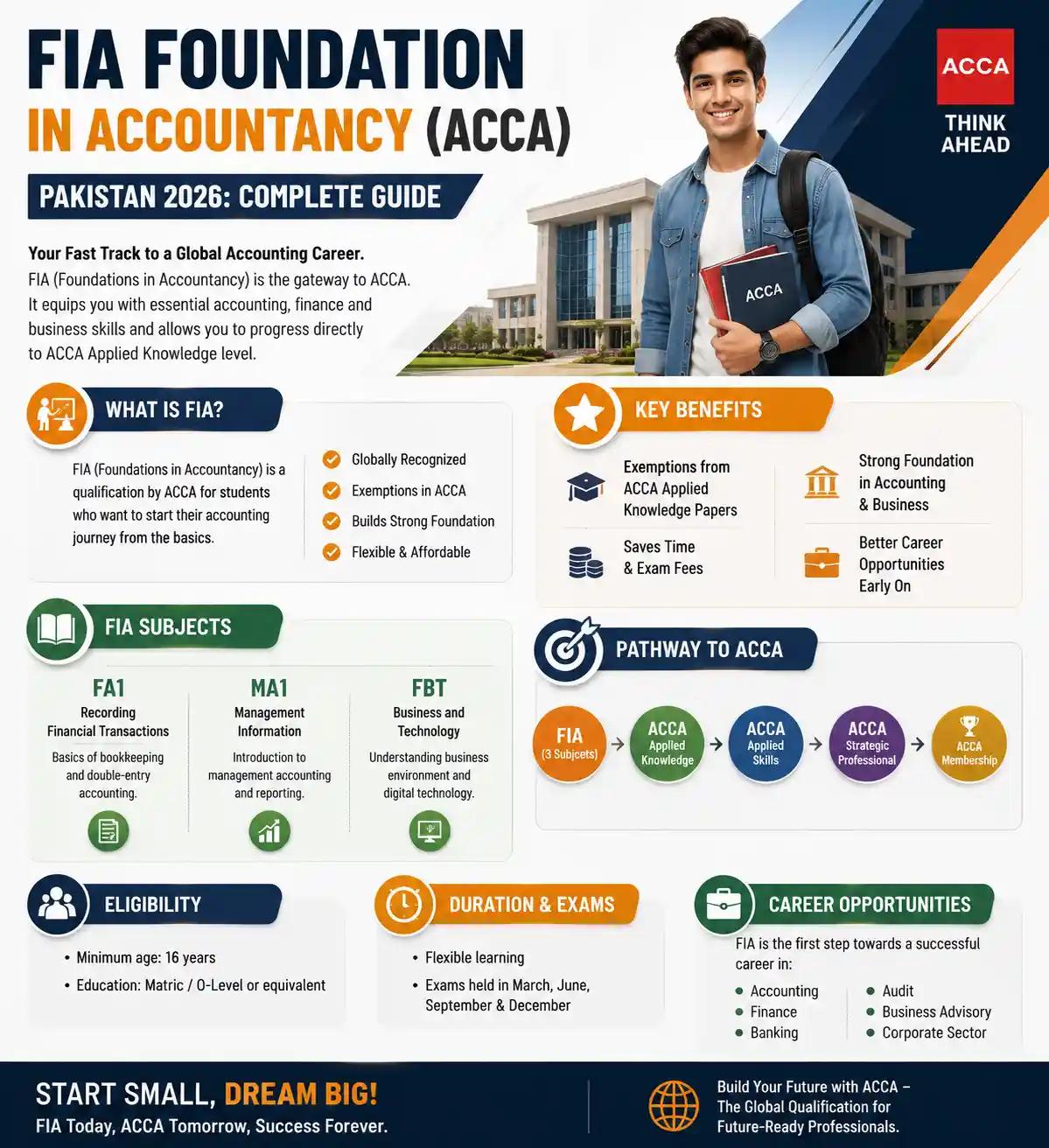
FIA (Foundation in Accountancy) is ACCA's entry-level accounting qualification designed for students who want to start a professional career in accounting and finance. It develops fundamental skills in bookkeeping, financial accounting, and management accounting, and provides a pathway toward the full ACCA qualification. Students can start FIA after Matric, Intermediate, or equivalent qualifications, depending on their eligibility. The program consists of foundation-level exams that prepare learners for advanced ACCA studies and professional accounting roles.
Key Facts
- Full name: Foundation in Accountancy (FIA) — offered by ACCA
- Level: Entry-level (below ACCA Applied Knowledge)
- Papers: Up to 9 papers (FA1, MA1, FA2, MA2, FBT, FFA, FMA, FFM, FAU)
- Exam mode: Computer-Based Exams (CBE) — available on demand
- Eligibility: No minimum academic requirement; open to Matric/O-Level students
- Duration: 6–18 months depending on pace and papers attempted
- Recognition: Internationally recognized by IFAC member bodies
- Pathway: Completing FIA gives direct entry and exemptions into ACCA
- Fees (Pakistan): ACCA registration + per-exam CBE fee (see fee section below)
What is FIA?
FIA (Foundation in Accountancy) is an entry-level accounting qualification developed by the Association of Chartered Certified Accountants (ACCA) for students and professionals who want to start their journey in accounting and finance.
The FIA pathway introduces learners to essential accounting concepts, including bookkeeping, financial accounting, and management accounting. It is designed to build a strong foundation before progressing toward the full ACCA qualification.
One of the key advantages of FIA is its accessibility. Students from backgrounds such as Matric, O-Level, Intermediate, or non-accounting fields can begin their accounting journey through FIA without requiring extensive prior finance knowledge.
For students in Pakistan who want to enter the professional accounting field, FIA provides a structured pathway to develop fundamental skills and progress toward advanced ACCA studies.

What is FIA in Accounting?
In accounting, FIA (Foundation in Accountancy) refers to ACCA's structured pathway designed to introduce students to the fundamental concepts of accounting and finance. It helps learners develop essential skills in areas such as bookkeeping, preparation of financial statements, business concepts, and management accounting.
The FIA qualification is made up of individual exams and awards that allow students to progress step by step. Learners can complete specific modules based on their entry level and gradually build their accounting knowledge before moving toward the full ACCA qualification.
FIA is not a separate accounting body; it is part of the ACCA qualification pathway. Therefore, terms such as ACCA FIA or FIA ACCA Foundation refer to the same foundation-level accounting route offered by ACCA.
For students in Pakistan, FIA provides an accessible starting point for entering the professional accounting field. Students from backgrounds such as Matric, O-Level, Intermediate, or non-accounting disciplines can use FIA to build the foundation required for further ACCA studies.
The Diploma in Accounting and Business within the FIA pathway develops knowledge in key areas including Business and Technology, Management Accounting, and Financial Accounting, helping students prepare for advanced professional accounting education.
What Level is FIA in ACCA Qualification?
FIA (Foundation in Accountancy) is the foundation-level pathway within the ACCA family of qualifications. It is designed for students who are starting their accounting journey and want to develop essential knowledge before progressing toward the main ACCA qualification.
After completing the relevant FIA requirements, eligible students can progress into the ACCA qualification pathway and continue their professional accounting studies.
| Level | Program | Papers | For Whom |
|---|---|---|---|
| Foundation | FIA (Foundation in Accountancy) | FA1, MA1, FA2, MA2, FBT, FFA, FMA, FFM, FAU | Beginners / Matric / O-Level |
| Applied Knowledge | ACCA (BT, MA, FA) | 3 Papers | Intermediate / A-Level / Diploma holders |
| Applied Skills | ACCA (LW, PM, TX, FR, AA, FM) | 6 Papers | After Applied Knowledge |
| Strategic Professional | ACCA (SBL, SBR + 2 Options) | 4 Papers | Advanced candidates |
Advanced candidates
So FIA is the entry gateway — below Applied Knowledge, but directly connected to it. Students who complete the FIA Diploma gain exemptions from the equivalent ACCA Knowledge level papers, eliminating the need to re-sit them.
FIA Eligibility Criteria in Pakistan
One of the key advantages of the FIA (Foundation in Accountancy) qualification is its flexible entry route. ACCA designed FIA to help students and professionals from different educational backgrounds start their journey in accounting and finance.
Unlike many professional qualifications that require specific academic backgrounds, FIA allows learners to begin without extensive prior accounting knowledge.
FIA Qualification Requirements
Students can generally start FIA with:
- No specific accounting background required
- No strict minimum academic qualification for entry
- Students after Matric/O-Level (Grade 10) can begin their accounting journey
- Intermediate/A-Level students can also enroll
- Working professionals from non-finance backgrounds can develop accounting skills through FIA
- Students should have a basic understanding of English as FIA examinations are conducted in English
For students in Pakistan, FIA provides an opportunity to enter the professional accounting field at an early stage. Students who complete Matric, O-Level, or Intermediate can use FIA as a structured pathway toward progressing to the ACCA qualification.
Compared with starting the full ACCA qualification directly, FIA can be a suitable option for students who want to build accounting fundamentals first and gradually advance toward professional-level studies.
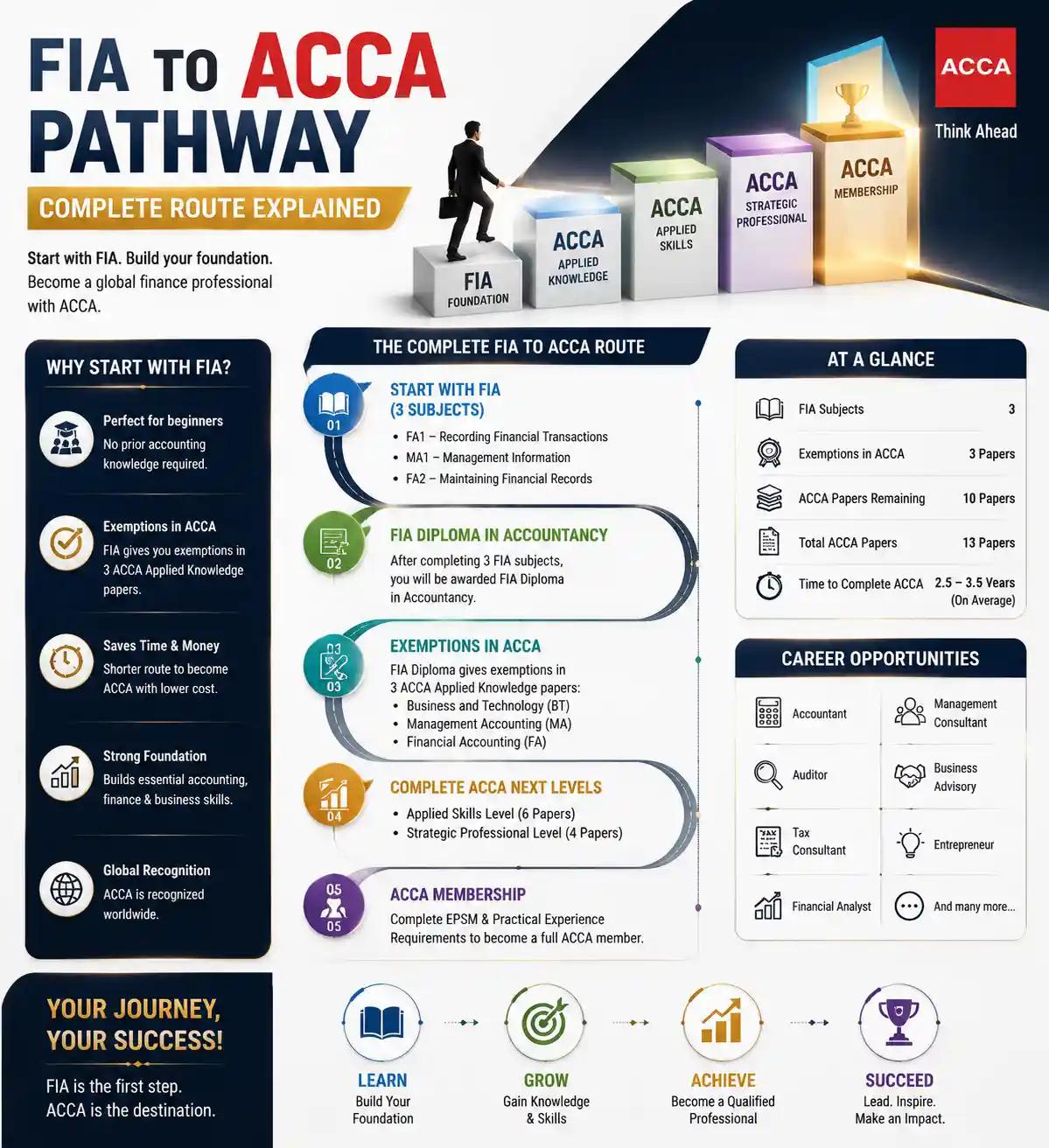
FIA to ACCA Pathway: Complete Route Explained
A common question students ask is: Is FIA necessary before ACCA? The answer depends on your educational background and entry eligibility.
Students who meet the direct entry requirements for the ACCA qualification can usually begin ACCA without completing FIA. However, students who are starting after Matric/O-Level or who want to build strong accounting foundations before moving to professional studies can choose the FIA pathway.
The general progression route is:
FIA → Diploma in Accounting and Business → ACCA Qualification
Through the FIA pathway, students develop fundamental knowledge in areas such as:
- Bookkeeping
- Financial accounting
- Management accounting
- Business concepts
After completing the required FIA modules, eligible students can progress toward ACCA with applicable exemptions according to ACCA's current rules.
FIA vs ACCA: What Is the Difference?
The main difference between FIA and ACCA is the level and depth of study.
- FIA focuses on building accounting foundations and is designed for beginners entering the profession.
- ACCA develops advanced technical, professional, and strategic skills required for professional accounting roles.
Think of FIA as the foundation that helps students develop the knowledge and confidence needed to progress successfully toward the ACCA qualification.
For students in Pakistan, FIA can be a valuable starting point, especially for those who want to begin a professional accounting journey early and gradually advance toward becoming ACCA professionals.
FIA Foundation in Accountancy Subjects
The FIA subjects list consists of several individual papers. The most important ones — particularly those that form the Diploma — are:
Business and Technology (FBT / FAB)
The BT (Business and Technology) paper (formerly FAB in FIA) is designed to help students understand how organizations function. Topics include the external environment, governance, ethics, and the impact of technology on business. It builds awareness of the professional and regulatory context in which accountants operate — a key skill for any entry level accounting qualification.
Foundation of Financial Accounting (FFA / FA2)
Often referred to as FFA (Foundations of Financial Accounting) or FA2, this is the heart of the FIA qualification. It covers bookkeeping fundamentals, double-entry, accruals, prepayments, depreciation, and the preparation of basic financial statements. Students learn to apply the IFRS accounting framework in real-world contexts — building essential skills for any accounting career.
Fundamentals of Business — Management Accounting (FMA / MA2)
FMA introduces the principles of management accounting basics — including cost classification, material and labour costing, overhead absorption, budgeting, and variance analysis. This paper corresponds to the ACCA MA paper and directly equips students for operational finance roles in any organisation.
Beyond the core three Diploma papers, FIA also includes FA1 (Recording Financial Transactions), MA1 (Management Information), FFM (Foundations in Financial Management), and FAU (Foundations in Audit). The ACCA FIA syllabus for each paper is fully detailed on the official ACCA global website at www.accaglobal.com.
FIA Exam Pattern and Structure
Understanding the FIA exam pattern helps students plan their preparation effectively and approach each paper with a clear strategy. Since FIA is designed as a foundation-level accounting qualification, its exams focus on testing basic concepts, practical understanding, and accounting knowledge required for progression toward ACCA.
FIA exams are conducted through Computer-Based Exams (CBE), allowing students to complete many papers through flexible exam scheduling at approved exam centers. The exam format generally includes objective-style questions and computer-based assessment methods depending on the paper
| Feature | Details |
|---|---|
| Exam Format | Computer-Based Exams (CBE) — on-demand at approved centres |
| Question Types | Multiple choice, multiple response, fill-in-the-blank, drag-and-drop |
| Duration | 2 hours per paper |
| Pass Mark | 50% for all papers |
| Retake Policy | Can be reattempted after a short waiting period |
| Exam Availability | Year-round at approved CBE centres in Pakistan |
| Results | Provisional result on screen immediately after the exam |
The on-demand CBE format is a major advantage. Unlike traditional paper-based exams with fixed timetables, students can book and sit FIA exams at a time that suits them. In Pakistan, CBE centres operate in major cities including Rawalpindi, Islamabad, Lahore, and Karachi.
For FIA exam preparation, ACCA provides official FIA study materials, specimen papers, and practice questions through its platform. Students can also access FIA mock exams and FIA revision notes through approved learning providers. Platforms like Coursera (www.coursera.org) also offer complementary accounting fundamentals courses that can reinforce your preparation
FIA Foundation in Accountancy Fees in Pakistan
The FIA Foundation in Accountancy fee consists of different components, including ACCA registration charges, annual subscription fees, examination fees, and tuition costs if you choose coaching support.
The total cost of FIA depends on the number of papers you attempt, exam attempts, learning resources, and the institute you select for preparation. ACCA fees are officially charged in GBP, while students in Pakistan usually calculate the overall investment according to the current exchange rate.
The following table provides an overview of the main FIA cost components:
| Fee Type | Approximate Amount (PKR) | Notes |
|---|---|---|
| ACCA Initial Registration | PKR 3,500 – 5,000 | One-time fee to become an ACCA student |
| Annual Subscription | PKR 4,000 – 6,000 | Annual fee to maintain active student status |
| CBE Exam Fee (per paper) | PKR 3,000 – 8,000 | Paid to CBE centre at booking; varies by centre |
| Study Materials (optional) | PKR 2,000 – 5,000 per book | BPP or Kaplan official texts |
| Tuition Fee (if enrolled) | Varies by institute | Depends on academy/institute |
Contact ICT Business School for current rates: www.ictbusinessschool.com/contact
The FIA course fee in Pakistan 2026 is considerably more affordable than full ACCA fees, making it the most cost-effective entry into professional accounting. Many students in Rawalpindi and Islamabad choose FIA precisely because of its accessibility and clear return on investment.
For the most current and accurate ACCA FIA registration fees, always check the official ACCA website or contact your nearest approved learning provider.
Benefits of FIA Foundation in Accountancy (ACCA)
The FIA Foundation in Accountancy qualification offers several advantages for students who want to begin a professional career in accounting and finance. It provides a flexible entry route, develops essential accounting skills, and creates a structured pathway toward the ACCA qualification.
One of the biggest advantages of FIA is its accessibility. Students from backgrounds such as Matric, O-Level, Intermediate, or non-accounting fields can start building their accounting knowledge without needing an advanced academic background. This makes FIA a practical option for students who want to enter the professional accounting field early.
FIA is also connected with the ACCA qualification pathway, allowing eligible students to progress toward ACCA with applicable exemptions according to ACCA's current policies. The qualification develops important skills in areas such as financial accounting, management accounting, business concepts, and technology.
Another benefit of FIA is its flexibility. Students can prepare through classroom learning, online study, or self-study options, and many FIA exams are available through computer-based testing formats that allow learners to attempt exams according to their preparation level.
Completing FIA papers also helps students build academic and professional confidence. Each completed module contributes toward developing a stronger accounting foundation and prepares learners for more advanced studies in ACCA and other professional finance qualifications.
Overall, FIA is a valuable starting point for students who want an affordable, flexible, and structured route into the accounting profession.
Career Opportunities After FIA Foundation in Accountancy
The FIA career scope is broader than many students initially expect. Although FIA is a foundation-level qualification, it provides practical accounting knowledge and skills that can help students start their careers in entry-level finance and accounting roles.
After completing FIA, students can explore opportunities in areas such as bookkeeping, accounts support, finance operations, and junior accounting roles. Many students also use FIA as a stepping stone toward the ACCA qualification, which further expands career opportunities and professional growth potential.
| Job Role | Typical Employer | Salary Range (PKR/month) |
|---|---|---|
| Accounts Assistant | SMEs, Retail, Manufacturing | 30,000 – 60,000 |
| Junior Bookkeeper | Accounting Firms, NGOs | 35,000 – 65,000 |
| Data Entry / Finance Clerk | Banks, Telecom, FMCG | 30,000 – 55,000 |
| Payroll Assistant | HR & Payroll Firms | 40,000 – 70,000 |
| Accounts Receivable / Payable | Large Corporates | 45,000 – 80,000 |
| Finance Intern (ACCA trainee) | Big 4 & Mid-tier Audit Firms | Stipend + ACCA training |
FIA Salary in Pakistan
The FIA salary in Pakistan depends on several factors, including the job role, employer, city, level of experience, and whether the student continues progressing toward the ACCA qualification. Since FIA is a foundation-level accounting qualification, most students initially enter entry-level finance and accounting positions where they gain practical experience and develop professional skills.
Students who complete FIA can expect opportunities in roles such as accounts assistant, bookkeeping associate, finance support officer, and junior accounting positions. Starting salaries may vary depending on the organization and the individual's skills, but gaining experience and progressing toward ACCA can significantly improve long-term earning potential.
Professionals who continue their journey from FIA to ACCA usually unlock broader career opportunities in audit, taxation, financial reporting, and corporate finance, where salary growth becomes stronger with experience and specialization.
Career Growth After FIA
FIA should be viewed as the beginning of an accounting career journey rather than the final destination. It provides students with the fundamental knowledge required to enter the finance field and creates a pathway toward advanced professional qualifications such as ACCA.
After gaining initial work experience, students can strengthen their careers by developing additional skills in areas such as financial reporting, accounting software, taxation, and business analysis. Many FIA students choose to continue toward ACCA, which allows them to move from entry-level accounting roles into more advanced positions with greater responsibilities.
With continuous learning and professional development, the career path can progress from junior accounting roles to positions such as accountant, finance executive, audit associate, financial analyst, and eventually senior finance roles after completing higher-level qualifications.
Expert Guidance
For students starting FIA, the most important thing is to approach this qualification as a process of building strong accounting foundations rather than just preparing for exams. If you do not have a previous accounting background, focus on understanding basic concepts such as bookkeeping, financial transactions, and accounting principles because these concepts will support you throughout your ACCA journey. Once your preparation is complete, avoid delaying your CBE attempts unnecessarily, as long gaps can affect your confidence and exam readiness. Make use of official ACCA practice questions and specimen exams to understand the exam style and improve your question-solving approach. Do not underestimate any FIA paper just because it appears easier, as each subject contributes to the knowledge base required for future professional studies. For self-study students, combining official study materials with structured lectures, revision practice, and mock tests can significantly improve learning outcomes. The key to FIA success is consistency, regular practice, and a clear understanding that FIA is not just a qualification on its own — it is the foundation that prepares you for a successful progression toward the ACCA qualification.
Why Choose ICT Business School for FIA and ACCA?
ICT Business School (www.ictbusinessschool.com) is one of Pakistan's most trusted institutes for professional accounting and business qualifications. Based in Rawalpindi with students from across Pakistan, ICT offers a comprehensive suite of programs that take you from FIA right through to full ACCA qualification and beyond.
At ICT Business School, students benefit from:
- Experienced, dedicated faculty — www.ictbusinessschool.com/faculty
- Structured FIA and ACCA tuition with FIA mock exams, FIA practice questions, and FIA revision notes
- Complete pathway from FIA → ACCA → and advanced professional qualifications
- Access to FIA online classes and recorded FIA video lectures for flexible study
- Guidance on ACCA FIA registration, exam booking, and FIA study plan
ICT Business School also offers a wide range of courses that complement your accounting journey:
- CA (ICAP pathway) — ideal for students targeting Pakistan's chartered accountancy qualification
- CIA (Internal Audit) — for those specialising in audit and assurance
- CMA — the management accounting professional qualification
- HND (Higher National Diploma) — Pearson's internationally recognized business diploma: www.ictbusinessschool.com/courses/hnd-higher-national-diploma
- Pearson BTEC Level 3 — business and management foundation for school leavers: www.ictbusinessschool.com/courses/pearson-btec-level-3
- Pearson BTEC Level 7 — advanced management and leadership: www.ictbusinessschool.com/courses/level-7-extended-diploma
- O Level and A Level programs — academic foundation for professional qualifications: www.ictbusinessschool.com/courses/o-level-program
Explore the ICT Business School blog for study tips, career guidance, and updates on professional qualifications in Pakistan: www.ictbusinessschool.com/blog
To learn more about ICT's approach and values: www.ictbusinessschool.com/about
For more professional development resources, also explore ICT Education at ict.edu.pk and industry partners at bacoconsultants.com.
Conclusion
The FIA Foundation in Accountancy is far more than just a beginner's course. It is a strategically designed, globally recognized, ACCA-backed qualification that opens doors to professional accounting careers — at any age, from any academic background.
Whether you are a Matric student in Rawalpindi taking your first steps into finance, an Intermediate graduate deciding between FIA and direct ACCA entry, or a working professional looking to formalise your accounting knowledge — FIA offers a clear, structured, and internationally recognized path forward.
With the right guidance from a trusted FIA institute in Rawalpindi or Islamabad like ICT Business School (www.ictbusinessschool.com), combined with consistent preparation using official FIA study materials and FIA mock exams, passing FIA exams in the first attempt is absolutely achievable.
Your accounting career does not have to wait. The FIA qualification ACCA is your launchpad — start today.
Explore Courses: www.ictbusinessschool.com/courses Contact ICT Business School: www.ictbusinessschool.com/contact
Frequently Asked Questions (FAQs)
What is FIA in ACCA? FIA stands for Foundation in Accountancy — ACCA's entry-level qualification suite. It introduces bookkeeping, financial accounting, and management accounting basics, and provides a pathway into the full ACCA qualification with exemptions.
Is FIA equal to ACCA? No. FIA is below ACCA. It is the foundation level, while ACCA is the full professional qualification. Completing the FIA Diploma earns exemptions from ACCA's Applied Knowledge papers (BT, MA, FA).
How many papers are in FIA? FIA includes up to 9 papers: FA1, MA1, FA2, MA2, FBT, FFA, FMA, FFM, and FAU. The core Diploma requires FBT, FFA, and FMA (3 papers). Students can choose how many additional papers to attempt.
How long does FIA take to complete? The FIA Diploma (3 core papers) can be completed in as little as 6 months with focused study. Completing additional papers may take 12–18 months. Since CBEs are on-demand, the pace is entirely up to the student.
Can I start ACCA after FIA? Yes. After completing the FIA Diploma, you are eligible to register for ACCA and receive exemptions from the Applied Knowledge papers (BT, MA, FA), allowing you to start directly at the Applied Skills level.
Is FIA recognized internationally? Yes. FIA is issued by ACCA, which is recognized in over 180 countries. The Diploma in Accounting and Business is respected by employers and educational institutions globally, including in the UK, Middle East, and Canada.
What jobs can I get after FIA? After FIA, you can pursue roles such as accounts assistant, junior bookkeeper, payroll assistant, accounts receivable/payable clerk, or finance intern. Combined with further ACCA papers, career options expand significantly into audit, tax, and financial management.
Is FIA difficult for beginners? FIA is designed for beginners with no prior accounting knowledge. The exams are CBE-based with multiple choice and objective questions. With proper FIA study materials, FIA mock exams, and tuition support, most motivated students pass on their first attempt.
Conclusion
FIA (Foundation in Accountancy) is an excellent starting point for students who want to build a career in accounting and finance. It provides a strong foundation in essential areas such as bookkeeping, financial accounting, and management accounting while creating a structured pathway toward the ACCA qualificationFor students in Pakistan, especially those coming from Matric, O-Level, Intermediate, or non-accounting backgrounds, FIA offers a flexible and accessible route to enter the professional accounting field. It allows learners to develop practical skills, gain confidence, and gradually progress toward advanced professional studies.However, students should view FIA as the beginning of their accounting journey rather than the final destination. By combining FIA with practical experience and progressing toward ACCA, learners can unlock wider career opportunities in audit, taxation, financial reporting, and corporate finance.With the right preparation strategy, consistent effort, and a clear career plan, FIA can become the first important step toward building a successful professional accounting career.