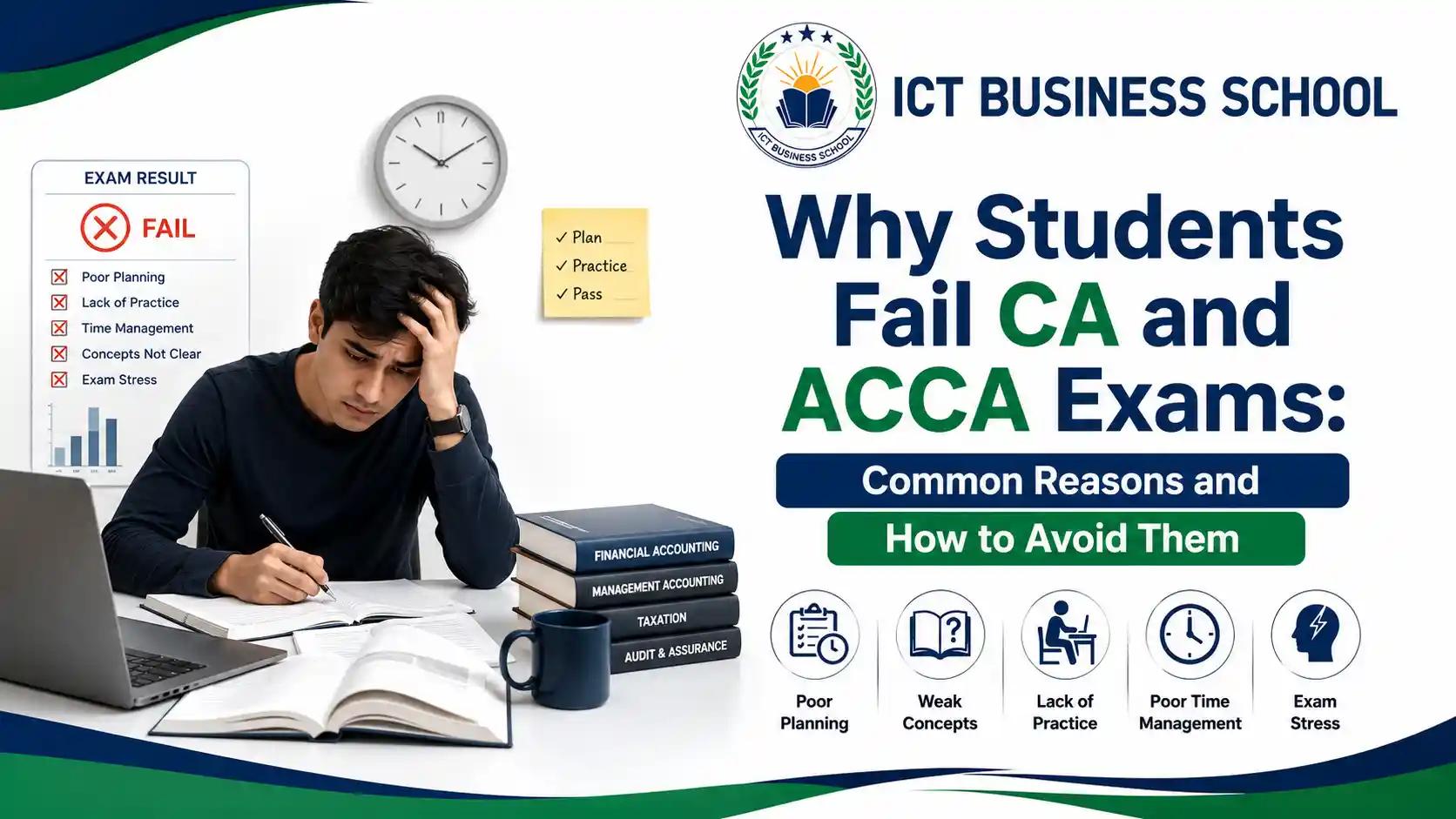
Most students fail CA and ACCA exams due to poor time management, weak conceptual understanding, insufficient past paper practice, and inconsistent study routines — not lack of intelligence. Fixing these five habits (planning, active recall, mock exams, past papers, and stress management) significantly improves pass rates on the first attempt. ICT Business School
Every year, thousands of hardworking students struggle to clear their CA and ACCA exams. It's rarely about intelligence. It's about how they prepare. This guide breaks down the real reasons behind exam failure and gives you a practical roadmap to pass on your first attempt.
Why Do CA Students Fail?
CA(Chartered Accountancy) is known for its low pass percentage, and this often has less to do with difficulty and more to do with preparation gaps.
Common reasons CA students fail include:
- Underestimating the syllabus depth — CA papers like Financial Reporting, Auditing, and Taxation require layered understanding, not surface-level reading.
- Relying only on coaching notes without practicing independently.
- Ignoring ICAI/ICAP study material in favor of shortcuts.
- Ignoring practical, article-based learning during training.
- Poor exam-day time allocation, leading to unfinished papers despite knowing the content.
Why Do ACCA Students Fail?
ACCA students face a different challenge — a globally standardized exam pattern with strict time pressure and application-based questions.
Key reasons ACCA students fail:
- Treating ACCA like a memorization-based exam instead of an application-based one.
- Skipping the Applied Skills and Strategic Professional practice questions.
- Not attempting enough past papers from ACCA Global's official archive.
- Weak command over case-study-style questions in papers like SBL and SBR.
- Underestimating professional-level papers, assuming earlier success guarantees later ease. ICT Business School
Is CA Harder Than ACCA?
This is one of the most searched comparisons — and the honest answer is: it depends on the student.
- CA demands deeper local law, taxation, and audit knowledge (relevant to ICAI or ICAP frameworks).
- ACCA demands strong application skills, English-language precision, and international accounting standards (IFRS) knowledge.
Neither is universally "harder" — both require discipline, consistency, and correct study techniques.
Most Common Study Mistakes (Root Causes of Failure)
1. Poor Time Management
Students often study reactively instead of following a structured revision timetable. Without a study planner, key topics get rushed before the exam.
2. Lack of Conceptual Understanding
Many students focus on completing the syllabus rather than understanding it. In subjects like Financial Reporting or Auditing, weak concepts collapse under exam pressure.
3. Memorization Instead of Learning
Cramming formulas or definitions without understanding why they apply leads to blank moments during exams — especially in scenario-based questions.
4. Ignoring Past Papers
Past papers reveal examiner patterns, common traps, and marking schemes. Students who skip them often get caught off guard by question style, even when they know the content.
5. Exam Anxiety and Stress
Stress before or during the exam significantly reduces recall ability and decision-making speed — even for well-prepared students.
6. Poor Revision Strategy
Revising everything equally, instead of prioritizing high-weightage and weak areas, wastes valuable preparation time.
7. Inconsistent Study Routine
Studying in bursts (heavy one week, none the next) breaks the learning momentum needed for retention.
8. Lack of Mock Exams
Without timed mock tests, students don't build real exam-condition speed, accuracy, or stamina.
How to Avoid These Mistakes: Best Study Techniques for CA and ACCA
- Use active recall instead of passive reading — test yourself instead of re-reading notes.
- Apply spaced repetition to retain concepts long-term instead of last-minute cramming.
- Practice past papers under timed conditions at least 6–8 weeks before the exam. ICT Business School
- Break the syllabus into weekly milestones using a revision timetable.
- Attempt at least 3–5 full mock exams before the actual paper.
- Prioritize high-weightage topics identified from past exam trends.
- Maintain a consistent daily study routine rather than irregular long sessions.
Daily Study Plan (Sample Structure)
| Time Block | Activity | Purpose |
|---|---|---|
| 1 Hour | New Concept Learning | Build understanding of new topics and core concepts |
| 1.5 Hours | Practice Questions | Apply concepts through problem-solving and exercises |
| 30 Minutes | Active Recall / Self-Testing | Strengthen memory and improve long-term retention |
| 1 Hour | Past Paper Practice | Build familiarity with the exam pattern and question types |
| 30 Minutes | Revision of Weak Areas | Fill knowledge gaps and reinforce difficult topics |
This structure works for both CA Foundation, Intermediate, and Final stages, as well as ACCA 's Applied Knowledge, Applied Skills, and Strategic Professional levels. ICT Business School
What Successful Students Do Differently
Toppers rarely rely on talent alone. They consistently:
- Study with structured plans, not random effort.
- Treat past papers as a core study tool, not an afterthought.
- Take mock exams seriously, replicating real exam conditions.
- Focus on understanding over memorization.
- Manage stress through routine, sleep, and realistic goals rather than last-minute panic.
Expert Guidance
Based on patterns seen across CA and ACCA cohorts, a few practical principles consistently separate passing students from repeat attempts:
- Don't start a new topic in the final two weeks — use that time purely for revision and mock exams.
- Study in 90-minute focused blocks with short breaks; long unfocused sessions reduce retention.
- Treat every past paper attempt as a real exam — no notes, no interruptions, strict timing.
- Identify your weakest paper early and give it more weekly hours than your strongest one.
- If you've failed before, review your actual exam script or feedback (where available) instead of restarting blindly — this shows exactly where marks were lost.
Professional guidance and structured coaching, such as programs offered through platforms like Why choose ICT Business School, can also help students stay accountable with structured timelines instead of self-study drift.
Key Facts
- CA and ACCA exams test application of knowledge, not just memorization.
- Past papers and mock exams are among the strongest predictors of exam success.
- Poor time management is one of the most common reasons for incomplete papers, even among well-prepared students.
- Consistency in daily study beats occasional long study marathons.
- Self-study is possible for disciplined students, but structured coaching helps with accountability and exam technique.
- Failing an exam does not indicate low ability — it usually indicates a preparation strategy gap.
Recovery: What to Do After Failing CA or ACCA
- Review your weak areas honestly — don't just repeat the same study method.
- Rebuild your revision timetable with more time for practice questions.
- Increase past paper and mock exam frequency before the next attempt.
- Consider structured guidance if self-study didn't work the first time — for example, exploring advanced corporate and taxation courses at ICT can help strengthen technical foundations.
- Manage motivation actively — set small, achievable weekly goals instead of focusing only on the final result.
Many students who fail once go on to pass with a revised strategy — the key is changing the method, not just repeating effort.
Final Tips to Pass on Your First Attempt
- Start preparation early — don't compress months of syllabus into weeks.
- Balance conceptual learning with heavy past-paper practice.
- Take mock exams seriously, under real time constraints.
- Prioritize sleep and consistency over last-minute all-nighters.
- Seek structured support if self-study isn't producing results — explore options like the O-Level Program, HND (Higher National Diploma), or the Level 7 Extended Diploma for a stronger academic foundation before or alongside CA/ACCA.
Frequently Asked Questions
Why do students fail CA exams? Mainly due to poor time management, weak conceptual clarity, and insufficient past paper practice — not lack of ability.
Why do students fail ACCA exams? Because ACCA questions are application-based, and many students prepare using memorization instead of practicing case-study-style questions.
Is CA harder than ACCA? Neither is universally harder — CA focuses more on local law and taxation depth, while ACCA emphasizes global standards and application skills.
Can average students pass CA or ACCA? Yes. Consistent daily study, past paper practice, and mock exams matter more than natural ability.
What is the biggest mistake students make? Memorizing content instead of understanding and practicing its application under exam conditions.
How many hours should I study daily? Most successful candidates study 3–5 focused hours daily, combining new learning with practice and revision.
Is coaching necessary, or is self-study enough? Self-study can work with strong discipline, but structured coaching helps with accountability, exam technique, and timely feedback.
What should I do after failing CA or ACCA? Review weak areas honestly, increase past paper practice, and consider structured support such as ICT Business School's course offerings to strengthen technical foundations before the next attempt.
Passing CA or ACCA isn't about working harder blindly — it's about working with the right strategy. If you're preparing for these exams and want structured, exam-focused guidance, explore ICT Business School or get in touch through their contact page to speak with their faculty about a study plan suited to your level.