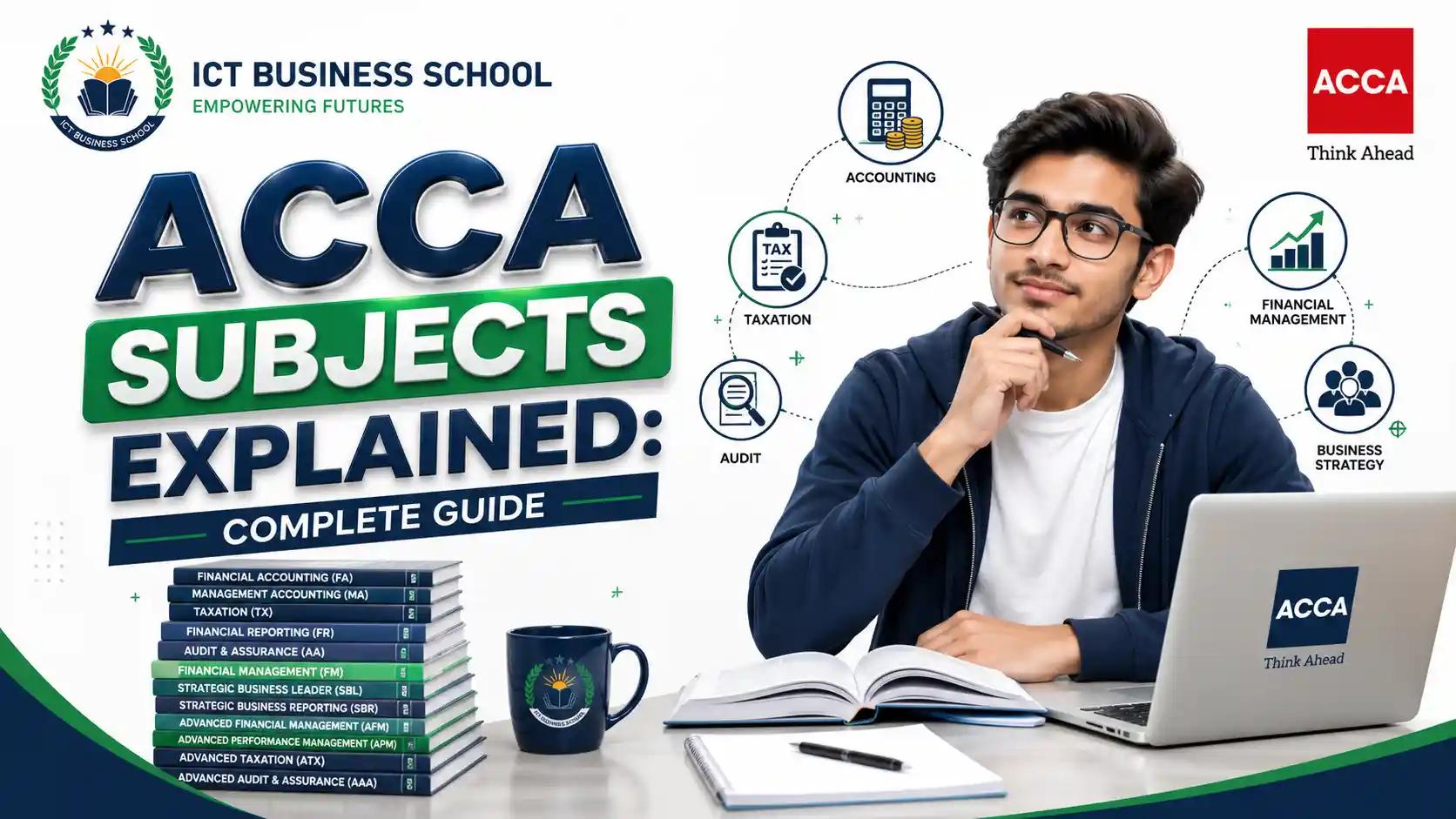
Quick Answer: ACCA has 13 subjects across three levels — Applied Knowledge (3 papers), Applied Skills (6 papers), and Strategic Professional (4 papers: 2 compulsory + 2 optional) — plus an Ethics and Professional Skills Module. Students must pass all 13 papers and complete 3 years of practical experience to qualify as a Chartered Certified Accountant.
ICT Business School,
ACCA Qualification Overview
ACCA (Association of Chartered Certified Accountants) is a globally recognised professional accounting qualification. It builds expertise in accounting, finance, taxation, audit, and business strategy.
This qualification is respected by employers worldwide, including Big Four firms (PwC, Deloitte, EY, KPMG) and multinational corporations. It's a popular choice for students seeking an internationally portable finance career.
Students exploring structured academic pathways before or alongside ACCA can explore advanced corporate and taxation courses at ICT Business School.
How Many ACCA Subjects Are There?
The ACCA qualification has 13 subjects (papers) in total, organised into three progressive levels:
- Applied Knowledge – 3 papers
- Applied Skills – 6 papers
- Strategic Professional – 4 papers (2 compulsory + 2 chosen from 4 options)
Each level builds directly on the one before it, so students must clear Applied Knowledge before moving to Applied Skills, and Applied Skills before Strategic Professional.
ACCA Qualification Levels
| Level | Number of Papers | Focus Area |
|---|---|---|
| Applied Knowledge | 3 | Core accounting and business fundamentals |
| Applied Skills | 6 | Technical accounting, tax, audit, law, and finance |
| Strategic Professional | 4 | Strategic leadership and advanced application |
| Ethics Module | 1 (Non-exam) | Professional ethics and practical workplace scenarios |
Applied Knowledge Subjects
This is the entry point of the ACCA qualification, ideal for beginners and students starting after 12th grade or graduation.
- Business and Technology (BT) – Business environment, organisational structure, governance, and technology's role in business
- Management Accounting (MA) – Budgeting, cost accounting, and internal decision-making information
- Financial Accounting (FA) – Recording and reporting financial transactions and preparing financial statements
These three papers are available as on-demand computer-based exams (CBEs), meaning students can book and sit them anytime — a major advantage for flexible study planning.
Applied Skills Subjects
This level develops technical competence across the core disciplines of accounting and finance.ICT Business School,
- Corporate and Business Law (LW) – Legal framework governing businesses, contracts, and governance
- Performance Management (PM) – Advanced management accounting and strategic decision-making
- Taxation (TX) – Income tax, corporation tax, capital gains, and compliance
- Financial Reporting (FR) – IFRS application and preparing financial statements
- Audit and Assurance (AA) – Audit planning, evidence gathering, and professional standards
- Financial Management (FM) – Investment appraisal, working capital management, and risk management
Applied Skills papers are session-based exams, held in the March, June, September, and December exam windows.
Strategic Professional Subjects
The final and most advanced level, designed to build leadership and strategic thinking.
Compulsory papers:
- Strategic Business Leader (SBL) – Leadership, governance, risk management, and ethics through case-study scenarios
- Strategic Business Reporting (SBR) – Advanced financial reporting and analytical interpretation
Optional papers (choose 2 of 4):
- Advanced Financial Management (AFM) – Best for careers in investment banking, treasury, or corporate finance
- Advanced Performance Management (APM) – Suited to strategy, consulting, and performance management roles
- Advanced Taxation (ATX) – Ideal for tax advisory careers
- Advanced Audit and Assurance (AAA) – Essential for senior audit roles at Big Four or mid-tier firmsICT Business School,
Choosing optional papers based on your intended career path — not perceived difficulty — leads to better long-term outcomes.
Ethics and Professional Skills Module
Alongside the 13 exam papers, ACCA requires completion of the Ethics and Professional Skills Module (EPSM). This isn't a traditional written exam — it's an interactive online module covering:
- Professional ethics and judgement
- Communication and analytical skills
- Commercial awareness
- Problem-solving in real workplace scenarios
Completing this module alongside Strategic Professional papers strengthens practical, job-ready skills.
Best Order to Complete ACCA Papers
While papers within a level can be taken in any order, a commonly recommended sequence is:
- BT → MA → FA (Applied Knowledge – build the foundation)
- LW → PM → TX → FR → AA → FM (Applied Skills – develop technical depth)
- SBL → SBR → 2 optional papers (Strategic Professional – apply strategic judgement)
Business and Technology (BT) is often recommended as the first paper, since it has one of the highest pass rates and eases students into the exam format.
ACCA Exemptions
Students with prior qualifications may be eligible for exemptions, reducing the total number of papers they need to sit.
- B.Com/BBA graduates may receive exemptions for some Applied Knowledge papers
- MBA (Finance) holders may receive broader exemptions across Applied Knowledge and select Applied Skills papers
- CA (Chartered Accountancy) qualified professionals often receive the highest number of exemptions
Exemptions are assessed individually through ACCA's official exemption calculator based on your academic background.
Difficulty Level of Each Subject
| Subject Level | Typical Pass Rate Range | Difficulty |
|---|---|---|
| Applied Knowledge (BT, MA, FA) | 65–88% | Easier, foundational |
| Applied Skills (LW, PM, TX, FR, AA, FM) | 40–55% | Moderate to challenging |
| Strategic Professional (SBL, SBR, Optional Papers) | 30–50% | Most challenging (advanced level) |
Financial Reporting (FR) and Performance Management (PM) are commonly cited as difficult "gatekeeper" papers at the Applied Skills level, while Strategic Business Leader (SBL) is considered the most demanding overall due to its case-study format.
Subject-Wise Study Tips
- BT/MA/FA: Focus on concepts early — these determine performance in later Applied Skills papers
- LW: Strong conceptual paper; consistent revision works better than last-minute cramming
- PM/FM: Practice numerical questions repeatedly under timed conditions
- TX: Stay updated on tax rate changes each exam session
- FR/SBR: Master IFRS standards thoroughly — they connect directly to real-world financial reporting
- AA/AAA: Understand audit procedures conceptually, not just theoretically
- SBL: Practice case-study writing and time management, since it tests judgement, not memorisation
Recommended Books and Resources
- Official ACCA-approved study texts (BPP, Kaplan)
- ACCA's own Study Hub and practice platform
- Past papers and specimen exams from ACCA Global
- Mock exams for timed practice
Expert Guidance
Practical advice for students starting or progressing through ACCA:
- Don't skip Applied Knowledge basics, even if you find them easy — weak fundamentals show up later in FR and SBR.
- Attempt papers in order where possible; skipping ahead often backfires at Strategic Professional level.
- Use past papers religiously. ACCA exams follow consistent patterns, and past papers reveal exactly how questions are structured.
- Choose optional papers strategically based on your career goal — audit, tax, or finance — not just which paper "sounds easier."
- Don't delay the Ethics module. Complete it alongside Strategic Professional papers rather than leaving it until the end.
Careers After ACCA
ACCA qualification opens doors across multiple sectors:
- Audit and assurance (Big Four and mid-tier firms)
- Taxation and compliance
- Financial reporting and analysis
- Corporate finance and treasury
- Internal audit and risk management
- Banking and financial services
- Management accounting and budgeting
Many ACCA-qualified professionals progress into senior roles such as Finance Manager, Financial Controller, and eventually CFO.
ACCA vs CA, CPA, CMA, and CIMA
| Qualification | Focus Area | Best Suited For |
|---|---|---|
| ACCA | Broad international accounting & finance | Global career mobility |
| CA (ICAP) | Local statutory audit and compliance | Strong domestic recognition |
| CPA | US accounting standards | Careers in the United States |
| CMA | Management accounting | Corporate finance and costing roles |
| CIMA | Business and management accounting | Strategic business roles |
ACCA is often chosen for its faster completion timeline and strong international recognition compared to purely local qualifications.
Key Facts
- ACCA has 13 exam papers across 3 levels: Applied Knowledge, Applied Skills, and Strategic Professional.
- A separate Ethics and Professional Skills Module is also mandatory.
- Applied Knowledge papers are available as on-demand exams year-round.
- Applied Skills and Strategic Professional exams run in March, June, September, and December.
- The pass mark for every ACCA subject is 50%.
- Students can attempt up to 4 exams per session and 8 per year.
- Exemptions are available for B.Com, BBA, MBA, and CA-qualified students.
- Two optional papers must be chosen at Strategic Professional level from AFM, APM, ATX, and AAA.
- 3 years of relevant practical experience (PER) is required for full membership.
FAQs
What are the 13 ACCA subjects? BT, MA, FA (Applied Knowledge); LW, PM, TX, FR, AA, FM (Applied Skills); and SBL, SBR plus 2 optional papers from AFM, APM, ATX, AAA (Strategic Professional).
How many papers are there in ACCA? There are 13 papers in total, plus a non-exam Ethics and Professional Skills Module.
What are the three levels of ACCA? Applied Knowledge, Applied Skills, and Strategic Professional.
Which ACCA subject is the easiest? Business and Technology (BT) generally has the highest pass rate, making it the easiest starting point.
Which ACCA paper is the hardest? Strategic Business Leader (SBL) is widely considered the hardest due to its case-study, judgement-based format.
Can I complete ACCA in two years? Yes, with strong planning, consistent study, and eligible exemptions, some students complete ACCA in around 2 years.
Is ACCA recognised internationally? Yes, ACCA is recognised in over 180 countries, including the UK, UAE, Pakistan, and Canada.
What are ACCA exemptions? Exemptions allow students with relevant prior qualifications (like B.Com or CA) to skip certain papers based on their academic background.
Start Your ACCA Journey the Right Way
Understanding the ACCA subjects is the first step — choosing the right academic foundation makes the journey easier. Why choose ICT Business School? With expert faculty, structured programs, and clear progression pathways, ICT Business School helps students build strong fundamentals before and during ACCA.
Explore ICT Business School's courses, including the O-Level Program, HND (Higher National Diploma), and Level 7 Extended Diploma. Learn more About ICT Business School, meet the Faculty, or Contact ICT Business School to plan your ACCA path today.