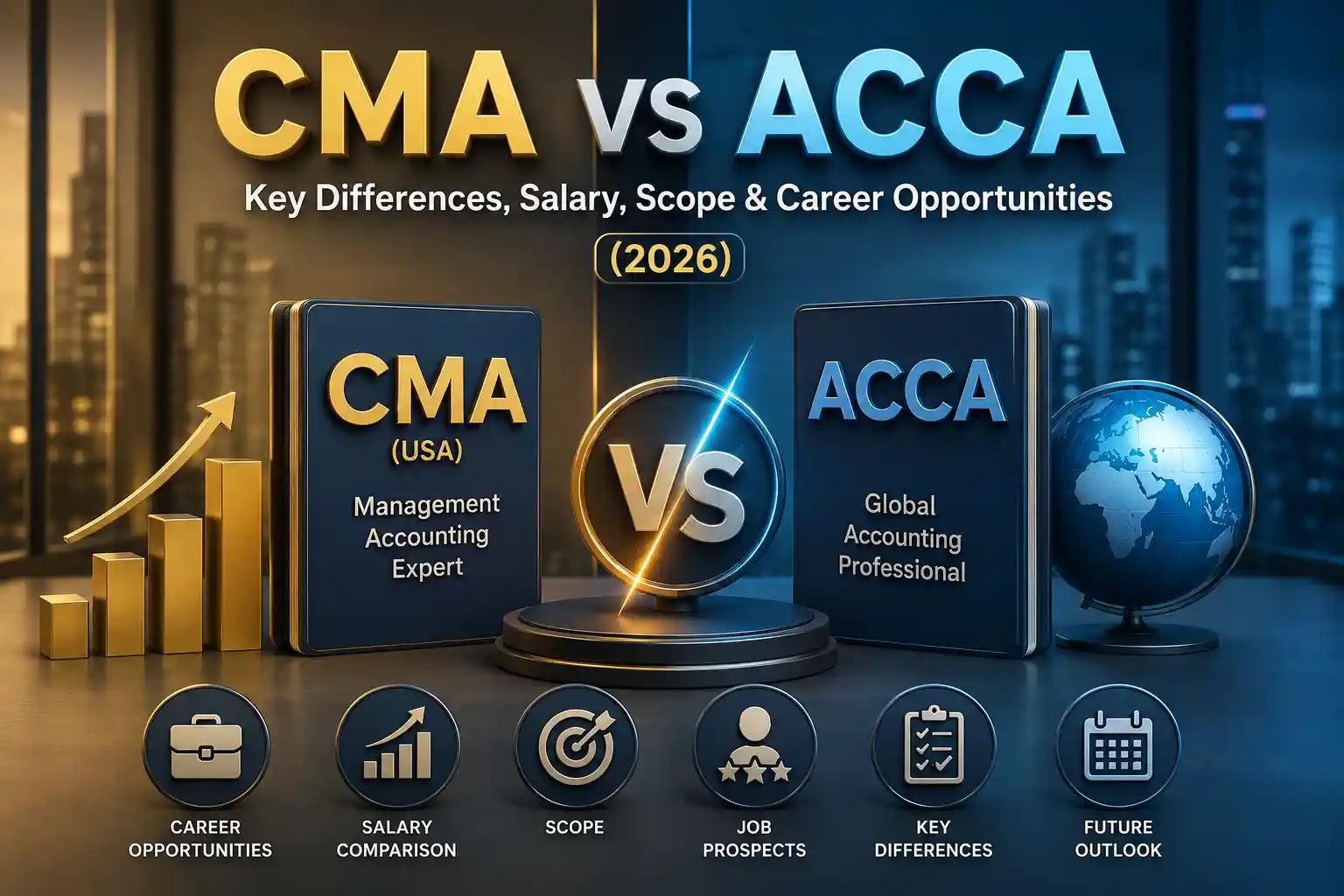
Confused between CMA and ACCA? One wrong choice can waste years of your career… but one can double your income.”
Quick Answer:
CMA is generally a stronger choice for professionals who want to build careers in management accounting, financial planning, budgeting, cost management, and corporate finance. ACCA, on the other hand, is better suited for those interested in auditing, taxation, financial reporting, and internationally recognized accounting roles. The right qualification depends on your career goals, preferred industry, and whether you plan to work primarily in Pakistan or pursue opportunities in global markets.
Introduction
Choosing between CMA and ACCA is one of the most important career decisions for students interested in accounting, finance, and business management. Both qualifications are internationally recognized and offer strong career opportunities, but they are designed for different professional goals and areas of expertise.
CMA focuses primarily on management accounting, financial planning, cost management, and strategic decision-making within organizations. ACCA, on the other hand, provides broader exposure to accounting, auditing, taxation, financial reporting, and global finance practices.
https://www.ictbusinessschool.com/
In this comprehensive CMA vs ACCA comparison, you'll learn the key differences in syllabus, exam structure, duration, difficulty, salary potential, career opportunities, and global recognition. Whether you plan to build your career in Pakistan or explore opportunities abroad, this guide will help you choose the qualification that best aligns with your long-term career goals.
What Are CMA and ACCA ?
What is CMA?
CMA stands for Certified Management Accountant, a globally recognized professional certification awarded by the Institute of Management Accountants (IMA), USA. The qualification is designed for professionals who want to build expertise in management accounting, financial planning, budgeting, cost management, performance analysis, and strategic decision-making.
https://www.ictbusinessschool.com/
Unlike traditional accounting qualifications that focus heavily on auditing and taxation, CMA emphasizes business strategy and corporate finance. The qualification consists of two examination parts and is widely respected by multinational companies, manufacturing organizations, financial institutions, and corporate employers worldwide.
For professionals interested in management accounting, financial leadership, and senior corporate finance roles, CMA is considered one of the most valuable certifications available today.
What is ACCA?
ACCA stands for the Association of Chartered Certified Accountants, a globally recognized accounting qualification based in the United Kingdom. The qualification prepares students for careers in accounting, auditing, taxation, financial reporting, financial management, and business advisory services.
https://www.ictbusinessschool.com/
ACCA follows a structured learning pathway that combines professional examinations, ethics training, and practical experience requirements. Because it is recognized in more than 180 countries, ACCA is a popular choice for students seeking opportunities with multinational companies, international audit firms, banks, and financial institutions.
For individuals who want a broad accounting qualification with strong international recognition, ACCA remains one of the most respected professional credentials in the finance and accounting industry.
Both CMA and ACCA are highly respected qualifications, but they are designed for different career paths. CMA focuses more on management accounting and corporate finance, while ACCA provides broader exposure to accounting, auditing, taxation, and financial reporting.
CMA vs ACCA: Quick Comparison
Governing Body
- The governing body of a professional qualification plays an important role in its credibility and global recognition. CMA is administered by the Institute of Management Accountants (IMA), USA, a leading organization focused on management accounting and corporate finance. ACCA is governed by the Association of Chartered Certified Accountants (ACCA), UK, one of the world's largest professional accounting bodies with a strong presence in accounting, auditing, taxation, and financial reporting.
Both organizations are internationally respected and maintain high professional and ethical standards for finance and accounting professionals.
https://www.ictbusinessschool.com/
Global Recognition
ACCA enjoys strong global recognition across accounting, auditing, taxation, and financial reporting roles, making it a widely accepted qualification in international job markets. It is particularly valued in countries such as the UK, UAE, Pakistan, India, Malaysia, and other Gulf regions, where multinational companies and audit firms actively hire ACCA professionals.
CMA (USA), on the other hand, is highly respected in areas such as corporate finance, management accounting, budgeting, financial planning, manufacturing, FMCG industries, oil and gas sectors, and multinational corporate environments. Its recognition is especially strong in the USA, Middle East, Canada, and large corporate organizations worldwide.
Both qualifications have strong global value, but their recognition differs based on industry focus and career direction.
Number of Exams
- CMA: 2 parts only (Part 1 and Part 2)
- ACCA: 13 papers across three levels (Applied Knowledge, Applied Skills, Strategic Professional)
Key Facts: Quick Comparison Table
| Feature | CMA (USA) | ACCA (UK) |
|---|---|---|
| Governing Body | IMA, USA | ACCA, UK |
| Total Exams | 2 Parts | 13 Papers |
| Duration | 6–18 months | 2–3 years |
| Focus Area | Management Accounting | Accounting, Audit, Tax |
| Best For | Corporate Finance, CFO Track | Audit, Tax, Global Roles |
| Global Recognition | Strong in MNCs & Gulf | Very Strong Worldwide |
| Difficulty | Moderate–High | Moderate–High (Lengthy) |
| ACCA Course Fees | — | Varies by country |
| CMA Course Fees | Varies | — |
| Average Salary (Gulf) | AED 8,000 – 25,000/month | AED 7,000 – 22,000/month |
CMA vs ACCA: Subjects and Syllabus Comparison
CMA Subjects
The CMA course syllabus covers:
- External Financial Reporting Decisions
- Planning, Budgeting, and Forecasting
- Performance Management
- Cost Management and Cost Accounting
- Internal Controls
- Technology and Analytics
- Financial Statement Analysis
- Corporate Finance
- Risk Management
- Professional Ethics and Decision-Making
The CMA course duration is typically 6–12 months for focused candidates, making it one of the fastest finance certifications to complete.
ACCA Subjects
The ACCA syllabus is broader and covers three levels:
Applied Knowledge Level:
- Business and Technology (BT)
- Management Accounting (MA)
- Financial Accounting (FA)
Applied Skills Level:
- Corporate and Business Law (LW)
- Performance Management (PM)
- Taxation (TX)
- Financial Reporting (FR)
- Audit and Assurance (AA)
- Financial Management (FM)
Strategic Professional Level:
- Strategic Business Leader (SBL)
- Strategic Business Reporting (SBR)
- Two optional papers (AFM, APM, ATX, AAA)
ACCA course subjects are aligned with International Financial Reporting Standards (IFRS) and are built for professionals targeting audit, taxation, and financial reporting careers globally.
CMA vs ACCA: Exam Pattern
CMA Exam Pattern
- 2 parts total
- Part 1: Financial Planning, Performance, and Analytics
- Part 2: Strategic Financial Management
- Format: 100 MCQs + 2 essay questions per part
- Each exam: 4 hours
- Computer-based exam at Prometric centers
- CMA exam vs ACCA: CMA is faster and more focused
ACCA Exam Pattern
- 13 papers across three levels
- Mixture of computer-based and written exams
- Some papers are on-demand (can be taken anytime)
- Strategic Professional papers are session-based (March, June, September, December)
- ACCA course duration after graduation depends on exemptions — graduates may skip some early papers
CMA vs ACCA: Duration (Time Required)
CMA Duration
The CMA qualification is relatively shorter and can typically be completed within 6 to 18 months, depending on the candidate’s study pace and preparation strategy. Some fast-track candidates are able to complete both exam parts in less than one year.
After passing the exams, candidates are also required to complete 2 years of relevant professional experience, which can be obtained before or after completing the exams.
Overall, CMA is considered a fast-track certification for individuals aiming to enter management accounting and corporate finance roles quickly.
https://www.ictbusinessschool.com/
ACCA Duration
- The ACCA qualification generally takes around 2 to 3 years to complete under a regular study plan. However, the duration can be significantly reduced to 1.5 to 2 years for students who receive exemptions based on prior qualifications such as a relevant degree or other certifications.
In Pakistan, most students complete ACCA within 2 to 3 years, depending on exam attempts and study pace. Similarly, in the UK and other regions, the duration varies based on individual progression and exemptions.
ACCA is a structured qualification that allows flexibility, but it requires more time compared to CMA due to its broader syllabus and number of papers.
CMA vs ACCA: Eligibility
CMA Eligibility
To pursue CMA (USA), candidates are required to have a bachelor’s degree from an accredited university in any field. In addition, students must hold an active membership with the Institute of Management Accountants (IMA).
Candidates are also required to complete 2 years of relevant professional experience in management accounting or financial management. This experience can be gained before or after passing the CMA exams, making the pathway flexible for both students and working professionals.
While a background in finance or accounting is helpful, it is not strictly mandatory, making CMA accessible to individuals from different academic backgrounds.
ACCA Eligibility
To enroll in ACCA, students generally need a minimum of 2 A-levels and 3 GCSEs or an equivalent qualification such as O-Levels, FSc, Intermediate, or A-Levels in Pakistan. This makes ACCA accessible to students immediately after completing secondary education.
Graduates with relevant degrees may also receive exemptions from certain papers, allowing them to complete the qualification faster.
In Pakistan, ACCA entry is flexible, allowing students from Intermediate, A-Level, or university backgrounds to start at different levels depending on their qualifications. This makes ACCA suitable for both fresh students and working professionals.
https://www.ictbusinessschool.com/
CMA vs ACCA: Difficulty Level
Is CMA Hard?
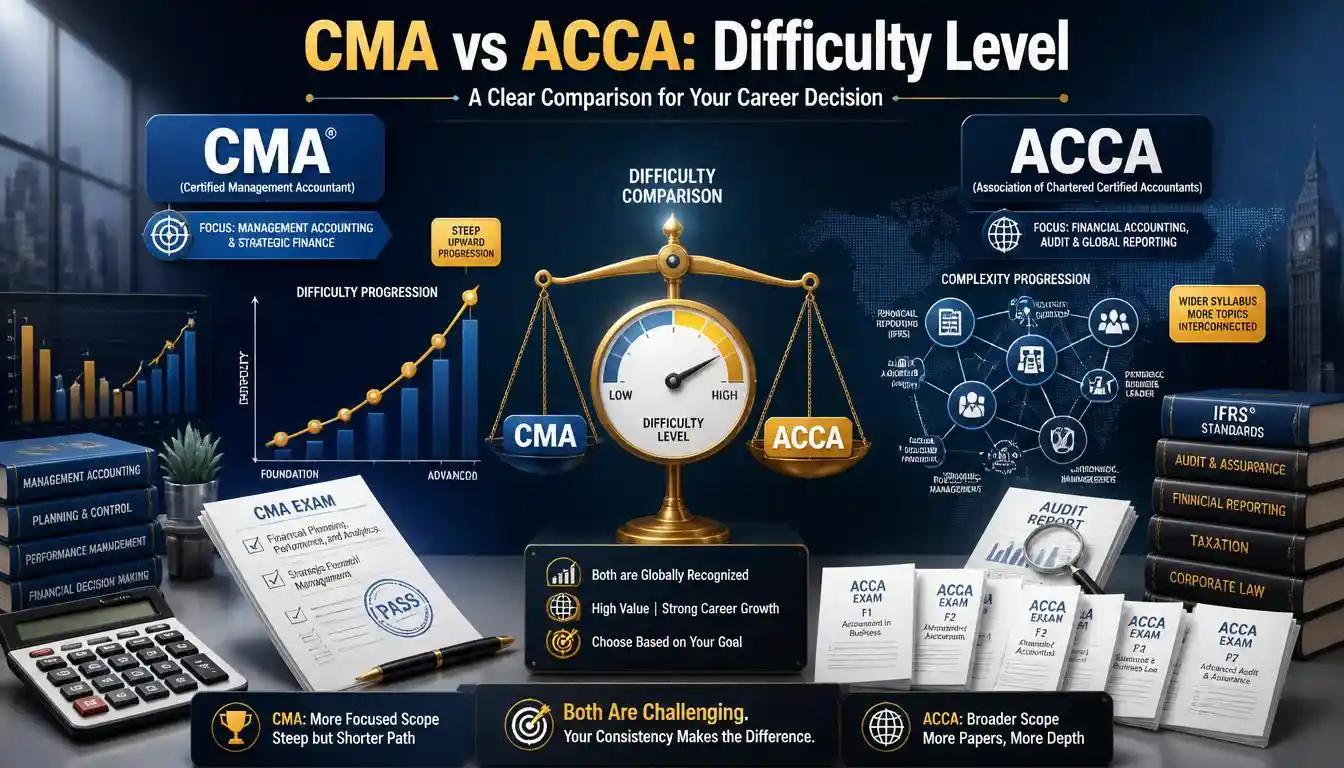
The CMA qualification is considered concept-driven and focuses heavily on analytical and strategic thinking. Instead of relying on memorization, it tests a candidate’s ability to apply management accounting and corporate finance concepts in real business scenarios. The exam consists of two parts, including multiple-choice questions and essay-based questions, which require strong understanding and application skills.
The global pass rate for CMA is around 45–50%, which shows that the exam is challenging but achievable with focused preparation and consistent study. Many students find CMA relatively faster to complete due to its shorter structure and specialized syllabus.
Overall, CMA is not easy, but it is manageable for candidates who are disciplined and focused on management accounting and corporate finance careers.
Is ACCA Hard?
ACCA is a broad and extensive qualification that covers accounting, auditing, taxation, financial reporting, law, and business strategy. With 13 papers across three levels, the volume of study material is significantly higher compared to many other accounting qualifications.
Certain papers such as Strategic Business Leader (SBL) and Advanced Financial Management (AFM) are widely regarded as some of the most challenging exams in the global accounting field due to their application-based and strategic nature.
ACCA requires consistent study, practice, and long-term commitment. While it is demanding, it becomes manageable with structured learning, proper guidance, and regular exam preparation.
CMA vs ACCA: Career Scope and Job Opportunities
CMA Career Options
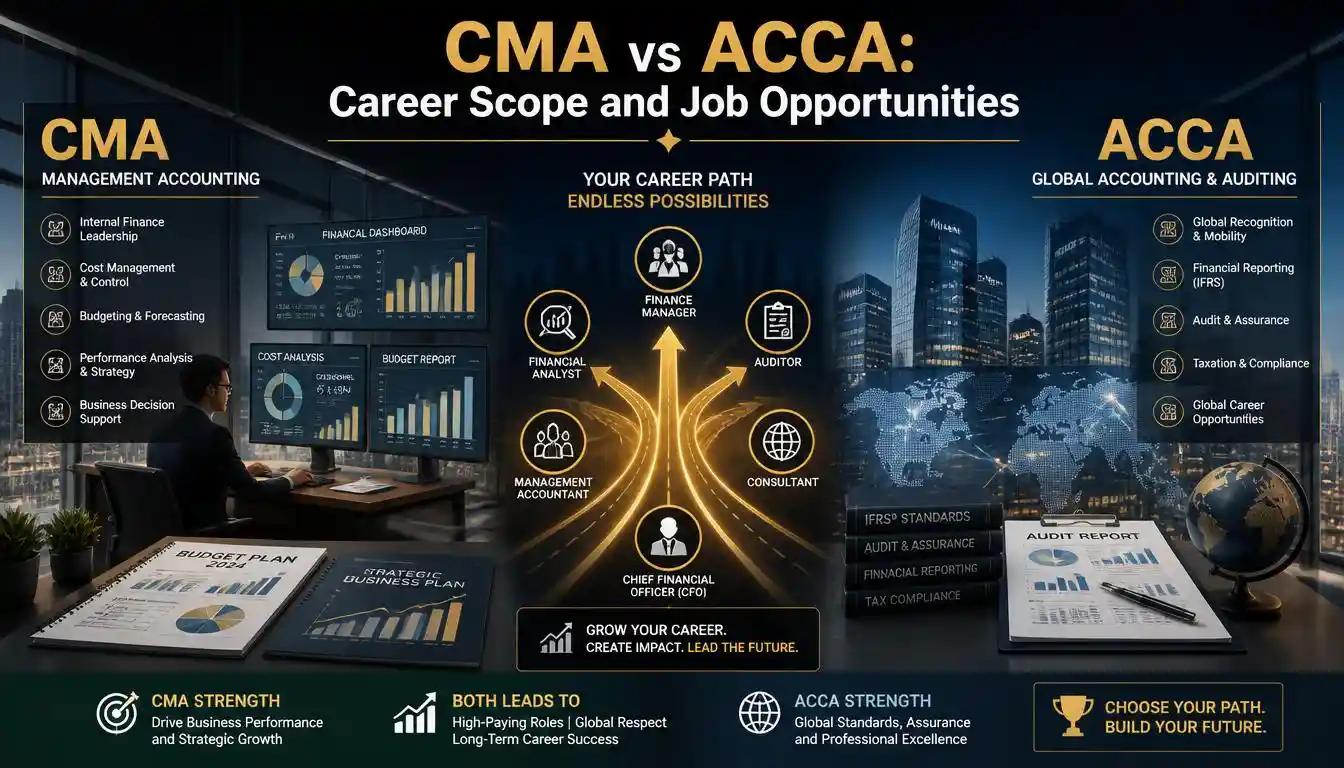
Professionals with CMA certification typically work in:
- Financial Analyst
- Management Accountant
- Finance Manager
- Cost Controller
- Budget Analyst
- Financial Controller
- Chief Financial Officer (CFO)
- Treasury Manager
- Corporate Finance Advisor
- Internal Auditor (with CIA complement)
CMA career opportunities are strongest in corporate finance, manufacturing, oil & gas, banking, FMCG, and technology sectors. CMA USA career opportunities are especially strong in the Middle East and Gulf countries.
ACCA Career Options
ACCA graduates typically work in:
- External Auditor (Big 4: Deloitte, KPMG, EY, PwC)
- Tax Consultant
- Financial Accountant
- Management Accountant
- Finance Manager
- Internal Auditor
- Forensic Accountant
- Financial Reporting Specialist
- Business Analyst
- Finance Director
ACCA jobs in Dubai, UK, Pakistan, India, and across Asia are strong because of ACCA's global recognition in the audit and financial services space.
Salary Comparison: CMA vs ACCA
CMA vs ACCA Salary in Pakistan:
| Level | CMA Salary (PKR/Month) | ACCA Salary (PKR/Month) |
|---|---|---|
| Entry-Level | 60,000 – 100,000 | 50,000 – 90,000 |
| Mid-Level | 120,000 – 220,000 | 100,000 – 200,000 |
| Senior-Level | 250,000 – 500,000+ | 200,000 – 450,000+ |
Which is Better: CMA or ACCA?
If You Choose CMA
CMA is the better choice if you want a fast-track and specialized qualification focused on management accounting and corporate finance. It can typically be completed within 6–18 months, making it one of the quickest professional accounting certifications.
This pathway is ideal for students and professionals who are interested in budgeting, cost control, financial planning, and strategic decision-making roles. CMA is especially valued in multinational companies, manufacturing industries, oil and gas, banking, and corporate finance sectors, particularly in the Gulf region.
If your goal is to reach senior positions such as finance manager, financial controller, or CFO, CMA provides a strong foundation in management accounting and financial leadership.
If You Choose ACCA
ACCA is the better option if you are looking for a broad, internationally recognized accounting qualification with opportunities in auditing, taxation, financial reporting, and financial management.
It is highly valued by Big 4 firms such as Deloitte, KPMG, EY, and PwC, as well as multinational companies and financial institutions. ACCA is widely accepted in countries including the UK, UAE, Pakistan, India, and across more than 180 countries worldwide.
This qualification is ideal for students aiming for careers in external audit, tax advisory, accounting, and financial reporting. ACCA is often considered the best option for those who want long-term global mobility in the accounting and finance profession.
Final Advice
Do not choose based on what is more popular. Choose based on what matches your interest and career goal:
- Love corporate strategy and financial planning? Choose CMA.
- Love auditing, taxation, and international accounting? Choose ACCA.
- Want maximum career flexibility? Do ACCA first, then add CMA.
ICT Business School offers expert coaching for both CMA and ACCA. Learn more about the programs: https://www.ictbusinessschool.com/courses
Can You Do Both CMA and ACCA?
Is It Possible?
Yes, it is possible to pursue both CMA (USA) and ACCA, and many finance professionals choose to do so. Holding both qualifications can significantly enhance your profile, especially in competitive job markets such as the Gulf region, Pakistan, and the UK.
ACCA provides a broad foundation in accounting, auditing, taxation, and financial reporting, while CMA focuses on deeper expertise in management accounting, corporate finance, budgeting, and strategic decision-making. Together, they create a powerful combination of both breadth and depth in finance.
Time and Effort Required
Pursuing both qualifications requires careful planning, as managing them simultaneously can be demanding. A common approach is to complete ACCA first, which typically takes 2–3 years and provides a strong overall accounting foundation. After that, CMA can be completed in an additional 6–12 months to build specialization in corporate finance and management accounting.
Alternatively, some professionals complete CMA first, especially if they are already working in corporate finance roles, and later pursue ACCA for broader international recognition.
Expert Guidance
From a senior finance career perspective, both CMA (USA) and ACCA are strong qualifications, but the right choice depends on your career stage and long-term goals.
If you are a student starting your journey and are unsure about your direction, ACCA is often considered a safer option due to its wider global recognition, structured pathway, and flexibility across different accounting and finance roles.
On the other hand, if you are already working in finance or aiming to move into corporate finance, management accounting, or senior leadership roles such as finance manager or CFO, CMA can be a more strategic and specialized choice.
Both qualifications require consistent effort and structured preparation. Enrolling in a professional training institute is generally more effective than self-study alone, especially for complex exam structures.
In regions like the UAE, both CMA and ACCA are valued in the job market. CMA is often preferred for corporate finance and strategic roles, while ACCA is stronger in audit, accounting, and Big 4 firms.
In Pakistan, both qualifications are gaining strong demand in the private sector. However, CA (ICAP) still holds the highest recognition in traditional audit and government-related roles, while ACCA and CMA are rapidly growing in multinational companies and corporate environments.
To further strengthen your career profile, it is highly recommended to build additional practical skills alongside your qualification. Platforms like Coursera offer valuable courses in financial modeling, Excel, and data analytics, which significantly improve employability in modern finance roles.
For structured career guidance and professional advisory support, you may explore specialized consulting services that help students choose the right finance pathway based on their goals.
Study CMA and ACCA at ICT Business School
ICT Business School (https://www.ictbusinessschool.com/) is one of Pakistan's most trusted professional education institutes. The school offers expert coaching for CMA, ACCA, CA (ICAP), and CIA (Internal Audit) — all under one roof.
Why choose ICT Business School? Because the faculty brings real-world professional experience into every session, and the structured programs are designed specifically to help students pass exams and build strong careers.
Available programs:
- CMA — Corporate finance and management accounting certification
- ACCA — Global accounting and audit qualification
- CA (ICAP) — Pakistan's leading chartered accountancy qualification
- CIA — Certified Internal Auditor for audit professionals
- HND (Higher National Diploma in Business): https://www.ictbusinessschool.com/courses/hnd-higher-national-diploma
- Pearson BTEC Level 3: https://www.ictbusinessschool.com/courses/pearson-btec-level-3
- Pearson BTEC Level 7 (Masters-equivalent): https://www.ictbusinessschool.com/courses/level-7-extended-diploma
- O Level and A Level Language Courses: https://www.ictbusinessschool.com/courses/o-level-program
Meet the expert faculty: https://www.ictbusinessschool.com/faculty Read career guides on the blog: https://www.ictbusinessschool.com/blog Learn about the institute: https://www.ictbusinessschool.com/about Get in touch today: https://www.ictbusinessschool.com/contact
Additional resources and tools: https://megafreetools.com/ | https://ict.edu.pk | https://bacoconsultants.com/
Frequently Asked Questions (FAQs)
Which is harder — CMA or ACCA? Both are challenging but in different ways. CMA has only 2 parts but requires deep analytical thinking. ACCA has 13 papers with a very broad syllabus. Most students find CMA faster to finish, while ACCA takes more total time due to higher paper volume.
Which has more scope — CMA or ACCA? ACCA has wider global scope because it is recognized in 180+ countries and valued across audit, tax, and financial reporting. CMA has strong scope in corporate finance, multinationals, and Gulf countries. Both have excellent career prospects — the scope depends on what role you are targeting.
CMA vs ACCA in Pakistan — which is better? Both are valued in Pakistan's corporate sector. ACCA is more widely recognized in Big 4 firms and multinational companies in Pakistan. CMA is preferred in manufacturing, banking, and FMCG companies. CA (ICAP) remains the top choice for government and public practice in Pakistan.
Can I switch between CMA and ACCA? Yes. Many professionals start with one and add the other later. If you have completed ACCA, you can pursue CMA to add corporate finance depth. There are no restrictions — just time, dedication, and resources.
Which has higher salary — CMA or ACCA? CMA professionals tend to earn slightly more in corporate finance and CFO-track roles, especially in the Gulf. ACCA professionals earn competitively in audit, Big 4 firms, and multinational companies. In Pakistan and UAE, both certifications command strong salaries at mid-to-senior levels.
Is ACCA recognized in the USA? ACCA is recognized in the USA but has less influence compared to CPA (Certified Public Accountant) in the American market. However, ACCA is globally portable and excellent for professionals working internationally.
Is CMA worth it in 2026? Yes. CMA is absolutely worth it in 2026. Demand for financial analysts, cost controllers, and corporate finance professionals is rising across Pakistan, UAE, Saudi Arabia, Qatar, and globally. The CMA qualification delivers strong salary returns and fast career advancement.
What jobs can I get after CMA? After CMA certification, you can work as a Financial Analyst, Management Accountant, Finance Manager, Cost Controller, Financial Controller, Budget Analyst, Treasury Manager, or Chief Financial Officer (CFO) in large corporations and multinationals.
Conclusion
CMA and ACCA are both powerful, globally respected finance certifications. They are not competitors — they serve different career goals.
CMA is the better choice for corporate finance, management accounting, and CFO-level careers. ACCA is the better choice for audit, taxation, financial reporting, and globally mobile accounting careers.
CMA is faster to complete. ACCA has broader global recognition. Both offer strong salaries and excellent job opportunities in Pakistan, UAE, Saudi Arabia, the UK, and beyond.
Final Advice
Stop asking which is more popular. Ask which one matches your career goal. If you love corporate finance and strategy — go CMA. If you love auditing, taxation, and international accounting — go ACCA. And if you want maximum professional strength, do both over time.
Start your journey with expert guidance at ICT Business School — a trusted institute for CMA, ACCA, CA, CIA, and more.
Enroll today and take the first step toward your finance career: https://www.ictbusinessschool.com/contact
Explore all professional programs at ICT Business School: https://www.ictbusinessschool.com/courses Read more career guides: https://www.ictbusinessschool.com/blog Additional free tools and resources: https://megafreetools.com/