
What if I told you that choosing the wrong qualification today could cost you years of your career? Many students assume CIA and ACCA lead to the same jobs—but that's one of the biggest misconceptions in the finance industry. One qualification can open doors to global accounting careers, while the other is designed for a completely different path. Before you invest your time, money, and effort, make sure you know which one actually matches your future.
CIA (Certified Internal Auditor) is the ideal qualification for professionals who want to build a career in internal auditing, risk management, governance, and compliance. ACCA (Association of Chartered Certified Accountants) is a broader accounting qualification that prepares students for careers in accounting, auditing, taxation, financial reporting, and finance. If your goal is to become an internal audit specialist, CIA is the better choice. If you want wider career opportunities in Pakistan and internationally, ACCA offers greater flexibility across the accounting and finance profession.
Introduction
Choosing between CIA and ACCA is one of the most important career decisions for students interested in accounting, finance, and auditing. Although both qualifications are internationally recognized, they are designed for different career paths and professional goals.
In Pakistan, ACCA is widely pursued by students seeking careers in accounting, taxation, auditing, and financial management, while CIA is preferred by professionals who want to specialize in internal audit, risk management, governance, and compliance. Both qualifications are also highly valued by multinational companies, banks, financial institutions, and corporate organizations across the UAE, Saudi Arabia, the UK, and other international markets.
This comprehensive CIA vs ACCA comparison covers eligibility, syllabus, exam structure, duration, salary, career opportunities, global recognition, and job scope to help you make an informed decision. Whether you plan to build your career in Pakistan or explore opportunities abroad, this guide will help you choose the qualification that best matches your long-term career goals.
2. Quick Comparison
| Factor | CIA | ACCA |
|---|---|---|
| Full Name | Certified Internal Auditor | Association of Chartered Certified Accountants |
| Awarding Body | nstitute of Internal Auditors (IIA | ACCA |
| Focus Area | Internal Audit & Risk | Accounting, Finance, Audit, Tax |
| Total Exams | 3 Parts | 13 Papers |
| Duration | 1–2 Years | 3–4 Years |
| Eligibility | Bachelor’s Degree + 24 months experience | After O/A Levels or 12th grade |
| Global Recognition | Recognized in 190+ countries | Recognized in 180+ countries |
| Best For | internal Audit, Risk & Compliance | Finance, Accounting, Big 4 firms |
| Average Salary (Pakistan) | PKR 100,000–250,000/month | PKR 80,000–300,000/month |
| Salary in UAE/Dubai | AED 8,000–18,000/month | AED 7,000–20,000/month |
3. CIA vs ACCA at a Glance

Before exploring each comparison in detail, here's a quick overview of the most important differences between CIA and ACCA. This side-by-side comparison covers eligibility, duration, career scope, salary potential, and professional recognition, helping students and working professionals understand which qualification is the better fit for their career goals. Whether you plan to build your career in Pakistan or pursue international opportunities, this overview provides a clear starting point before diving into the detailed comparison.
CIA VS ACCA: Eligibility Comparison
CIA Eligibility Requirements:
- To become a Certified Internal Auditor (CIA), candidates must hold a bachelor's degree from an accredited university, regardless of their field of study. In addition, the certification requires 24 months of relevant work experience in internal auditing or a related field. The good news is that students can appear for the CIA exams before completing this experience requirement, allowing them to begin their certification journey earlier. Candidates are also required to become members of the Institute of Internal Auditors (IIA) before registering for the exams.s
ACCA Entry Requirements:
- ACCA offers one of the most flexible entry pathways for aspiring accounting professionals. Students in Pakistan can begin ACCA after completing Intermediate (FSc, I.Com, ICS), A-Levels, or an equivalent qualification. Those with relevant bachelor's degrees may also receive exemptions from selected papers, helping them complete the qualification in less time. This flexibility makes ACCA an attractive option for both fresh students and graduates looking to build a career in accounting and finance.
Verdict: For most Pakistani students, ACCA is the more accessible qualification because it can be started immediately after Intermediate or A-Levels. In contrast, CIA is better suited to graduates or finance professionals who already have a degree and want to specialize in internal auditing and risk management.t.
CIA VS ACCA:Duration Comparison
CIA Duration:
- The CIA qualification is relatively short and can typically be completed within 1 to 2 years, depending on a candidate's study schedule and exam progress. It consists of three exam parts, making it one of the fastest professional certifications for individuals pursuing a career in internal auditing. Candidates must also complete 24 months of relevant work experience, which can run alongside their exam preparation.
ACCA Duration:
- ACCA follows a broader qualification pathway with 13 papers divided across the Applied Knowledge, Applied Skills, and Strategic Professional levels. Most students in Pakistan complete ACCA within 3 to 4 years, although graduates who receive exemptions may finish sooner. In addition to passing the exams, students must also complete the Practical Experience Requirement (PER) to become fully qualified.
Verdict: If your priority is completing a professional qualification in a shorter time, CIA is the faster option. However, if you want broader career opportunities in accounting, taxation, auditing, and financial management, ACCA offers a more comprehensive pathway despite requiring a longer study period.
CIA VS ACCA Fees Comparison
| Factor | CIA | ACCA |
|---|---|---|
| Registration Fee | USD 230 (approx) | USD 89 (approx) |
| Per Exam Fee | USD 330–385 per part | USD 124–232 per paper |
| Total Exam Cost (approx) | USD 1,200–1,500 | USD 1,800–2,500+ |
| Study Materials | USD 200–400 | USD 300–600+ |
| Annual Subscription | Institute of Internal Auditors membership required | ACCA annual subscription required |
Both qualifications involve notable investment. Coaching at a recognized institute reduces overall cost through structured prep. ICT Business School (https://www.ictbusinessschool.com/courses) offers guided CIA and ACCA preparation with expert faculty and affordable fee structures.
CIA VS ACCA Subjects and Syllabus Comparison
CIA Subjects (3 Parts):
- The CIA qualification is structured into three exam parts, each designed to build practical expertise in internal auditing, governance, and risk management.
Part 1 focuses on the fundamentals of internal auditing, including governance, risk management, internal controls, and professional ethics.
Part 2 covers audit planning, audit engagements, fieldwork, communication, and reporting.
Part 3 expands into business knowledge by covering finance, information technology, business management, and organizational strategy.
The CIA syllabus is highly specialized, making it ideal for professionals who want to build a career in internal auditing, compliance, and corporate governance.
ACCA Subjects (13 Papers):
- ACCA follows a broader syllabus consisting of 13 papers across three qualification levels. The Applied Knowledge level introduces Business and Technology, Management Accounting, and Financial Accounting. The Applied Skills level covers Corporate and Business Law, Performance Management, Taxation, Financial Reporting, Audit and Assurance, and Financial Management.
At the Strategic Professional level, students complete Strategic Business Leader and Strategic Business Reporting, along with two optional papers based on their career interests.
Unlike CIA, ACCA provides comprehensive knowledge of accounting, auditing, taxation, financial reporting, and business management, making it suitable for a wide range of finance and accounting careers in Pakistan and internationally.
Final Insight:
The main difference lies in specialization. CIA focuses exclusively on internal auditing, governance, and risk management, whereas ACCA provides a broader accounting qualification covering taxation, financial reporting, auditing, management accounting, and corporate finance. For Pakistani students seeking versatile career opportunities, ACCA offers wider career options, while CIA is the stronger choice for professionals aiming to specialize in internal audit.
CIA VS ACCA Exam Structure Comparison
CIA Exam Pattern:
- The CIA qualification consists of three computer-based examination parts, all of which are entirely multiple-choice question (MCQ) based.
Part 1 includes 125 MCQs with a 150-minute time limit, while
Part 2 and Part 3 each contain 100 MCQs to be completed within 120 minutes. The exams are conducted through Pearson VUE testing centers and are available throughout the year, giving candidates greater flexibility in scheduling. To pass each exam, candidates must achieve a scaled score of 600 out of 750.
ACCA Exam Pattern:
- ACCA follows a more comprehensive examination structure with 13 papers that combine multiple-choice questions, objective tests, and scenario-based written assessments. While the earlier papers include objective-style questions, the Strategic Professional level focuses heavily on case studies and written responses that assess analytical thinking, professional judgment, and practical application. ACCA examinations are conducted four times a year—in March, June, September, and December—with most papers offered as computer-based exams.
Final Insight
When comparing the exam structure, CIA is generally more straightforward because all examinations are MCQ-based and available year-round. ACCA, however, is more demanding due to its combination of objective and written assessments, making it better suited for students who want a broader and more comprehensive accounting qualification. For Pakistani students, the choice depends on whether they prefer a specialized internal audit certification or a wider accounting and finance pathway.
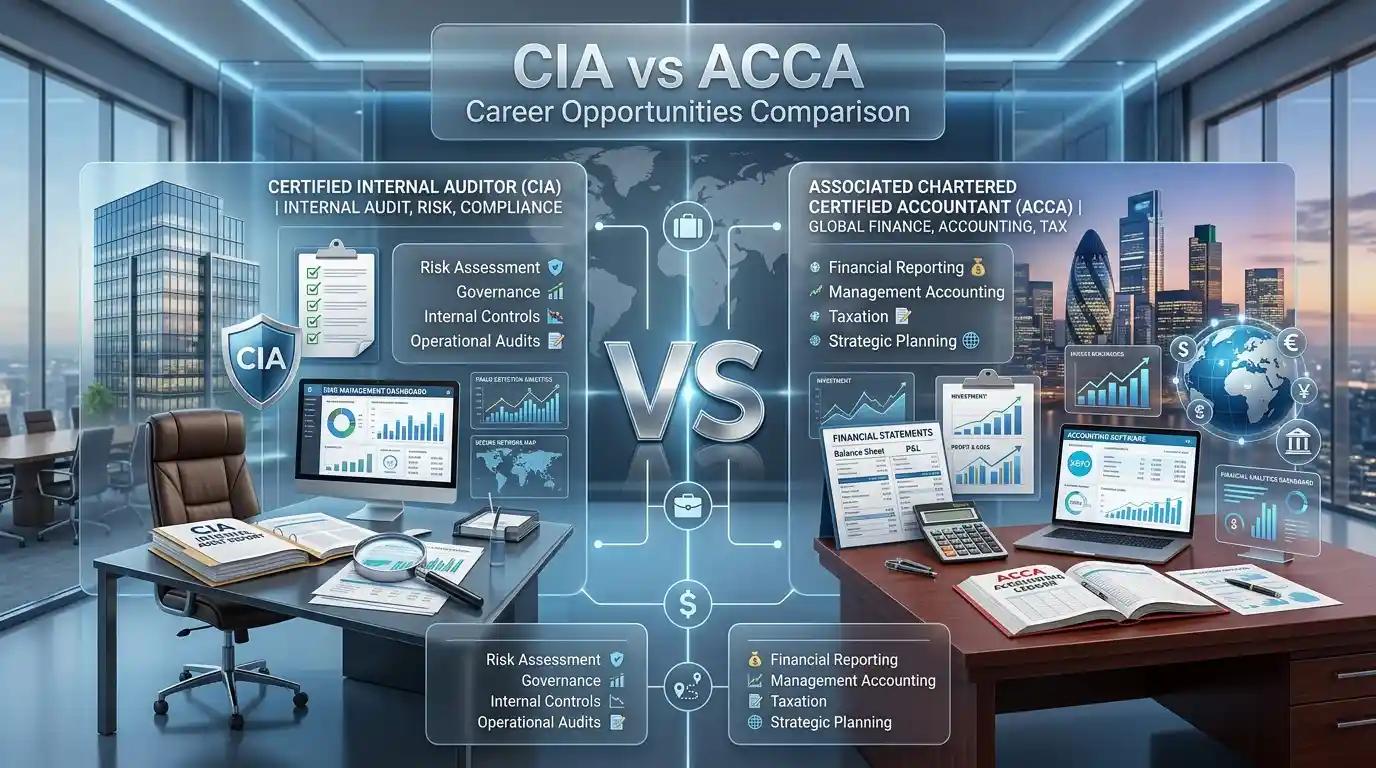
CIA VS ACCA Career Opportunities Comparison
CIA Career Opportunities:
- CIA is a specialized qualification designed for professionals who want to build careers in internal auditing, risk management, governance, and compliance. CIA-qualified professionals commonly work as Internal Auditors, Risk and Compliance Managers, IT Auditors, Fraud Examiners, Forensic Auditors, Internal Audit Managers, and Chief Audit Executives (CAE).
In Pakistan, CIA professionals are in demand across commercial banks, multinational companies, insurance firms, manufacturing organizations, listed companies, and public sector institutions. Internationally, demand is particularly strong in the UAE, Saudi Arabia, and other Gulf countries, where organizations continue to strengthen their internal audit and corporate governance functions.
ACCA Career Opportunities:
- ACCA offers a broader range of career opportunities across accounting, auditing, taxation, financial reporting, and corporate finance. ACCA-qualified professionals commonly work as External Auditors, Financial Accountants, Tax Consultants, Financial Analysts, Financial Controllers, Finance Managers, CFOs, and Finance Directors.
In Pakistan, ACCA professionals are highly sought after by Big 4 accounting firms, multinational companies, banks, FMCG organizations, telecom companies, and financial institutions. Globally, ACCA provides excellent career opportunities in the UK, UAE, Saudi Arabia, Canada, and many other international markets because of its strong global recognition.
CIA VS ACCA Salary Comparison
| Region | CIA Salary (Monthly) | ACCA Salary (Monthly) |
|---|---|---|
| Pakistan (Entry Level) | PKR 80,000–120,000 | PKR 70,000–110,000 |
| Pakistan (Senior Level) | PKR 200,000–400,000 | PKR 250,000–500,000+ |
| India (Entry Level) | INR 50,000–80,000 | INR 45,000–75,000 |
| UAE / Dubai | AED 8,000–18,000 | AED 7,000–20,000 |
| Saudi Arabia | SAR 10,000–22,000 | SAR 9,000–25,000 |
| UK | GBP 3,500–6,000 | GBP 3,500–7,000 |
Both qualifications offer excellent accounting salary growth over time. ACCA has a slightly higher ceiling in senior finance roles due to its broader scope. CIA holders who move into Head of Internal Audit or Chief Audit Executive roles can also command very high compensation packages, especially in multinationals and banking.
Earning Potential Conclusion: For long-term CA vs ACCA salary growth — ACCA provides broader earning potential. For audit-specific high-paying roles, CIA is unmatched.
Key Facts
- CIA has only 3 exams and can be completed in 1–2 years; ACCA has 13 papers over 3–4 years
- ACCA is open after 12th grade; CIA requires a bachelor's degree first
- Both are recognized in 180–190+ countries globally
- CIA is the gold standard for internal audit careers; ACCA is broader across all finance careers
- ACCA vs CA salary in Pakistan is comparable, with ACCA offering stronger international mobility
- ACCA has stronger recognition in Gulf countries like UAE and Saudi Arabia for finance roles
- CIA holders dominate internal audit leadership positions in banks, corporations, and government
- Both qualifications are highly valued by Big 4 firms globally
Expert Guidance
After guiding students and finance professionals in choosing accounting qualifications, one thing becomes very clear: there is no single qualification that is "better" for everyone. The right choice depends on where you see yourself five or ten years from now.
If you are a student in Pakistan who has recently completed Intermediate (FSc, I.Com), A-Levels, or a bachelor's degree and want the flexibility to work in accounting, auditing, taxation, or corporate finance, ACCA is usually the stronger starting point. It provides a broad foundation and opens career opportunities in Pakistan as well as internationally.
If you are already working in banking, finance, internal audit, or risk management and want to specialize in internal auditing, CIA is an excellent next step. Because it is more focused, it helps professionals move into senior internal audit, governance, compliance, and risk management roles more quickly.
One pattern we have consistently observed is that professionals who combine ACCA with CIA often have a competitive advantage in the job market. ACCA builds strong technical knowledge in accounting and finance, while CIA develops specialized expertise in internal auditing and corporate governance. Together, they create a skill set that is highly valued by banks, multinational companies, and large corporate organizations in Pakistan and internationally.
Before making your final decision, take time to evaluate your long-term career goals rather than choosing a qualification based only on popularity or duration. Selecting the qualification that aligns with your career path will deliver far greater value over the course of your professional journey.
Courses at ICT Business School
If you are serious about a professional accounting qualification, choosing the right institute is as important as choosing the right qualification. ICT Business School (https://www.ictbusinessschool.com/) is one of Pakistan's trusted institutes for professional and academic certifications.
Programs offered at ICT Business School:
- ACCA: Full ACCA pathway with expert faculty and structured preparation
- CA (ICAP Pathway): For students targeting chartered accountancy in Pakistan
- CIA: Certified Internal Auditor preparation program
- CMA: Certified Management Accountant program
- O Level Program: https://www.ictbusinessschool.com/courses/o-level-program — Foundation for ACCA and professional careers
- HND (Higher National Diploma): https://www.ictbusinessschool.com/courses/hnd-higher-national-diploma — Business specialization
- Pearson BTEC Level 3: https://www.ictbusinessschool.com/courses/pearson-btec-level-3
- Level 7 Extended Diploma: https://www.ictbusinessschool.com/courses/level-7-extended-diploma
The institute has qualified and experienced faculty (https://www.ictbusinessschool.com/faculty) who guide students through every stage of their professional qualification journey. Learn more about ICT Business School (https://www.ictbusinessschool.com/about) and why it is one of the best choices for students in Pakistan.
Explore advanced corporate, audit, and taxation courses at ICT: https://www.ictbusinessschool.com/courses
CIA vs ACCA:Which Qualification Should You Choose?
| Goal | Best Choice |
|---|---|
| Want a high-paying finance career globally | ACCA |
| Specializing in internal audit and risk | CIA |
| Starting right after 12th / A Levels | ACCA |
| Already have a degree and working in finance | CIA |
| Want jobs in Big 4 accounting firms | ACCA |
| Targeting Gulf / UAE audit jobs | CIA or ACCA (both strong) |
| Want faster certification (fewer exams) | CIA |
| Want comprehensive accounting + tax + audit skills | ACCA |
| Maximum international recognition | ACCA (slight edge) |
| Best for banking sector internal audit | CIA |
How to Get Started (Free + Paid Options)
You do not have to wait to start learning. Several free and paid resources can help you explore both CIA and ACCA before enrolling:
- Free Options: ACCA's own website offers free study resources and specimen papers. IIA Global provides CIA exam blueprints and practice questions at no cost.
- Online Platforms: Coursera (https://www.coursera.org) offers accounting and finance fundamentals that build your base before sitting CIA or ACCA exams.
- Paid Coaching: Structured prep at a professional institute gives you guided study plans, mock exams, and expert feedback — all critical for improving pass rates.
For professional consultation on which qualification suits your background, contact ICT Business School directly: https://www.ictbusinessschool.com/contact
Read more career guidance on the ICT Blog: https://www.ictbusinessschool.com/blog
Additional academic and career resources are available at https://ict.edu.pk
For business consultancy alongside your certification, visit BACO Consultants: https://bacoconsultants.com/
CIA vs ACCA: Scope in Pakistan,
In Pakistan, both CIA and ACCA are respected professional qualifications, but they are valued in different areas of the finance industry. ACCA has a broader presence across accounting firms, multinational companies, banks, FMCG organizations, and the corporate sector. It is widely recognized by employers and is a preferred qualification for careers in accounting, external audit, taxation, financial reporting, and corporate finance. Leading firms such as Deloitte Yousuf Adil, KPMG Pakistan, EY Ford Rhodes, and other major employers regularly recruit ACCA-qualified professionals.
CIA, on the other hand, is a specialized qualification focused on internal auditing, governance, risk management, and compliance. In Pakistan, CIA-certified professionals are highly valued by commercial banks, insurance companies, listed organizations, and large corporations that maintain dedicated internal audit departments. The qualification is particularly beneficial for professionals who want to progress into senior internal audit and risk management leadership roles.
For most Pakistani students starting their careers, ACCA provides wider job opportunities and greater flexibility across the accounting and finance profession. However, for professionals who want to specialize in internal auditing and corporate governance, CIA offers a clear career advantage within its area of expertise.
FAQS
Q1. Is ACCA better than CIA? It depends on your career goal. ACCA is better for broad accounting and finance careers globally. CIA is better if you specifically want to specialize in internal auditing. Many professionals hold both.
Q2. Which is harder — CIA or ACCA? ACCA is generally considered more demanding overall because it has 13 papers covering diverse topics including tax, audit, and strategic finance. CIA has only 3 parts but is highly technical in audit knowledge.
Q3. Which has a higher salary — CIA or ACCA? ACCA has a wider salary range due to its broader career scope. However, senior CIA professionals in Chief Audit Executive or Head of Internal Audit roles can earn equal or higher packages, especially in multinational companies.
Q4. Can I do ACCA after 12th grade? Yes. ACCA is one of the most accessible professional accounting qualifications — students can begin after completing O Levels, A Levels, or FSC Commerce (Intermediate / 12th grade).
Q5. Is CIA valid in Pakistan? Yes. CIA is internationally recognized and accepted by major Pakistani banks, corporations, and multinational companies for internal audit and risk management roles.
Q6. Which is better for jobs abroad — CIA or ACCA? Both are recognized in 180–190+ countries. ACCA has a slight edge in the UK, Europe, and East Asia for broad finance roles. CIA is equally strong in the Gulf and North American markets for audit-specific positions.
Q7. How many years does CIA vs ACCA take? CIA typically takes 1–2 years to complete all 3 exam parts. ACCA typically takes 3–4 years to complete all 13 papers. Both require additional work experience for full membership.
Q8. Which is best for a finance career — CIA or ACCA? ACCA is the better all-round choice for a comprehensive finance career. CIA is the top choice for a dedicated audit and risk management career path.
Conclusion
Both CIA and ACCA are outstanding professional accounting qualifications with strong global recognition and excellent career prospects. The right choice comes down to your personal career goal, academic background, and the time you have available.
Choose ACCA if you want a comprehensive accounting and finance career, want to start right after school, or are aiming for Big 4 firms and international finance roles. Choose CIA if you are already in finance, want to specialize in internal auditing, and want a faster path to a focused, high-impact certification.
For the best possible preparation in Pakistan, look no further than ICT Business School — a trusted institute offering ACCA, CIA, CA, CMA, HND, and Pearson BTEC programs under one roof, guided by expert faculty.
Ready to Start Your Finance Career?
Whether you choose CIA or ACCA, ICT Business School is here to guide you every step of the way. Expert faculty, structured study programs, and a proven track record make ICT one of Pakistan's top choices for professional certifications.
- Explore All Courses: https://www.ictbusinessschool.com/courses
- Get Free Career Counselling: https://www.ictbusinessschool.com/contact
- Why Choose ICT Business School: https://www.ictbusinessschool.com/about