Quick Answer
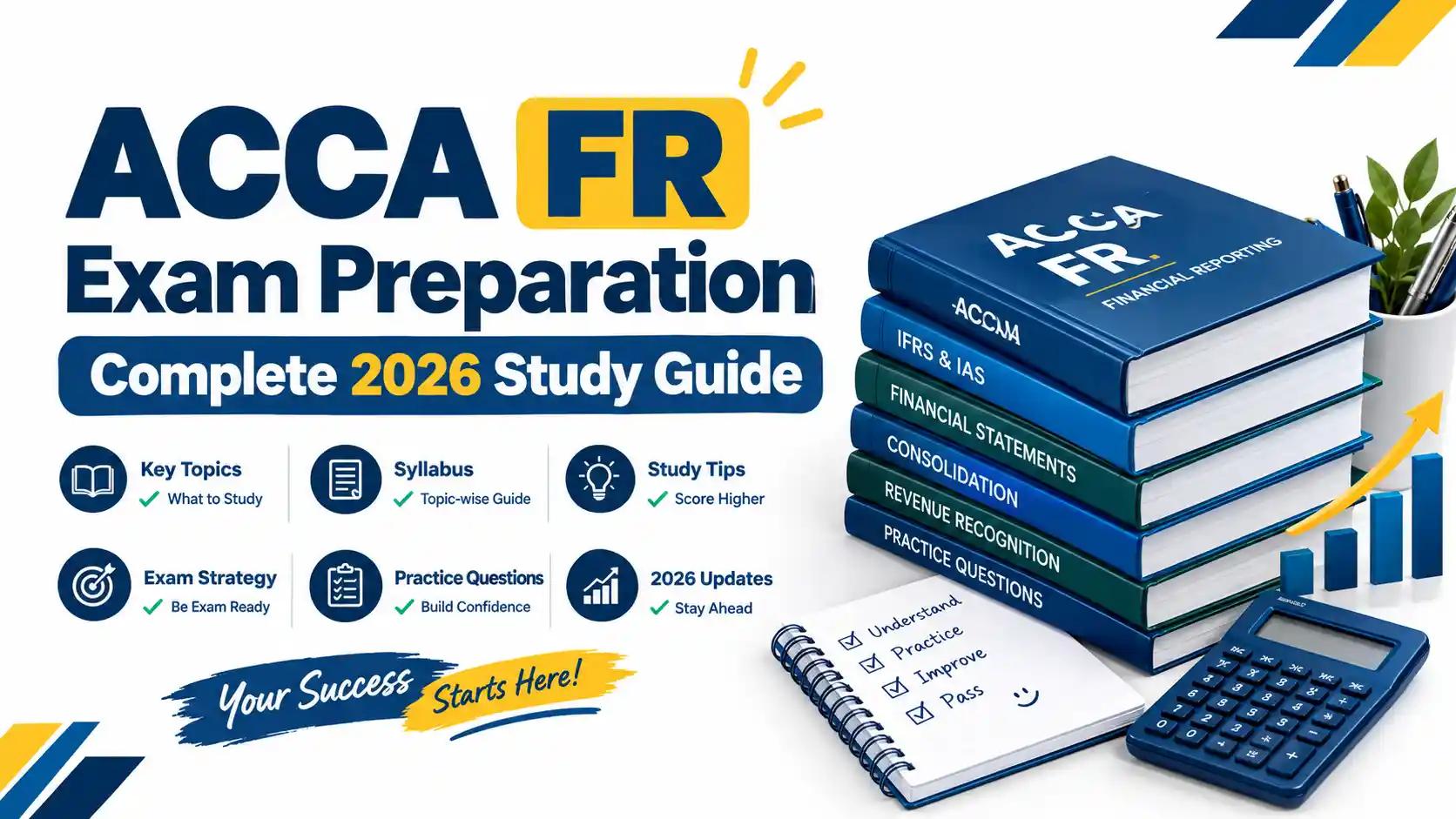
ACCA FR exam preparation means mastering IFRS-based financial statement preparation across single entities and groups, then practicing structured written answers, since Section C alone carries 40% of the marks through consolidation and interpretation questions. Students studying at an ACCA-focused institute like ICT Business School typically pair classroom teaching of the ACCA Financial Reporting paper with heavy past-paper practice to build the speed FR demands.
Introduction
If the ACCA Financial Reporting syllabus feels like an overwhelming stack of IAS and IFRS numbers, you're reacting the same way most students do in their first few weeks — FR packs more technical standards into one paper than almost any other Applied Skills exam. The good news is that it's entirely learnable once you understand which topics actually carry the marks and how the exam is structured.
This guide breaks down the full ACCA FR syllabus, the 2026 IFRS 18 update every current candidate needs to know about, and a realistic study plan built around how the paper is actually marked. It's written for students training with the Institute of Digital Trainings... actually, for students at ICT Business School, an ACCA-approved learning partner based in Islamabad, where FR is taught with a heavy focus on consolidation practice — the area that decides most students' results. Whether you're comparing ACCA against CA or other qualifications or already enrolled, this article covers everything you need in one place.
Key Takeaways
- ACCA FR is a 3-hour computer-based exam worth 100 marks across three sections, with a 50% pass mark.
- Section A (30 marks) and Section B (30 marks) are objective test questions; Section C (40 marks) is constructed-response, usually one group accounts question and one interpretation or single-entity question.
- The global FR pass rate was 51% in December 2025 and 50% in June 2025 — moderately challenging among Applied Skills papers.
- IFRS 18: Presentation and Disclosure in Financial Statements now supersedes IAS 1 in the current ACCA FR study guide, changing financial statement formats and introducing new mandatory subtotals.
- Group accounts (consolidation) is the single most heavily weighted and most feared topic in the entire syllabus.
- FR is the direct foundation for Strategic Business Reporting (SBR) at the Strategic Professional level.
What Is ACCA FR and Why Does It Matter?
ACCA Financial Reporting (FR), formerly F7, is an Applied Skills-level paper that teaches candidates to prepare and interpret financial statements under IFRS Accounting Standards, for both single entities and corporate groups. It sits after Financial Accounting (FA) and directly feeds into Strategic Business Reporting (SBR) at the Strategic Professional level.
FR matters for three practical reasons:
- It's compulsory for every ACCA student and builds the technical accounting foundation the entire qualification rests on.
- It's the paper most heavily tested through IFRS application rather than theory, which means strong FR skills translate directly into real accounting and audit work.
- Weak FR knowledge creates a compounding problem later, since SBR assumes full command of FR-level consolidation and IFRS application.
Students exploring the full ACCA subjects list will find FR usually studied after FA and alongside or after Audit and Assurance (AA), since AA examines financial statements from the auditor's perspective using the same statements FR teaches you to prepare.
ACCA FR Exam Format and Structure
ACCA FR is a 3-hour computer-based exam (CBE) worth 100 marks across three sections, and candidates need 50 marks to pass. Every question is compulsory — there's no choice of which questions to answer.
| Section | Format | Marks | Details |
|---|---|---|---|
| Section A | 15 objective test (OT) questions | 30 marks | 2 marks each, no partial credit |
| Section B | 3 OT case scenarios | 30 marks | Each case has related questions worth 10 marks total |
| Section C | 2 constructed response questions | 40 marks | Typically one group accounts (consolidation) question, one single-entity or interpretation question |
| Total | 100 marks | Pass mark: 50% |
Key structural points to plan your revision around:
- Section A rewards accurate, fast recall — with no partial marks, precision matters more than depth here.
- Section C is where results are usually decided, since consolidation questions are lengthy, calculation-heavy, and require correct financial statement formats under time pressure.
- The exam runs on ACCA's on-screen CBE platform, so practicing on the official CBE Practice Platform before exam day is essential.
- FR is offered in all four annual sessions, so check ACCA exam dates and deadlines when planning your sitting.
Important Note: Because Section C alone is worth 40% of the paper, a student who is strong at OT questions but weak at consolidation can still fail overall. Balanced preparation across all three sections is non-negotiable.
ACCA FR Syllabus: Key Topics Breakdown
The ACCA FR syllabus is organised into eight core areas, all built around applying IFRS Accounting Standards to real financial reporting scenarios, moving from the conceptual framework through single-entity accounting to group consolidation and analysis.
1. Conceptual and Regulatory Framework
Covers the IASB Conceptual Framework for Financial Reporting — the principles of recognition, measurement, and presentation that underpin every other topic in the syllabus.
2. Accounting for Transactions in Financial Statements
Covers the core standards examined almost every sitting: IAS 16 (property, plant and equipment), IAS 38 (intangible assets), IAS 2 (inventories), IAS 37 (provisions and contingent liabilities), IAS 36 (impairment of assets), IFRS 15 (revenue from contracts with customers), and IFRS 16 (leases). These standards routinely appear in both OT questions and Section C.
3. Preparation of Financial Statements
Covers preparing a complete set of financial statements for a single company from a trial balance, including year-end adjustments — a core skill tested directly in Section C.
4. Consolidated Financial Statements (Group Accounts)
This is the most heavily weighted and most challenging area of the entire FR syllabus. It covers IFRS 10 (control and consolidation principles), IFRS 3 (business combinations), goodwill, non-controlling interest (NCI), fair value adjustments, and IAS 28 (equity accounting for associates). A consolidated statement of financial position or income statement is almost guaranteed in Section C.
5. Statement of Cash Flows
Covers IAS 7, testing candidates on preparing a statement of cash flows using the indirect method, including at group level.
6. Interpretation of Financial Statements
Covers ratio analysis — profitability, liquidity, efficiency, gearing, and investor ratios — along with the limitations of ratio analysis and awareness of creative accounting practices.
7. Other Standards
Includes standards like IFRS 9 (financial instruments), IAS 12 (income taxes), IFRS 5 (non-current assets held for sale), IAS 10 (events after the reporting period), and IAS 8 (accounting policies, changes in estimates and errors).
8. Presentation and Disclosure
Covers how financial statements are structured and what must be disclosed — now directly affected by the 2026 IFRS 18 update, covered in the next section.
Summary Box — Highest-frequency standards to prioritise: IFRS 15, IAS 16, IFRS 16, IAS 12, and IAS 36 appear most often in Section A and B objective test questions, while consolidation standards (IFRS 10, IFRS 3, IAS 28) dominate Section C.
What Is the 2026 IFRS 18 Update and Does It Affect FR?
IFRS 18: Presentation and Disclosure in Financial Statements officially supersedes IAS 1 in ACCA's current study guide, introducing mandatory new subtotals like Operating Profit and reorganising the income statement into new defined categories. It also affects related disclosures without replacing IAS 7 (Statement of Cash Flows) outright.
According to ACCA's own Financial Reporting syllabus and study guide for September 2025 to June 2026, IFRS 18 has already been incorporated into the FR study guide, impacting the required format of financial statements. This is one of the most significant syllabus changes candidates have seen in FR for several years, since it changes how income statement structure is examined rather than just adding a new standalone topic.
Latest Update Callout (2026): If you're sitting FR anytime from the current examinable period onward, confirm the exact treatment of IFRS 18 against ACCA's official syllabus and study guide before your exam date, since transitional guidance can be refined between sessions. Don't rely solely on older revision kits that were written before this change. Faculty at ICT Business School update FR teaching materials each session specifically to reflect changes like this one.
How to Build an ACCA FR Study Plan
A realistic ACCA FR study plan runs 10–12 weeks, weighted heavily toward consolidation practice in the final third, since Section C's 40 marks disproportionately determine pass or fail outcomes.
| Weeks | Focus | Activity |
|---|---|---|
| 1–3 | Conceptual framework, PPE, intangibles, inventory | Learn concepts, short OT practice |
| 4–6 | Revenue, leases, provisions, impairment | Learn concepts, begin short written questions |
| 7–9 | Group accounts (consolidation) | Heavy practice — this is the highest-value topic |
| 10 | Interpretation, cash flows, remaining standards | Complete syllabus coverage |
| 11–12 | Full past papers & mock exam | Timed practice, one full mock under exam conditions |
Best Practices:
- Dedicate disproportionate time to consolidation — many students under-practice it because it feels intimidating, which is exactly why it decides so many results.
- Practice writing correct financial statement formats from memory, especially under the IFRS 18-updated presentation requirements.
- Review ACCA's examiner's reports after every past paper — FR examiners consistently flag incorrect statement formats as the top reason for lost marks.
- Time yourself on Section C questions specifically; a 20-mark consolidation question needs to be completed in roughly 36 minutes including workings.
Common Mistake: Students often master individual standards in isolation but struggle to apply several together in one consolidation question — practicing integrated, multi-standard questions from week 7 onward closes this gap.
Best ACCA FR Study Materials and Resources
Effective ACCA FR preparation combines ACCA's official syllabus documents with a high volume of practice questions, since the paper rewards calculation speed and format accuracy more than pure theory recall.
Recommended resources include:
- ACCA's Official Study Guide — confirms exactly what's examinable, including the current IFRS 18 transition guidance (via ACCA Global).
- ACCA Examiner's Reports — published after every session, consistently highlighting format and application errors.
- ACCA Technical Articles — written by the FR examining team on topics like deferred tax, leases, and revenue recognition.
- Approved Content Provider revision kits — for structured question banks mapped to the syllabus.
- ACCA's CBE Practice Platform — essential for getting comfortable with the on-screen exam environment before sitting the real exam.
Students can also use IDT's guide to best ACCA practice platforms and the ACCA study hub for structured, session-by-session revision resources rather than piecing materials together independently.
ACCA FR Past Papers and Practice Strategy
Past papers are essential for FR because consolidation questions require a very specific working format that's difficult to learn from theory alone.
How to use past papers effectively for FR specifically:
- Start with Section A and B questions to lock in fast, accurate recall of individual standards.
- Move to full past papers untimed once the syllabus is covered, focusing on getting Section C workings correct.
- Add timing once your technique is solid — 1.8 minutes per mark is the benchmark pace.
- Mark against the official model answer, paying close attention to how consolidation workings are laid out (net assets working, goodwill working, NCI working, retained earnings working).
- Repeat consolidation questions specifically — doing five or six consolidation attempts is more valuable than doing ten scattered questions across easier topics.
Checklist before your exam:
- Completed at least 4–6 full past papers under timed conditions
- Can produce a full consolidated statement of financial position from a trial balance without notes
- Reviewed the latest examinable IFRS 18 guidance
- Practiced on ACCA's CBE platform interface
- Reviewed examiner's reports for recurring format mistakes
Common Mistakes Students Make in FR
Based on patterns consistently highlighted in ACCA's own examiner commentary, the most frequent reasons students lose marks in FR are:
- Incorrect financial statement formats. Even mathematically correct figures lose marks if placed in the wrong statement section.
- Weak consolidation workings. Skipping or poorly labelling workings (goodwill, NCI, net assets) makes it hard to earn method marks even with errors.
- Treating standards in isolation. Section C questions often combine multiple standards — a lease adjustment feeding into a consolidation, for example — and students who only study topics separately struggle here.
- Running out of time in Section C. Spending too long perfecting Section A OT questions leaves insufficient time for the higher-value constructed response section.
- Ignoring updated presentation requirements. Using outdated IAS 1-based formats instead of the current IFRS 18-aligned structure.
Expert Tip: Always show your workings clearly and label them, even under time pressure — ACCA's marking scheme awards method marks for correct approach even when the final figure is wrong.
Exam Technique: How to Answer FR Questions
Strong ACCA FR exam technique means prioritizing Section C time allocation, showing clear workings, and using the correct, current financial statement format for every answer.
Practical technique tips:
- Do Section C before Section A and B if consolidation is your strength, securing the highest-value marks first while you're fresh.
- Set up your workings template first for consolidation questions before filling in numbers — this prevents the "blank page panic" that costs time.
- Don't skip disclosure notes where required — presentation and disclosure carry real marks under the current syllabus.
- Use the on-screen spreadsheet tool for workings rather than typing everything into a single text box, since it mirrors how professional accountants actually prepare statements.
- Answer every OT question, even by educated guess — there's no negative marking, so blank answers guarantee zero marks.
ACCA FR Pass Rate and What It Means for You
The global pass rate for ACCA FR was 51% in the December 2025 session, following 50% in June 2025 and 49% in March 2025, based on official ACCA session results. This places FR above the Applied Skills average, though nearly half of all candidates still don't pass on a given attempt.
What this means practically:
- A 51% pass rate reflects genuine difficulty, not unpredictability — most failures trace back to weak consolidation technique rather than bad luck.
- Students who specifically drill Section C question types tend to perform meaningfully above the global average.
- A resit is common and adds time and cost, which is why front-loading consolidation practice from week 7 onward (rather than leaving it to the final weeks) pays off.
As of the December 2025 and March 2026 sessions; always check ACCA Global's official pass rate page for the latest published figures, since results update every quarter.
Is ACCA FR Hard? How It Compares to Other Papers
ACCA FR is considered moderately challenging — more demanding than Financial Accounting (FA) or Corporate and Business Law (LW), but generally more approachable than papers like Performance Management (PM) or Advanced Financial Reporting (SBR).
| Paper | Level | Approx. Pass Rate (Dec 2025) | Nature |
|---|---|---|---|
| LW | Applied Skills | ~82% | Objective test, largely recall-based |
| FA | Applied Skills/Foundation | ~68% | Foundational bookkeeping and statements |
| TX | Applied Skills | ~55% | Mixed OT and calculation |
| FR | Applied Skills | ~51% | IFRS application, heavy on consolidation |
| FM | Applied Skills | ~48% | Numerical, investment and financing decisions |
| AA | Applied Skills | ~46% | Mostly written, scenario-based |
| PM | Applied Skills | ~40% | Calculation-heavy, application-based |
| SBR | Strategic Professional | ~48% | Builds directly on FR at a more complex level |
Which is harder: ACCA FR or ACCA AA?
Both sit close together in difficulty, but they test different skills — FR is harder for students who struggle with calculation-heavy consolidation work, while AA is harder for students who struggle with structured professional writing. Students strong in numerical accounting work often find FR more intuitive than AA's written scenario demands, and vice versa.
Which Is Better: ACCA FR or CA's Financial Reporting Papers?
Both ACCA FR and ICAP's CA-track Financial Accounting and Reporting papers (FAR1 and FAR2) build genuine IFRS-based technical skill, but they differ in structure, local recognition, and how they lead into later qualification stages. ACCA FR is internationally recognised and feeds directly into SBR, while ICAP's FAR1 and FAR2 papers are structured specifically around Pakistan's CAF-level curriculum.
For students still deciding between ACCA and Chartered Accountancy, the technical content overlaps substantially at this level, so the decision usually comes down to career goals — international mobility and flexibility typically favour ACCA, while deep, Pakistan-specific practice rights typically favour CA. Our detailed CA vs ACCA comparison breaks this down further, including fee structures and time-to-qualify differences.
Career Value: Why FR Matters Beyond the Exam
Passing FR isn't just an exam milestone — it builds the exact technical foundation used daily in financial reporting, audit support, and corporate finance roles. Understanding IFRS application, consolidation, and financial statement interpretation translates directly into day-one competency for junior accounting and finance positions.
Based on industry trends, ACCA-qualified professionals with strong financial reporting skills typically find opportunities in corporate accounting departments, external audit firms, and financial analysis roles, though actual salary and career outcomes vary by employer, experience, and location. Students researching this path can review the broader ACCA scope, jobs, and salary landscape in Pakistan and the general future scope of accounting jobs for a fuller picture of where FR-level skills lead.
FR knowledge also directly underpins Strategic Business Reporting (SBR) at the Strategic Professional level, so weak FR fundamentals tend to resurface as a bigger problem later rather than disappearing after the exam is passed.
Why Choose ICT Business School for ACCA FR Exam Preparation
Self-studying FR is possible, but the paper's consolidation-heavy Section C is exactly where structured teaching and guided practice make the biggest difference — it's hard to self-assess whether your workings would earn full method marks without expert review. ICT Business School, based in Islamabad and accessible across the twin cities, teaches ACCA FR with a deliberate focus on consolidation technique and updated IFRS 18-aligned formats, not just standard-by-standard theory.
What this looks like in practice:
- Classes taught by faculty with real accounting and reporting backgrounds who bring practical context to IFRS application.
- Structured mock exams built around the actual Section A/B/C format, with dedicated consolidation drilling sessions.
- Materials updated each session to reflect current syllabus changes, including the IFRS 18 transition.
- [INSERT VERIFIED DATA: specific FR batch pass rate or recent cohort result, once available for publication]
Rather than making broad claims, here's the honest picture: many ICT Business School students preparing for FR and related ACCA papers have gone on to build careers in accounting, audit, and finance roles in Pakistan and abroad — and structured, in-person consolidation practice tends to shorten the learning curve significantly compared to studying entirely alone. Many students also explore common pitfalls in our guide on why students fail CA and ACCA exams before starting their own preparation.
If you're based in Islamabad, Rawalpindi, or nearby areas of the twin cities and want FR taught with a structured, consolidation-first approach, you can explore the ACCA Financial Reporting course details or book a seat by contacting the admissions team to discuss the next available intake.
FAQs
1. What is the ACCA FR exam format?
ACCA FR is a 3-hour computer-based exam worth 100 marks across three sections: Section A (15 OT questions, 30 marks), Section B (3 OT cases, 30 marks), and Section C (2 constructed response questions, 40 marks). The pass mark is 50%.
2. Is ACCA FR hard to pass?
FR is moderately challenging, with a pass rate around 49–51% in recent sessions. Most failures trace back to weak consolidation technique in Section C rather than the objective test sections.
3. How long should I study for ACCA FR?
Most students need 10–12 weeks, with a heavy focus on group accounts (consolidation) practice in the final third of the study plan, since it carries the most marks.
4. What is the hardest topic in ACCA FR?
Consolidated financial statements (group accounts) is consistently the most feared and heavily weighted topic, appearing as a major Section C question in almost every sitting.
5. Does the IFRS 18 update affect the ACCA FR exam?
Yes — IFRS 18 supersedes IAS 1 in the current ACCA FR study guide, introducing new mandatory subtotals and changing financial statement presentation formats, so candidates should confirm the latest examinable treatment on ACCA's official syllabus.
6. Which is better: ACCA FR or CA's Financial Reporting papers?
Both build genuine IFRS-based technical skill, but ACCA FR is internationally recognised and leads into SBR, while ICAP's FAR1/FAR2 are tailored specifically to Pakistan's CA curriculum — the right choice depends on your career goals.
7. Can I self-study for ACCA FR?
Yes, many students self-study successfully using official ACCA materials and revision kits, though structured guidance on consolidation workings often helps close the gap that decides pass/fail outcomes.
8. What comes after ACCA FR?
FR leads directly into Strategic Business Reporting (SBR) at the Strategic Professional level, which builds on the same IFRS and consolidation concepts at a more complex, integrated level.
Conclusion
ACCA FR rewards students who treat consolidation as the priority topic it actually is, rather than one of many equally weighted areas — Section C alone decides 40% of your result, and it's almost always built around group accounts. Build a study plan that front-loads standard-by-standard learning early and shifts hard into consolidation practice by week seven, stay current on the IFRS 18 presentation changes, and treat past-paper format accuracy as seriously as getting the numbers right.
If you'd like structured teaching, consolidation-focused mock exams, and faculty support built specifically around the current FR syllabus, book a seat at ICT Business School to discuss the next available intake in Islamabad.
Last Updated: September 2026. Pass rate data reflects the December 2025 and March 2026 ACCA sessions; IFRS 18 transition details reflect ACCA's September 2025–June 2026 syllabus and study guide. This content should be reviewed every 6 months given how frequently exam-related figures and syllabus guidance change.