Thinking about studying BTEC Level 3 but wondering if you actually qualify? Whether you’re a school leaver with GCSEs, an adult returning to education, an international student, or someone with a relevant vocational qualification, your eligibility may depend on more than just your grades. From the usual 4–5 GCSE requirements and English & Maths qualifications to alternative Level 2 qualifications and relevant work experience, there are several pathways into BTEC Level 3. So, what exactly do you need to get started—and do the requirements change depending on the course or your qualifications? Let’s explore the BTEC Level 3 entry requirements and eligibility criteria in detail.ICT Business School
Quick answer: BTEC Level 3 eligibility generally requires four to five GCSEs (or equivalent Level 2 qualifications) including English and Maths, though exact BTEC Level 3 entry requirements vary by college and course. School leavers, mature students, and international students can all apply, and many providers also accept equivalent qualifications or relevant work experience instead of GCSEs.ICT Business School
What Is BTEC Level 3?
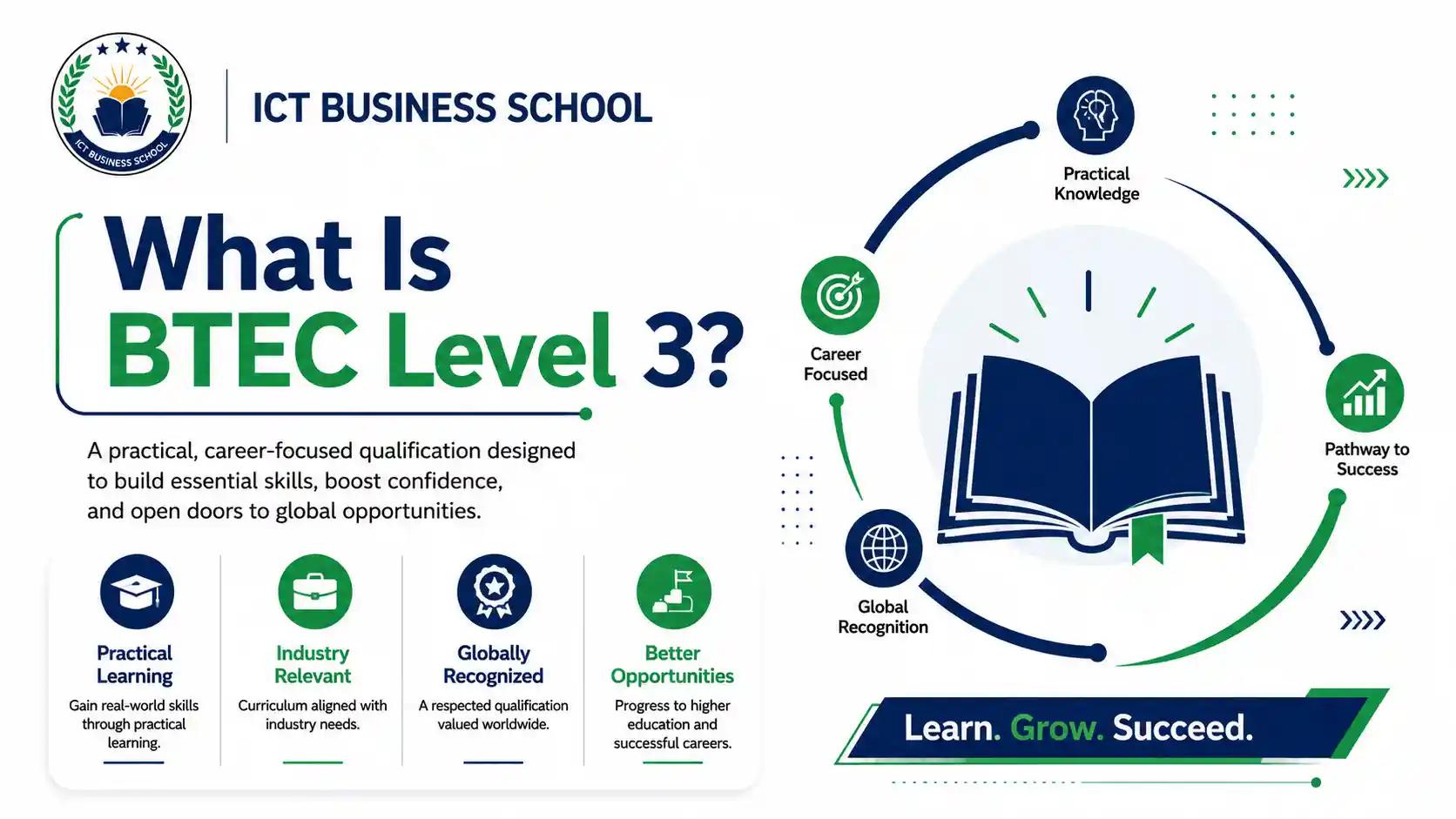
BTEC Level 3 is a vocational qualification developed by Pearson, one of the world's most recognised awarding bodies. It sits within the Regulated Qualifications Framework (RQF) at the same level as A Levels, which is why it's often called a BTEC Level 3 National.ICT Business School
Unlike traditional academic qualifications, BTEC courses focus on practical, career-focused education. Students complete coursework, assignments, and real-world projects rather than relying only on final examinations. This makes BTEC Nationals a popular choice for learners who prefer applied, hands-on learning over purely theoretical study.
BTEC Level 3 qualifications come in different sizes, including:
- BTEC Level 3 Certificate
- BTEC Level 3 Diploma
- BTEC Level 3 Extended Diploma
Subjects range widely, covering areas such as Business, IT and Computing, Engineering, Health and Social Care, Applied Science, Sport, Construction, Media, Art and Design, Performing Arts, and Travel and Tourism. You can browse available options through ICT Business School's course listings , including the Pearson BTEC Level 3 programme.ICT Business School
What Are the BTEC Level 3 Entry Requirements?
BTEC Level 3 entry requirements are set by individual colleges, so requirements forBTEC Level 3 can differ slightly from one institution to another. That said, most course entry requirements follow a similar pattern.
Typical BTEC Level 3 admission requirements include:
- Four to five GCSEs at grade 4/C or above, or an equivalent Level 2 qualification
- GCSE English and Maths, or Functional Skills Level 2 as an alternative
- A relevant Level 2 Diploma, Level 2 BTEC, or Level 2 Certificate in some cases
- Minimum age requirement, usually 16 years or above
- An interview or application form, depending on the college
Because BTEC Level 3 qualification requirements are course-specific, it's always worth checking the exact academic requirements for the subject you want to study. For example, BTEC Level 3 Engineering entry requirements may ask for a Science or Maths GCSE, while BTEC Level 3 Business entry requirements often focus more broadly on English and Maths.ICT Business School
BTEC Level 3 Entry Requirements at a Glance
| Requirement Type | Typical Expectation | Notes |
|---|---|---|
| GCSE Qualifications | 4–5 GCSEs, Grade 4/C or above | Equivalent qualifications are also accepted |
| English & Maths | GCSE or Functional Skills Level 2 | Some colleges accept alternative English/Maths evidence |
| Age | 16+ (school leavers) / No upper limit for adults | Mature students are commonly accepted |
| International Students | Equivalent overseas qualification + English proficiency | Assessed on a case-by-case basis |
| Prior BTEC/Level 2 | Level 2 Diploma or relevant vocational qualification | A useful alternative to GCSEs |
Who Is Eligible for BTEC Level 3?
BTEC Level 3 eligibility isn't limited to one type of learner. Colleges generally welcome a broad mix of applicants, including:
- School leavers progressing from GCSEs into further education
- Adults and mature students returning to study or changing career direction
- International students holding equivalent overseas academic qualifications
- Career changers who already have relevant work experience
Student eligibility criteria typically consider prior learning, academic background, and, where relevant, English language ability. Admission criteria are designed to be flexible enough that motivated learners from different educational backgrounds can access post-16 education and further education courses.
Is BTEC Level 3 Accepted in Pakistan?
Yes. BTEC Level 3 is a Pearson qualification recognised internationally, and it is widely accepted in Pakistan through approved Pearson centres. Students in Pakistan can study BTEC Level 3 as an alternative or addition to local qualifications such as O Levels or Matric, then progress into higher education or employment.
Institutions such as ICT Business School (ictbusinessschool.com) and ICT (ict.edu.pk) offer Pearson-approved BTEC pathways for Pakistani students, making it easier to access an internationally recognised vocational qualification without studying abroad. You can also review broader course options via the ICT course directory (ict.edu.pk/courses) and IDT Pakistan's course listings (idtpakistan.pk/courses).ICT Business School
What Is BTEC Level 3 Equivalent To?
BTEC Level 3 sits at the same academic level as A Levels within the UK's qualification framework. However, the two differ significantly in teaching style and assessment:
- A Levels rely mainly on final written exams
- BTEC Level 3 relies mainly on coursework, practical assignments, and continuous assessment
In terms of value, a BTEC Level 3 Extended Diploma can carry UCAS points broadly comparable to three A Levels, which is why many universities accept it for degree entry. Since grading is based on Pass, Merit, and Distinction, students with strong practical and coursework skills often perform very well.
What Is BTEC Level 3 Extended Diploma?
The BTEC Level 3 Extended Diploma is the largest BTEC Level 3 qualification, roughly equivalent in size and academic weight to three A Levels. It's designed for students who want an in-depth, career-focused programme that prepares them for either university progression or direct entry into employment.
Key features of the Extended Diploma include:
- A broader curriculum than the BTEC Level 3 Diploma or Certificate
- Strong emphasis on practical learning and career-focused education
- Recognised by universities for degree-level entry through UCAS
- Available across subjects like Business, IT, Engineering, and Health and Social Care
Students who want a smaller commitment can instead choose a BTEC Level 3 Diploma or Certificate, both of which are also explained on the Pearson BTEC Level 3 course page (ictbusinessschool.com/courses/pearson-btec-level-3).ICT Business School
BTEC Level 3 Eligibility in Pakistan: Requirements and Qualifications
BTEC Level 3 eligibility requirements in Pakistan generally mirror UK standards, adapted for local qualifications. Common entry routes include:
- Matriculation (Grade 10) with good academic standing
- O Level qualifications, particularly with English and Maths
- A relevant Level 2 vocational qualification
- Mature applicants with relevant work experience, assessed individually
Because Pearson approved centres in Pakistan set their own course-specific requirements, it's best to confirm exact entry criteria directly with the college. Why choose ICT Business School (ictbusinessschool.com/about)? The institution offers guided admissions support, so students unsure about their eligibility can get a clear answer before applying. For students wanting a structured route into higher qualifications afterward, you can also explore advanced corporate and taxation courses at ICT through the HND pathway (ictbusinessschool.com/courses/hnd-higher-national-diploma), or view the Level 7 Extended Diploma (ictbusinessschool.com/courses/level-7-extended-diploma) for postgraduate-level progression.ICT Business School
Expert Guidance
Choosing the right BTEC Level 3 pathway is easier with a few practical steps:
- Check course-specific requirements first. BTEC Level 3 Engineering and BTEC Level 3 Health and Social Care, for example, may ask for different GCSE subjects.
- Don't assume you need perfect grades. Many colleges accept equivalent qualifications, Functional Skills, or relevant experience instead of specific GCSE grades.
- Mature students should highlight experience. Work history in a related field can strengthen an application even without recent academic qualifications.
- International students should confirm equivalency early. Ask the admissions team how your local qualification maps onto UK Level 2 or Level 3 standards.
- Think about progression before you enrol. If university is the goal, check that your chosen BTEC Level 3 Diploma or Extended Diploma is accepted by your target universities via UCAS.
Speaking with an admissions advisor is often the fastest way to confirm eligibility. You can review academic support options via the ICT Business School faculty page (ictbusinessschool.com/faculty) or get in touch through the contact page (ictbusinessschool.com/contact).ICT Business School
Key Facts
- BTEC Level 3 is a Pearson-regulated qualification at the same level as A Levels.
- Typical entry requirements include 4–5 GCSEs, including English and Maths, or equivalent qualifications.
- School leavers, adults, mature students, and international students can all apply.
- BTEC Level 3 uses coursework and practical assessment rather than relying mainly on final exams.
- A BTEC Level 3 Extended Diploma can carry UCAS points comparable to three A Levels.
- BTEC Level 3 is widely accepted in Pakistan through Pearson-approved centres.
- Exact BTEC Level 3 course requirements vary by college and subject.ICT Business School
FAQs
What are the entry requirements for BTEC Level 3? Most colleges ask for 4–5 GCSEs, including English and Maths, or an equivalent Level 2 qualification.
Do you need GCSEs to study BTEC Level 3? Not always. Many colleges accept equivalent qualifications, Functional Skills, or relevant prior learning instead.
What GCSE grades are needed for BTEC Level 3? This varies by provider, but grade 4/C or above in core subjects is a common benchmark.
Can I study BTEC Level 3 without GCSEs? Yes, some students qualify through equivalent Level 2 qualifications, Functional Skills, or relevant experience.
Can adults apply for BTEC Level 3? Yes. Mature students are welcome, and prior work experience can support an application.
Can international students study BTEC Level 3? Yes, provided their qualifications are assessed as equivalent to UK Level 2 standards, often alongside English proficiency evidence.
Is BTEC Level 3 equivalent to A Levels? Yes, it sits at the same qualification level, though it's assessed mainly through coursework rather than exams.
Do BTEC Level 3 entry requirements vary by course? Yes. Subjects like Engineering or Applied Science may ask for specific GCSEs relevant to that field.
Ready to Start Your BTEC Level 3 Journey?
If you're ready to check your BTEC Level 3 eligibility, explore the full Pearson BTEC Level 3 programme (ictbusinessschool.com/courses/pearson-btec-level-3) at ICT Business School, or browse the complete course catalogue (ictbusinessschool.com/courses). Not sure if you qualify? Contact the admissions team today (ictbusinessschool.com/contact) for personalised guidance, or read more student resources on the ICT Business School blog (ictbusinessschool.com/blog).