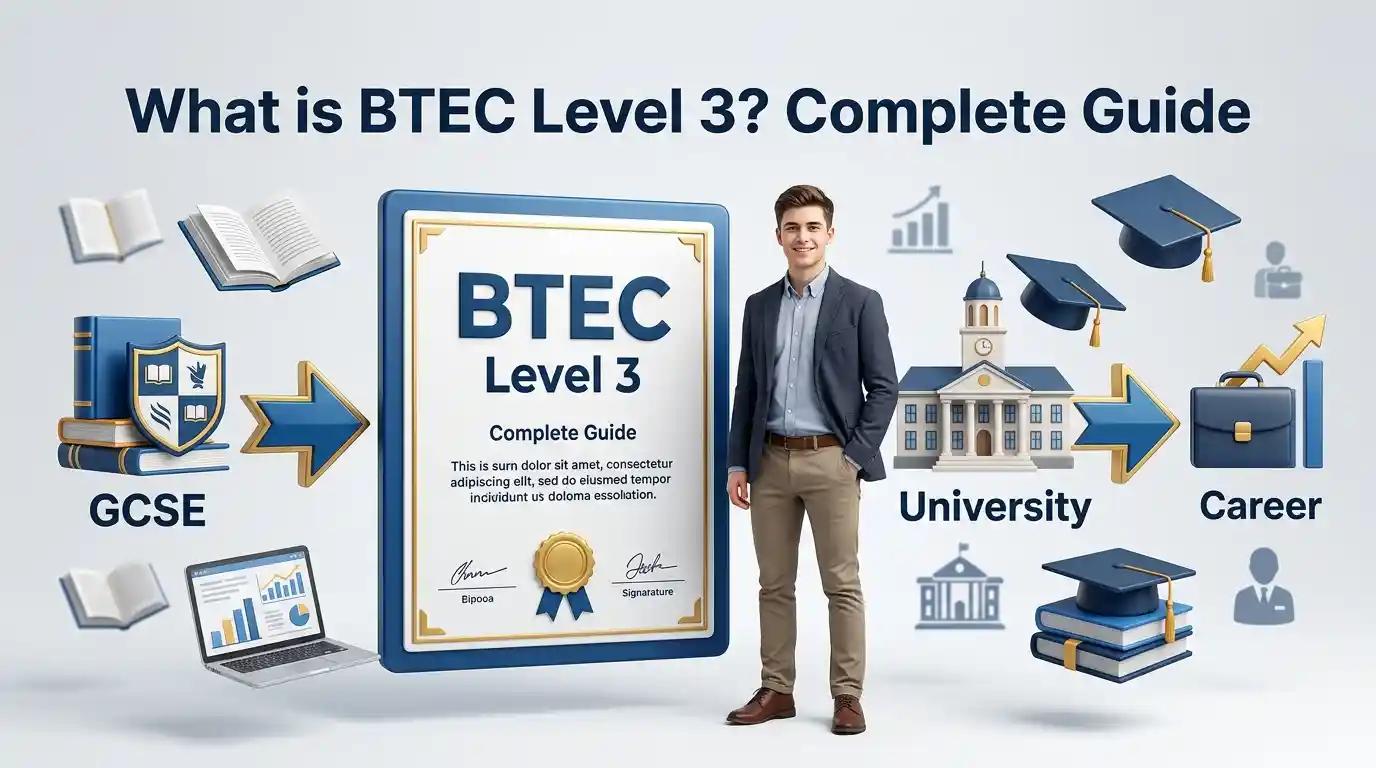
Quick answer:
BTEC Level 3 is a Pearson-awarded, vocational qualification in the UK education system, roughly equivalent to A Levels. It mixes coursework, practical assignments, and some exams, and is widely accepted by universities in the UK and abroad. Students typically take it after GCSEs/O Levels, over one to two years, in subjects like business, IT, engineering, and health and social care.
Introduction to BTEC Level 3
BTEC Level 3 is one of the most recognized vocational qualifications offered by Pearson, the UK's largest awarding body. It sits at the same level as A Levels on the UK's Regulated Qualifications Framework (RQF), but it's built around practical, skills-based learning rather than purely academic study.
Students choose BTEC Level 3 when they want hands-on, career-focused education that still keeps the door open to university. It's popular across the UK and increasingly in Pakistan, where institutes now offer Pearson BTEC programmes locally.
Understanding BTEC Level 3 Qualifications
BTEC stands for Business and Technology Education Council, though today it's simply known as Pearson BTEC. A BTEC Level 3 qualification can come in different sizes:
- BTEC Level 3 Certificate – smallest size, fewer credits
- BTEC Level 3 Diploma – equivalent to roughly one A Level
- BTEC Level 3 Extended Diploma – equivalent to roughly three A Levels
Each size carries a different number of UCAS points and suits different goals — some students combine BTEC with A Levels, while others take the Extended Diploma as a full standalone qualification.
How to Become a BTEC Level 3 Student?

Getting onto a BTEC Level 3 course is more straightforward than many people expect. Most colleges and approved Pearson centres run a simple application and interview process.
Eligibility Criteria for BTEC Level 3
Typical BTEC Level 3 entry requirements include:
- Completion of GCSEs, O Levels, or an equivalent secondary qualification
- Usually 4–5 passing grades, including English and Maths (requirements vary by centre)
- A genuine interest in a practical, vocational subject area
- Sometimes a short interview or assessment, especially for competitive courses
International students, including those applying from Pakistan, can usually join with equivalent qualifications such as Matric or O Level results, verified by the admitting institute.
BTEC Level 3 Admission Process
The admission process generally follows these steps:
- Choose a Pearson-approved centre or college
- Submit academic transcripts and an application form
- Attend an interview or counselling session (subject-dependent)
- Receive an offer and confirm enrollment
- Begin classes, usually aligned with the academic year
If you're based in Pakistan, institutes like ICT Business School's Pearson BTEC Level 3 programme (ictbusinessschool.com/courses/pearson-btec-level-3) guide students through this entire process locally, including document verification with Pearson UK.
BTEC Level 3 Course Structure
BTEC Level 3 is built around units rather than traditional subjects. Each unit focuses on a specific, practical skill area connected to the chosen field of study.
Course Structure and Syllabus
A typical BTEC Level 3 course includes:
- A set of mandatory (core) units
- A number of optional units chosen by the student or centre
- Coursework-based assignments for most units
- A smaller number of externally assessed units, which may include exams
This structure means students build a portfolio of work over time, rather than relying on one final exam to determine their entire grade.
Subjects Covered in BTEC Level 3
Pearson offers BTEC Level 3 in a wide range of subjects, including:
- Business Studies
- Information Technology / Computing
- Engineering
- Health and Social Care
- Applied Science
- Art and Design
- Sport
Among these, BTEC Level 3 Business and BTEC Level 3 IT tend to be the most popular choices in Pakistan, largely because they connect directly to corporate and tech career paths.
Duration of a BTEC Level 3 Qualification
Duration depends on the qualification size:
- Certificate: around 6–9 months
- Diploma: roughly 1 academic year
- Extended Diploma: typically 2 years, run alongside or instead of A Levels
BTEC Level 3 Assessment and Examination Structure
BTEC Level 3 doesn't rely solely on final exams. Most units are assessed through coursework, projects, and practical assignments marked against set criteria. A smaller portion of units include external assessments, which can be exam-style tests depending on the subject and qualification size.
This blended approach is one reason students who don't thrive under exam pressure often do well with BTEC — but it still demands consistent effort throughout the course, not just at the end.
BTEC Level 3 Marks Breakdown
| Subject / Unit | Exam Type | Duration | Total Marks |
|---|---|---|---|
| Business – Personal & Business Finance | Written exam (2 sections) | 2 hours | 100 marks |
| Information Technology – IT Systems | Written exam | 2 hours | 90 marks |
| Psychological Approaches | Written exam | 1 hour 30 minutes | 72 marks |
| Information Technology – Set Task | Supervised onscreen/practical task | Part A: 3 hours, Part B: 2 hours (over 2 days) | Varies by task |
BTEC Level 3 Grading System Explained
| BTEC Grade | Meaning | Approximate A Level Equivalent |
|---|---|---|
| Distinction* (D* | Outstanding performance | A* |
| Distinction (D) | Excellent performance | A |
| Merit (M) | Good performance | C |
| Pass (P) | Satisfactory performance | E |
For larger qualifications like the Extended Diploma, these grades combine across multiple units to form an overall result, which then converts into UCAS points for university applications.
Why Choose BTEC Level 3?
BTEC Level 3 appeals to students who want a qualification that's practical, career-relevant, and still respected by universities.
Key Benefits of BTEC Level 3
- Hands-on, applied learning instead of pure theory
- Coursework-based assessment reduces exam-day pressure
- Recognized by many UK and international universities
- Earns UCAS tariff points, similar to A Levels
- Builds industry-relevant skills employers value
- Flexible subject choices matched to career interests
- Internationally portable qualification, useful for students applying abroad
How BTEC Level 3 Supports Your Academic and Career Goals
Because BTEC Level 3 blends academic credit with practical skill-building, it works as a bridge in both directions. Students can progress straight into employment, move into a Higher National Diploma (HND), or apply to undergraduate degree programmes using their BTEC UCAS points.
For students aiming at business, finance, or management careers, institutes that combine BTEC with progression routes into qualifications like HND (ictbusinessschool.com/courses/hnd-higher-national-diploma) or the Pearson BTEC Level 7 Extended Diploma (ictbusinessschool.com/courses/level-7-extended-diploma) offer a clear, structured pathway from secondary education through to degree-level study.
Career Opportunities After BTEC Level 3
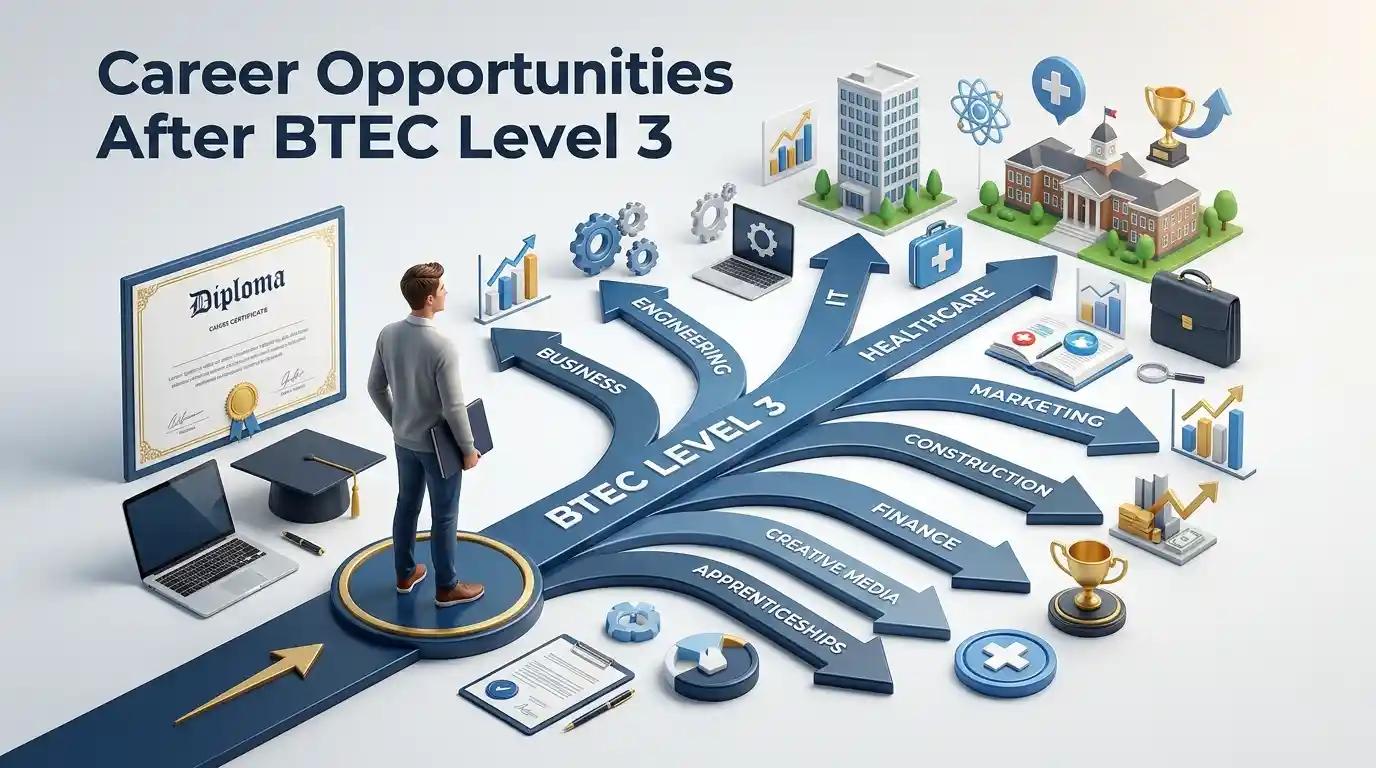
A BTEC Level 3 qualification opens several routes, depending on whether a student wants to study further or start working:
- Progress to university – many UK and international universities accept BTEC Level 3 for undergraduate entry
- Move into an HND or HNC – a natural next step for vocational learners
- Enter the workforce directly – especially in business support, IT, healthcare assistant, and engineering technician roles
- Combine with professional qualifications – such as ACCA, CA, CIA, or CMA for students aiming at finance and accounting careers
- Apply for apprenticeships – BTEC's practical focus aligns well with apprenticeship requirements
Students in Pakistan often pair BTEC Level 3 with professional finance and audit qualifications to strengthen their employability. Explore advanced corporate and taxation courses at ICT (ictbusinessschool.com/courses) for options like ACCA, CA, CIA, and CMA that build naturally on a BTEC foundation.
Expert Guidance
- Choose a subject you're genuinely interested in — BTEC's coursework-heavy structure rewards sustained engagement, not last-minute cramming.
- If university is the goal, check each target university's specific BTEC entry requirements before enrolling, since acceptance criteria vary by institution and course.
- Keep a portfolio of your assignments and projects; many BTEC students use this same work later for job applications or HND progression.
- If you're studying BTEC outside the UK, confirm the centre is Pearson-approved, so your certificate carries full international recognition.
- Pace yourself across the full course rather than focusing only on final units — grades are built cumulatively, unit by unit.
Key Facts
- BTEC Level 3 is awarded by Pearson and regulated under the UK's RQF
- It sits at the same qualification level as A Levels
- Available in Certificate, Diploma, and Extended Diploma sizes
- Graded as Pass, Merit, Distinction, or Distinction*
- Assessed mainly through coursework, with some external/exam-style units
- Earns UCAS tariff points for university applications
- Covers subjects including Business, IT, Engineering, Health and Social Care, and more
- Accepted by many universities in the UK, and recognized internationally, including in Pakistan
Final Thoughts
BTEC Level 3 is a practical, respected alternative to A Levels for students who want applied, career-focused learning without closing off university options. With clear progression routes into HND programmes, degrees, or direct employment, it's a flexible choice for post-16 education.
If you're exploring BTEC Level 3 in Pakistan, ICT Business School (ictbusinessschool.com) offers Pearson-approved BTEC Level 3 and Level 7 programmes alongside ACCA, CA, CIA, CMA, HND, and O/A Level courses. Why choose ICT Business School (ictbusinessschool.com/about)? Because it gives students a clear, structured pathway from secondary-level study right through to professional qualification — all under one roof.
Ready to start your BTEC Level 3 journey? Contact ICT Business School today (ictbusinessschool.com/contact) to speak with an admissions advisor and find the right course for your goals.
FAQs
What is BTEC Level 3 equivalent to? BTEC Level 3 is broadly equivalent to A Levels. A BTEC Level 3 Diploma is roughly equal to one A Level, while the Extended Diploma is roughly equal to three A Levels.
Is BTEC Level 3 harder than A Levels? Not harder — just different. BTEC relies more on coursework and practical assignments, while A Levels rely more heavily on final exams.
How many UCAS points is BTEC Level 3 worth? UCAS points vary by qualification size and grade achieved. Check the latest UCAS Tariff tables for exact figures, since these are updated periodically by UCAS.
Can I go to university with a BTEC Level 3 qualification? Yes. Many UK and international universities accept BTEC Level 3, particularly the Diploma and Extended Diploma, for undergraduate admission.
Is BTEC Level 3 recognized internationally? Yes. As a Pearson qualification regulated in the UK, BTEC Level 3 is recognized by many institutions and employers worldwide, including in Pakistan.
How long does it take to complete BTEC Level 3? Anywhere from 6 months (Certificate) to 2 years (Extended Diploma), depending on the qualification size chosen.
What jobs can you get with a BTEC Level 3 qualification? Entry-level roles in business support, IT, healthcare assistance, and engineering technician positions are common, alongside progression into further study.
Does BTEC Level 3 have exams?
Some units include external, exam-style assessments, but most of the qualification is assessed through coursework and practical assignments.
Conclusion
BTEC Level 3 is a smart, practical choice for students who want career-focused, hands-on learning without giving up their chances of getting into university. It offers flexibility — you can move straight into a job, progress to an HND, or use your UCAS points to apply for a degree program.
Compared to A Levels, it's not harder or easier — it just rewards a different kind of student: one who learns better through projects, coursework, and real-world application rather than sitting final exams.
If you're based in Pakistan and exploring BTEC Level 3, ICT Business School (ictbusinessschool.com) is a Pearson-approved centre offering BTEC Level 3 and Level 7 programs, along with ACCA, CA, CIA, CMA, HND, and O/A Level courses — all under one roof. This means your BTEC journey doesn't have to stop at one qualification; it can lead straight into professional and degree-level pathways.
Want to start your BTEC Level 3 journey the right way? Contact ICT Business School today (ictbusinessschool.com/contact) and speak with an admissions advisor to find the course that fits your goals.