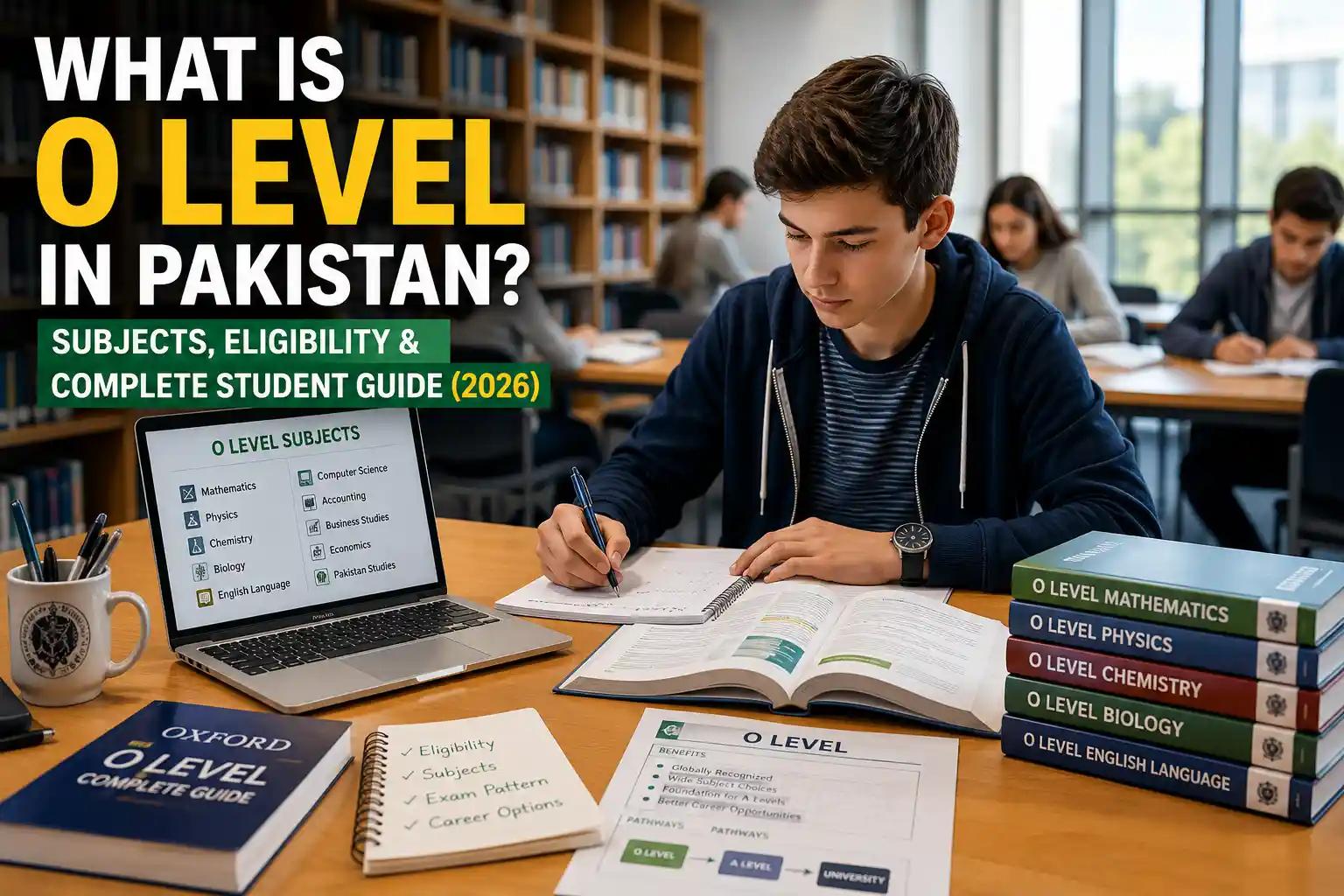
Confused about O Level and whether it's the right choice for your child? You're not alone. Every year, thousands of parents and students in Pakistan compare O Level with Matric before making one of the most important academic decisions. In this complete guide, you'll learn what O Level is, how the education system works, subject selection, grading, IBCC equivalence, career opportunities, and why many students choose O Level as a pathway to higher education and future success.
Quick Answer:
O Level (Ordinary Level) is an internationally recognized secondary school qualification offered by Cambridge Assessment International Education (CAIE). In Pakistan, it is considered equivalent to Matric (SSC) after obtaining an IBCC equivalence certificate. The O Level program typically takes 2–3 years to complete and provides students with a strong academic foundation for A Levels, local universities, and international higher education. It is one of the most popular choices for students seeking a globally recognized qualification and broader academic and career opportunities.
Introduction to O Level Education

If you're wondering what O Level is and whether it's the right choice for your child, you're not alone. Every year, thousands of students and parents in Pakistan explore the O Level education system as an alternative to Matric because of its international recognition and flexible learning approach. Offered by Cambridge Assessment International Education (CAIE), the O Level qualification provides students with a strong academic foundation, develops critical thinking and problem-solving skills, and prepares them for A Levels, university admission, and future career opportunities. In this guide, you'll learn everything you need to know about O Level in Pakistan, including its subjects, grading system, eligibility, duration, benefits, and how it compares with the Matric system.
Who Offers the O Level Qualification?
The O Level qualification is offered by Cambridge Assessment International Education (CAIE), one of the world's leading providers of international education. As part of the University of Cambridge, CAIE develops globally recognized qualifications that are accepted by schools, colleges, and universities in Pakistan and many other countries. Its curriculum is designed to develop critical thinking, problem-solving, and analytical skills, helping students build a strong academic foundation for A Levels and higher education.
Overview of O level Education
O Level is an internationally recognized secondary school qualification that serves as an alternative to the Matric system in Pakistan. The program usually takes 2 to 3 years to complete and allows students to study a range of subjects based on their interests and future academic goals. Unlike the Matric system, O Level follows a subject-based assessment approach, where each subject is examined and graded individually. After obtaining IBCC equivalence, O Level students can continue to A Levels, Intermediate, or apply for admission to universities in Pakistan, making it a flexible and widely accepted educational pathway.
What is O Level Education
Definition of O Level
O Level (Ordinary Level) is an internationally recognized secondary school qualification offered by Cambridge Assessment International Education (CAIE). It is designed for students aged 14 to 16 years and is considered equivalent to Matric (SSC) in Pakistan after obtaining IBCC equivalence. Unlike traditional education systems, O Level follows a subject-based curriculum, where each subject is assessed and graded individually. This approach helps schools, colleges, and universities evaluate a student's strengths across different subjects rather than relying on a single overall result.
Purpose of O Level Education
The primary purpose of O Level education is to develop critical thinking, analytical skills, problem-solving abilities, and conceptual understanding instead of rote memorization. The curriculum encourages students to apply their knowledge in practical situations, preparing them for A Levels, higher education, and future careers. This learner-focused approach makes O Level one of the most respected secondary education systems in Pakistan and around the world.
Who Should Choose O Level
O Level is an excellent choice for students who want an internationally recognized education and plan to continue with A Levels or pursue higher education in Pakistan or abroad. It is also suitable for students who prefer a concept-based learning approach, wish to develop strong English language and analytical skills, or want greater flexibility in choosing subjects based on their interests and future career goals. In Pakistan, many parents choose the O Level pathway because it provides a strong academic foundation and opens opportunities for admission to leading colleges and universities after obtaining the required IBCC equivalence.
How Does O Level Education System Work
Subjects Selection
One of the biggest advantages of the O Level education system is its flexibility in subject selection. Students can choose subjects based on their interests, academic strengths, and future career goals instead of following a fixed curriculum. In Pakistan, schools generally offer combinations from Science, Commerce, and Humanities, allowing students to build a study plan that supports their desired university program and career path.
Examination System
The O Level examination system is managed by Cambridge Assessment International Education (CAIE). Students are assessed through written examinations, practical exams (where applicable), coursework for selected subjects, and other assessment methods depending on the subject requirements. Cambridge conducts examinations twice each year, during the May/June and October/November sessions, through authorized examination centres across Pakistan and other countries.
Study Duration
The O Level program typically takes 2 to 3 years to complete, depending on the student's academic plan and the number of subjects selected. Most students in Pakistan begin O Levels after completing Grade 8 and finish the qualification before progressing to A Levels or other higher secondary education pathways.
Grading System
Grades range from A* to E in the O Level grading system. Here's a quick breakdown:
| Grade | Meaning |
|---|---|
| A* | Outstanding performance |
| A | Excellent performance |
| B | Very good performance |
| C | Good / minimum competitive grade for many programs |
| D | Satisfactory |
| E | Minimum passing grade |
O Level passing marks generally fall around the grade E threshold, though exact grade boundaries (the "threshold") change slightly each exam session.
Brief History of O Level
The O Level (Ordinary Level) qualification has a long history of providing internationally recognized secondary education. Originally developed in the United Kingdom, it has evolved into one of the world's most respected school qualifications through Cambridge Assessment International Education (CAIE). Today, O Level is studied by thousands of students in Pakistan and many other countries because of its high academic standards, internationally accepted curriculum, and strong preparation for higher education. Understanding the history and development of O Level helps students and parents appreciate why it is recognized by schools, colleges, and universities around the world.
Ab iske baad tumhare H3s start honge:
What are O Levels in Pakistan
O level Schools in Pakistan
O Level programs are offered by many private and international schools across Pakistan. While the highest concentration of O Level schools is found in Karachi, Lahore, and Islamabad, the qualification is also available in other major cities. These schools follow the Cambridge curriculum and prepare students for examinations conducted by Cambridge Assessment International Education (CAIE), providing an internationally recognized education alongside the requirements for IBCC equivalence in Pakistan.
Why Do Students Choose O Levels in Pakistan?
Many students and parents in Pakistan choose O Levels because of their international recognition, concept-based learning approach, and flexible subject choices. The curriculum encourages critical thinking, analytical skills, and practical understanding rather than rote memorization. O Level also provides a smooth progression to A Levels and is widely accepted by colleges and universities in Pakistan after obtaining IBCC equivalence, making it an attractive option for students planning their future education.
What is O Level Equivalent to
Matric Equivalence
In Pakistan, the O Level qualification is academically equivalent to Matric (SSC) after the IBCC issues an official equivalence certificate. Although the curriculum, teaching methods, and grading systems are different, both qualifications represent the completion of secondary education. Once the equivalence certificate is obtained, O Level students become eligible to apply for Intermediate (FSc, FA, ICS, ICom) and other higher secondary programs offered by colleges across Pakistan.
IBCC Equivalence
The Inter Board Committee of Chairmen (IBCC) is responsible for issuing equivalence certificates to O Level students in Pakistan. The IBCC converts Cambridge O Level grades into an equivalent Matric score according to its official equivalence policy. This certificate is required when applying for admission to Intermediate colleges, universities, and other educational institutions that follow Pakistan's national education system. Students should apply for the IBCC equivalence certificate after completing the required O Level subjects to avoid delays in the admission process.
Is O Level Better Then Matric

Learning Style Difference
O Level focuses on conceptual learning and application-based questions, while Matric tends to rely more on memorization and textbook-based answers.
Difficulty Level
It is considered more challenging than Matric by many students, mainly because of its analytical question style and English-medium instruction.
Career Benefits
It provides international study opportunities, since O Level (paired with A Level) is widely accepted by universities outside Pakistan, including in the UK, Canada, and Australia.
What are O Level Subjects
Compulsory Subjects
English, Mathematics, and Sciences are common core subjects across nearly all O Level subject combinations.
Science Subjects
Physics, Chemistry, and Biology are the standard science options.
Arts Subjects
History, Geography, and similar humanities subjects fall under the arts group.
Optional Subjects
Additional subjects are chosen based on student interest — Business Studies, Accounting, Computer Science, Urdu, Islamiyat, and Pakistan Studies are common picks in Pakistan.
Key Facts
- O Level subjects in Pakistan typically range from 6 to 8 subjects, though this varies by school.
- English Language and Mathematics are almost always compulsory.
- Pakistan Studies and Islamiyat (or an equivalent) are often required for IBCC equivalence.
- Students can also register as private candidates if not enrolled in a Cambridge-affiliated school.
What is O Level or A Level
O Level Explanation
O Level is a secondary education qualification, generally taken after middle school.
A Level Explanation
A Level is an advanced level qualification for higher studies, taken after completing O Levels, and is the direct gateway to university admission.
Study Pathway
The typical pathway looks like this: O Level → A Level → University admission. This is the same structure followed at institutions like ICT Business School, where students can continue their academic journey smoothly through O/A Level programs into professional qualifications.
O Level Admission Requirements
Minimum Qualification
Usually Grade 8 or 9 completion is required for O Level admission, though this depends on the individual school's policy.
Entry Test
Some schools conduct admission tests covering English, Math, and general aptitude before granting admission.
English Requirement
Basic English proficiency is needed, since the entire curriculum and exams are conducted in English.
Subject Selection
Students choose subjects based on career goals — for example, those aiming for engineering typically take Physics, Chemistry, and Additional Mathematics.
Expert Advice
Choosing between O Level and Matric is one of the most important academic decisions for students and parents in Pakistan. Before selecting the O Level pathway, evaluate the student's learning style, academic strengths, future career goals, and university plans rather than following trends. O Level is particularly suitable for students who enjoy concept-based learning, critical thinking, and an internationally recognized curriculum.
Students should carefully choose their O Level subjects based on the field they want to pursue in the future, such as Medicine, Engineering, Business, Computer Science, or Social Sciences. It is also important to understand the IBCC equivalence process early, as the equivalence certificate is required for admissions to many colleges and universities in Pakistan.
Parents should select a school that offers experienced Cambridge teachers, strong academic support, and proper career counselling. Students are encouraged to maintain consistent study habits, participate in extracurricular activities, and develop communication and analytical skills alongside their academics, as these qualities are highly valued by colleges and universities.
If you are planning to enroll in an O Level program and need guidance on admissions, subject selection, or future academic pathways, ICT Cambridge School can help you choose the right direction based on your educational goals.
Courses at ICT Business School
For students who complete O Levels and want a clear path forward — whether academic or professional — ICT Business School offers a strong lineup of options:
- O/A Levels — for students continuing their Cambridge pathway
- HND (Higher National Diploma) in Business — a practical, internationally recognized business qualification
- Pearson BTEC Level 3 — equivalent to A Level standard, ideal after O Levels
- Pearson BTEC Level 7 Extended Diploma — a postgraduate-level professional qualification
- ACCA — for students aiming for a career in accounting and finance
- CA (ICAP pathway) — Pakistan's premier chartered accountancy route
- CIA (Certified Internal Auditor) — for internal audit specialization
- CMA (Certified Management Accountant) — for management accounting careers
Why choose ICT Business School? Because it bridges the gap between school-level qualifications like O Levels and globally recognized professional certifications, all under one roof. You can explore advanced corporate and taxation courses at ICT to see the full range of programs available after O/A Levels.
How to Learn (Free + Paid Options)
Free options:
- Past papers and syllabus documents from Cambridge's official resources
- YouTube channels covering O Level Physics, Chemistry, Biology, and Maths topic by topic
- Free introductory courses on platforms like Coursera for supplementary skills (study techniques, English writing, basic computing)
Paid options:
- Enrolling in a recognized O Level school or academy
- Hiring a subject tutor for weaker areas like Mathematics or Chemistry
- Structured coaching centers that specialize in Cambridge exam preparation
For students looking at what comes after O Levels, ICT Business School's courses page and the HND program details are good starting points to plan the next academic step.
Career Opportunities
After completing O Levels, students can choose different academic pathways based on their interests and long-term career goals.
- Accounting & Finance: Continue with A Levels and then pursue professional qualifications such as ACCA, CA, or CMA to build a career in accounting, finance, auditing, taxation, and corporate management.
- Business & Management: Study A Levels, Pearson BTEC, or Higher National Diploma (HND) before progressing to undergraduate and postgraduate degrees in business, marketing, management, or entrepreneurship.
- Computer Science & Technology: Choose subjects related to mathematics and computer science before pursuing degrees in software engineering, artificial intelligence, cybersecurity, or data science.
- Engineering & Medical Sciences: Select the appropriate science subjects in O Levels and A Levels to qualify for engineering, medical, pharmacy, and other healthcare-related degree programs.
- University Admissions: O Level students who complete the required IBCC equivalence can apply to colleges and universities in Pakistan and continue their higher education through recognized academic pathways.
Finance & Accounting — via ACCA, CA, or CMA after A Levels - Business Management — via HND or BTEC Level 7
- Internal Audit — via CIA certification
- International University Admission — using O Level + A Level as the academic foundation
- Corporate Sector Roles — many multinational companies in Pakistan prefer candidates with a Cambridge academic background combined with a professional certification
FAQs
What is O Level in simple words? O Level is a secondary school qualification from Cambridge, taken instead of or alongside Matric, where each subject is graded separately.
Is O Level equal to Matric? Not exactly equal, but IBCC treats it as equivalent to Matric (Grade 9–10) for admission purposes in Pakistan.
How many subjects are in O Levels? Most students take between 6 and 8 subjects, though this can vary by school.
What is the age for O Level students? Most students start O Level around age 14–15, after completing Grade 8 or 9.
Is O Level difficult or easy? It's generally considered more conceptually demanding than Matric, but manageable with consistent preparation.
Which board conducts O Level exams? Cambridge Assessment International Education conducts and certifies O Level exams globally.
What comes after O Levels? Students typically move to A Levels, and from there to university or professional courses like ACCA, CA, HND, or BTEC.
Is O Level accepted in universities? Yes, both in Pakistan (with IBCC equivalence) and internationally, especially when paired with A Levels.
Conclusion
O Level offers a strong, internationally recognized foundation for students who want more than just a local Matric certificate — it builds analytical thinking, opens doors to A Levels, and sets up a smoother path toward global universities and professional careers. Whether you're still deciding on subjects or already planning what comes after O Levels, the right next step matters.
Ready to plan your academic future? Contact ICT Business School today to explore O/A Level programs, HND, BTEC, ACCA, CA, CIA, and CMA pathways — all designed to take you from school straight into a recognized professional career. Visit our courses page or check out our blog for more guidance on choosing the right path after O Levels.