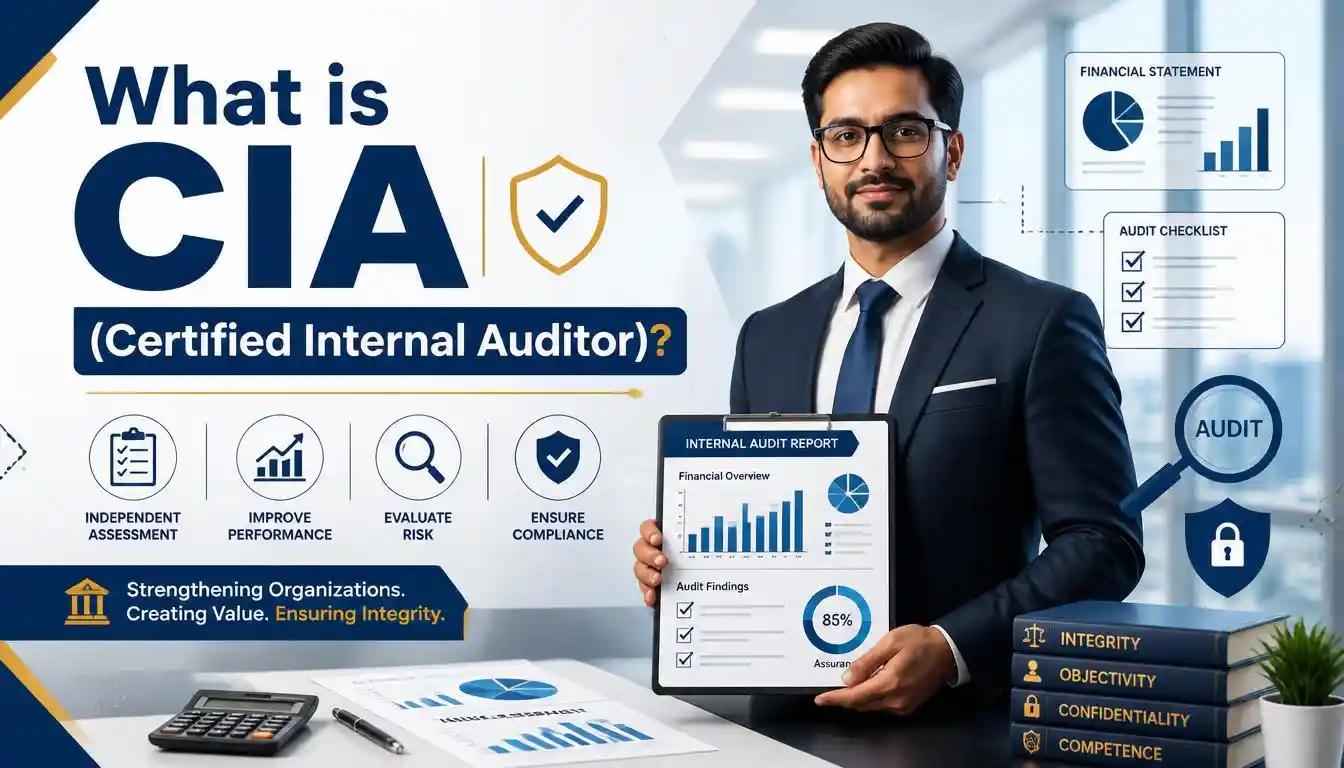
CIA (Certified Internal Auditor) is the world's only globally recognized certification for internal auditors, awarded by the Institute of Internal Auditors (IIA). It validates your expertise in internal auditing, risk management, corporate governance, and financial control systems — and is respected by employers in over 170 countries. ICT Business School
Key Facts
- Full name: Certified Internal Auditor (CIA)
- Awarding body: Institute of Internal Auditors (IIA), USA
- Parts: 3 exam parts (Part 1, Part 2, Part 3)
- Exam format: Multiple Choice Questions (MCQs) — Computer-Based
- Eligibility: Bachelor's degree + internal audit work experience
- Duration: 1–3 years depending on study pace
- Recognized in: 170+ countries globally
- Pass rate: Approximately 40–50% per part (competitive but achievable)
- Salary after CIA: PKR 80,000–300,000/month in Pakistan; USD 70,000–120,000/year in USA
- Best for: Internal auditors, compliance officers, risk managers, governance professionals
What is CIA?
CIA stands for Certified Internal Auditor. It is the premier, globally recognized professional certification in the field of internal auditing, issued by the Institute of Internal Auditors (IIA) — the global authority on internal audit standards and practices.
The CIA certification validates that a professional possesses the knowledge, skills, and judgment required to carry out effective internal auditing in any organization, anywhere in the world. It covers everything from risk-based auditing and corporate governance to fraud detection auditing, compliance auditing, and financial control systems.
Unlike country-specific qualifications, the CIA is a truly international credential. Whether you are working in Pakistan, India, the UAE, the UK, or the USA — the CIA certification carries the same weight and recognition.
ICT Business School
How to Become a CIA
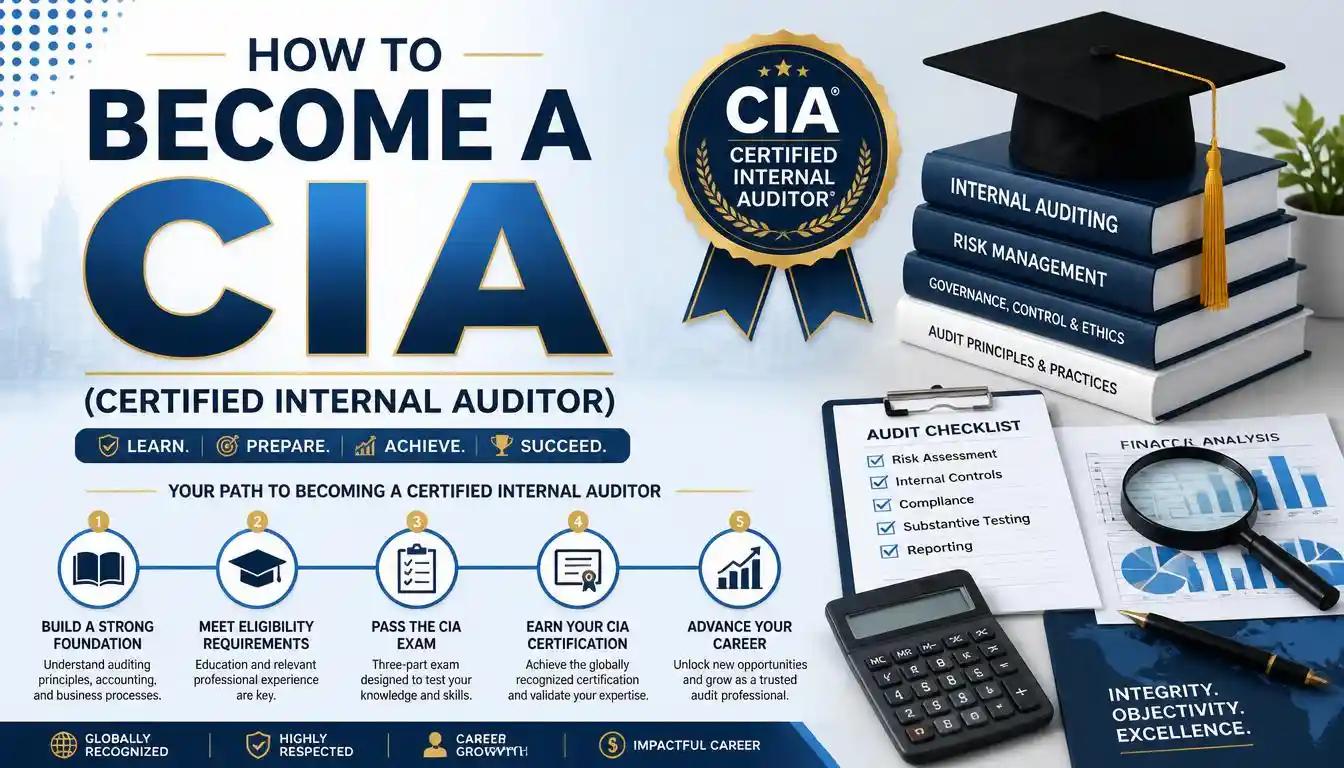
Becoming a Certified Internal Auditor is a structured process. You need to meet eligibility criteria, pass three exam parts, and fulfill a work experience requirement.
Here is the step-by-step path:
- Check your eligibility — confirm your educational and professional qualifications
- Register with the IIA — create an account at the IIA global portal
- Apply for the CIA program — submit academic transcripts and experience documentation
- Schedule and sit your exams — Part 1, Part 2, and Part 3 (in any order, though Part 1 is recommended first)
- Complete work experience — 24 months of internal audit experience (or 12 months with a postgraduate degree)
- Receive your CIA certification — awarded upon passing all three parts and verifying experience
CIA Course Overview — CIA Internal Audit Basics
The CIA course is not a taught program in the traditional sense. It is a self-study, exam-based professional certification administered by the IIA. Candidates prepare using official IIA study materials, approved review courses, and CIA exam prep resources.
However, many professionals and students enroll in structured CIA preparation courses at institutes like ICT Business School (www.ictbusinessschool.com/courses) to benefit from guided study, structured timetables, FIA mock exams, and expert faculty support.
The CIA course covers the core disciplines of internal auditing — giving candidates a deep understanding of assurance services, fraud risk management, internal audit standards, and financial compliance — all aligned with the Global Internal Audit Standards set by the IIA.
For students in Pakistan, CIA coaching centers in Islamabad, Rawalpindi, Lahore, and Karachi offer both in-person and online CIA preparation. For self-study guidance, you can also supplement your preparation with free resources on platforms like Coursera (www.coursera.org).
CIA Eligibility
Understanding CIA certification requirements before applying saves time and prevents costly mistakes. ICT Business School
Educational Requirements
To sit the CIA exam, candidates must hold one of the following:
- A Bachelor's degree (or equivalent) from an accredited university in any discipline
- A postgraduate degree — reduces required work experience from 24 months to 12 months
- Students without a degree may still apply but must have 5 years of verified internal audit experience as an alternative pathway
Importantly, your degree does not need to be in accounting or finance. Many CIA candidates come from law, IT, business administration, and engineering backgrounds — because the CIA covers governance and risk broadly, not just financial accounting.
Work Experience Requirements
The CIA certification requires verified internal audit experience:
- 24 months of internal audit experience — for Bachelor's degree holders
- 12 months of internal audit experience — for postgraduate degree holders
- Experience must be verified by a CIA-certified supervisor or your organization's chief audit executive
Work experience can be completed before or after passing the exams. This gives candidates flexibility — you can start studying and sitting exams while building your experience simultaneously.
Who Can Apply for CIA
The CIA certification is open to a wide range of professionals:
- Fresh graduates aiming to enter the internal audit profession
- Working professionals in internal audit, compliance, and risk management
- Finance and accounting professionals seeking to specialize in auditing
- IT and operations professionals moving into audit roles
- ACCA, CA, CMA, and CPA holders who want an additional specialist audit credential
Note: ACCA members may be eligible for the CIA Challenge Exam — a fast-track route that reduces the number of parts required. Contact the IIA or your local approved learning provider for current CIA challenge exam eligibility and study material details.
CIA Syllabus
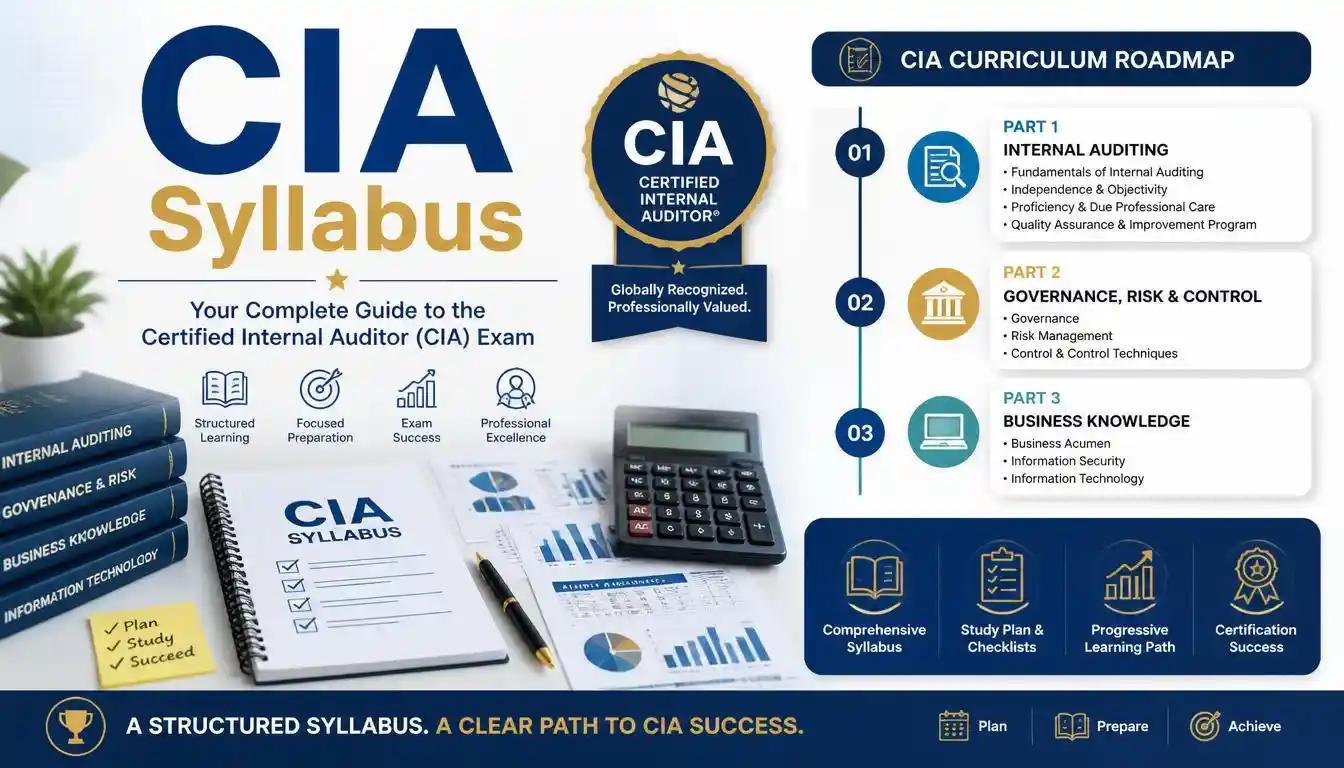
The CIA exam syllabus is divided into three parts, each covering a distinct area of internal auditing knowledge and practice.
Syllabus Overview — Foundations of Internal Auditing
Part 1 is the foundational paper. It covers:
- Mandatory guidance of the International Professional Practices Framework (IPPF)
- Independence and objectivity of the internal auditor
- Proficiency and due professional care
- Quality assurance and improvement programs
- Governance, risk management, and control concepts
- Fraud risks and controls. ICT Business School
This is the recommended starting point for all CIA candidates. It establishes the conceptual framework that underpins everything in Parts 2 and 3.
Syllabus Overview — Practice of Internal Auditing
Part 2 moves from theory to practical application. It covers:
- Managing the internal audit activity
- Planning the engagement
- Performing the engagement
- Communicating engagement results
- Monitoring progress and resolution of management responses
- Risk-based audit planning and execution
Part 2 is considered the most practical of the three parts and is highly relevant for professionals already working in internal audit roles.
Syllabus Overview — Business Knowledge for Internal Auditing
Part 3 covers the broader business and technical knowledge an internal auditor must possess. It includes:
- Business acumen (organizational structures, corporate governance, business processes)
- Information technology and data analytics
- Financial management and accounting concepts
- Risk management frameworks
- Global audit standards and regulatory environments
Part 3 is often considered the most academically demanding — particularly for candidates without a strong business or finance background. ICT Business School
CIA Technical Areas
The CIA certification goes beyond traditional financial auditing. It demands competency across several technical disciplines that reflect the modern internal auditor's expanded role.
Financial and Operational Auditing
This covers the review and assessment of financial statements, internal controls over financial reporting, and operational processes for efficiency and effectiveness. Candidates learn to evaluate whether an organization's financial control systems are functioning correctly and whether operational activities align with organizational objectives.
Topics include:
- Financial statement analysis
- Revenue and expenditure cycle auditing
- Fixed asset auditing
- Payroll and HR audit procedures
- Operational performance measurement
Risk Management and Governance
Risk management and governance sit at the core of the CIA qualification. Internal auditors are expected to understand and evaluate an organization's risk management frameworks, including how risks are identified, assessed, mitigated, and monitored.
Key areas include:
- Enterprise Risk Management (ERM)
- Corporate governance structures and responsibilities
- Board and audit committee relationships
- Regulatory and legal compliance frameworks
- Ethical governance and integrity in organizations
This section directly aligns with the Global Internal Audit Standards and the IIA's three lines of defense model — a framework used by virtually every major corporation and government institution worldwide.
Internal Control Systems
Internal control is the mechanism through which organizations prevent errors, detect fraud, and ensure compliance. CIA candidates must understand control frameworks such as COSO and how to evaluate them in practice.
Topics include:
- COSO Internal Control Framework
- Control environment assessment
- Segregation of duties
- Authorization and approval controls
- Control testing and evaluation
- Reporting on control deficiencies. ICT Business School
IT and Data Systems
Modern internal auditors must be comfortable with technology. The CIA syllabus recognizes this and dedicates significant coverage to IT audit and data analytics.
Topics include:
- IT general controls and application controls
- Cybersecurity audit concepts
- Data analytics in auditing
- Systems development life cycle (SDLC) review
- Cloud computing risks and controls
- Business continuity and disaster recovery auditing
CIA Exams
Exam Structure
| Part | Title | Number of Questions | Time Allowed |
|---|---|---|---|
| Part 1 | Foundations of Internal Auditing | 125 MCQs | 2.5 hours |
| Part 2 | Practice of Internal Auditing | 100 MCQs | 2 hours |
| Part 3 | Business Knowledge for Internal Auditing | 100 MCQs | 2 hours |
All three parts are independent. Candidates can sit them in any order, though the IIA recommends starting with Part 1. Once you pass a part, that result is valid for 3 years — giving you time to complete the remaining parts.
Exam Format — MCQs and Duration
The CIA exam is entirely multiple choice (MCQ) — no written answers, no case studies, no calculations beyond basic analysis. This makes the format more predictable than some other professional qualifications, but the depth of knowledge required should not be underestimated.
- Format: Computer-based testing (CBT) at Pearson VUE centres worldwide
- Question style: Scenario-based MCQs testing application of knowledge, not just recall
- CIA exam centres in Pakistan: Available in Karachi, Lahore, Islamabad, and other major cities
- Scheduling: On-demand — sit when you are ready, no fixed exam windows
Passing Criteria and Difficulty Level
- Passing score: 600 out of 750 (scaled score)
- Pass rate: Approximately 40–50% per part globally
- Difficulty: Moderate to high — Part 1 and Part 3 are generally considered the most challenging
- Retake policy: Candidates may retake failed parts; a retake fee applies
Is the CIA certification hard? Yes — but with a structured CIA study plan, quality CIA exam study materials, and consistent preparation over 3–6 months per part, passing on the first attempt is realistic. Many successful CIA candidates at ICT Business School achieve this with proper coaching.
Expert Guidance
Here is practical advice from CIA-qualified professionals and tutors:
- Start with Part 1. It gives you the conceptual foundation that makes Parts 2 and 3 easier to understand.
- Use official IIA review materials — the IIA's own CIA Learning System is the most exam-aligned resource available.
- Practice scenario-based questions daily. CIA MCQs test application, not just memory. Doing 30–50 practice questions per day is the single most effective preparation habit.
- Do not underestimate Part 3. Many candidates pass Parts 1 and 2 but struggle with Part 3 because it requires broad business knowledge. Allocate extra preparation time for it.
- Study in focused blocks. 90-minute study sessions with short breaks outperform marathon cramming sessions. Consistency over months beats intensity over days.
- Build your experience simultaneously. If you are already working in audit, compliance, or finance — your daily work IS your CIA preparation. Connect what you study to what you do.
CIA Certification Cost in Pakistan and Globally
| Fee Component | Amount (USD) | Approximate PKR |
|---|---|---|
| IIA Membership Fee | USD 45–245 | PKR 12,000–70,000 |
| CIA Application Fee | USD 115 | PKR 32,000 |
| Exam Fee per Part (Member) | USD 200–250 | PKR 56,000–70,000 |
| Exam Fee per Part (Non-Member) | USD 280–370 | PKR 78,000–104,000 |
| Total Estimated Cost | USD 900–1,500 | PKR 250,000–420,000 |
IIA membership significantly reduces exam fees. Joining as a student or professional member before registering for exams is strongly recommended to reduce your CIA certification cost in Pakistan.
CIA Career Opportunities and Salary
Job Opportunities After CIA
The CIA job opportunities are extensive and span virtually every industry sector:
- Internal Auditor / Senior Internal Auditor
- Audit Manager / Chief Audit Executive
- Risk and Compliance Officer
- Fraud Investigations Specialist
- IT Auditor
- Financial Controls Analyst
- Governance, Risk and Compliance (GRC) Consultant
- Internal Audit Director. ICT Business School
Conclusion
The CIA (Certified Internal Auditor) certification is one of the most valuable professional credentials available to anyone pursuing a career in internal auditing, risk management, corporate governance, or compliance. It is the only globally recognized internal audit certification and carries real weight with employers in Pakistan, the UAE, the UK, the USA, and beyond.
Whether you are a fresh graduate planning your career, a working professional looking to accelerate your progression, or an ACCA or CA holder seeking a specialist audit credential — the CIA qualification gives you the knowledge, credibility, and competitive edge that today's audit and risk employers are actively looking for.
With structured preparation, the right study materials, and expert guidance from a trusted institution like ICT Business School, passing the CIA exam and building a high-value audit career is well within your reach.
Your journey into professional internal auditing starts with a single step. Take it today.
Explore CIA and all courses at ICT Business School: www.ictbusinessschool.com/courses Contact ICT Business School: www.ictbusinessschool.com/contactcertified professionals are in demand across banking and financial services, manufacturing, government and public sector, healthcare, telecom, energy, and multinational corporations.
CIA Salary Pakistan And Abroad
| Location | Entry-Level | Mid-Level | Senior / Manager |
|---|---|---|---|
| Pakistan | PKR 80,000–120,000/month | PKR 150,000–250,000/month | PKR 300,000+/month |
| UAE / Dubai | AED 8,000–15,000/month | AED 18,000–28,000/month | AED 35,000+/month |
| USA | USD 60,000–75,000/year | USD 85,000–105,000/year | USD 120,000+/year |
| UK | GBP 40,000–55,000/year | GBP 60,000–80,000/year | GBP 90,000+/year |
The CIA certification consistently commands a salary premium of 20–35% over non-certified internal auditors at every level. This makes the CIA certification worth it from a pure return-on-investment perspective.
CIA vs ACCA Quick Comparison
| Feature | CIA | ACCA |
|---|---|---|
| Focus | Internal Auditing | Broad Accounting & Finance |
| Awarding Body | IIA (USA) | ACCA (UK) |
| Number of Exams | 3 Parts | Up to 13 Papers |
| Best For | Internal Auditors | Finance, Audit, Accounting Careers |
| Global Recognition | 170+ countries | 180+ countries |
| Pakistan Popularity | Growing fast | Very High |
Why Choose ICT Business School for CIA?
ICT Business School (www.ictbusinessschool.com) is one of Pakistan's most trusted institutes for professional accounting and audit qualifications. Based in Rawalpindi and serving students from across Pakistan, ICT offers structured CIA preparation alongside a full suite of professional programs.
At ICT Business School, CIA students benefit from:
- Expert faculty with CIA-certified tutors — www.ictbusinessschool.com/faculty
- Structured study plans aligned with the IIA CIA exam syllabus
- CIA mock exams, practice questions, and revision sessions
- Guidance on IIA registration, exam booking, and challenge exam eligibility for ACCA members
- Flexible CIA online classes and recorded lectures for working professionals
ICT also offers a full range of complementary qualifications:
- ACCA — internationally recognized accounting qualification; explore at www.ictbusinessschool.com/courses
- CA (ICAP pathway) — Pakistan's chartered accountancy qualification
- CMA — management accounting professional certification
- HND (Higher National Diploma) — Pearson business diploma: www.ictbusinessschool.com/courses/hnd-higher-national-diploma
- Pearson BTEC Level 3 — www.ictbusinessschool.com/courses/pearson-btec-level-3
- Pearson BTEC Level 7 — www.ictbusinessschool.com/courses/level-7-extended-diploma
- O Level and A Level programs — www.ictbusinessschool.com/courses/o-level-program
Read about ICT Business School's values and teaching philosophy at www.ictbusinessschool.com/about, or explore the latest study tips and career guides at www.ictbusinessschool.com/blog.
For additional resources and professional consultancy, visit ict.edu.pk and bacoconsultants.com.
Frequently Asked Questions (FAQs)
What is CIA certification? CIA stands for Certified Internal Auditor — the world's only globally recognized professional certification for internal auditors, awarded by the Institute of Internal Auditors (IIA). It covers internal auditing, risk management, governance, fraud detection, and financial controls.
Who is eligible for the CIA exam? Candidates need a Bachelor's degree (or higher) from an accredited university and 24 months of internal audit work experience (12 months if postgraduate). Fresh graduates can begin studying and sitting exams while building their experience concurrently.
How many papers are in the CIA exam? The CIA certification has 3 exam parts: Part 1 (Foundations of Internal Auditing), Part 2 (Practice of Internal Auditing), and Part 3 (Business Knowledge for Internal Auditing). All are MCQ-based and computer-based.
Is CIA certification hard? Yes — the CIA pass rate is approximately 40–50% per part globally. Part 1 and Part 3 are considered the most challenging. However, with a structured study plan, official IIA materials, and consistent practice over 3–6 months per part, passing on the first attempt is very achievable.
How much does CIA certification cost in Pakistan? The total CIA certification cost in Pakistan is approximately PKR 250,000–420,000 for all three parts including IIA membership, application fees, and exam fees. IIA membership reduces exam fees significantly and is strongly recommended.
What is the salary after CIA certification in Pakistan? CIA certified professionals in Pakistan earn PKR 80,000–120,000/month at entry level, rising to PKR 150,000–250,000/month at mid-level and PKR 300,000+ at senior and management level.
Is CIA better than CPA? It depends on your career goal. CIA is the best choice for internal auditing, risk management, and governance roles globally. CPA is better suited for public accounting and taxation careers primarily in the USA. For broad international finance careers, ACCA is also a strong option.
How long does CIA certification take? Most candidates complete all three parts of the CIA within 1.5 to 3 years. With intensive preparation and a focused study plan, some candidates complete all parts within 12–18 months.
Conclusion
The CIA (Certified Internal Auditor) certification is one of the most valuable professional credentials available to anyone pursuing a career in internal auditing, risk management, corporate governance, or compliance. It is the only globally recognized internal audit certification and carries real weight with employers in Pakistan, the UAE, the UK, the USA, and beyond.
Whether you are a fresh graduate planning your career, a working professional looking to accelerate your progression, or an ACCA or CA holder seeking a specialist audit credential — the CIA qualification gives you the knowledge, credibility, and competitive edge that today's audit and risk employers are actively looking for.
With structured preparation, the right study materials, and expert guidance from a trusted institution like ICT Business School, passing the CIA exam and building a high-value audit career is well within your reach.
Your journey into professional internal auditing starts with a single step. Take it today.
Explore CIA and all courses at ICT Business School: www.ictbusinessschool.com/courses Contact ICT Business School: www.ictbusinessschool.com/contact