
What if you could unlock strong management skills without committing to a full Master’s degree?
Quick Answer:
A Postgraduate Diploma in Business is an advanced qualification for bachelor's degree holders who want specialised business management skills without the full time and cost of an MBA. It usually takes 6–12 months, focuses on practical coursework over theory, and often serves as a direct pathway into an MBA or Master's degree.
Key Facts
- A Postgraduate Diploma in Business is studied after a Bachelor's degree.
- Duration is typically 6 months to 1 year, much shorter than a 2-year MBA.
- Assessment relies on assignments, case studies, presentations, and reports rather than a dissertation.
- It is roughly equivalent to Master's-level study in terms of academic depth, though it is not a full Master's degree.
- Costs are generally lower than an MBA, making it a practical alternative for working professionals.
- Many graduates use it as a stepping stone into an MBA or Master's in Business Management.
- Common specialisations include finance, marketing, HR, operations, and business strategy.
What is a Postgraduate Diploma in Business?
A Postgraduate Diploma in Business is a graduate-level qualification designed for people who already hold a Bachelor's degree and want focused, practical training in business management. It sits between a Bachelor's degree and a full Master's degree in terms of depth and duration.
Course Overview
The programme covers core business functions — management, finance, marketing, HR, and operations — through applied learning rather than heavy academic theory. Most courses combine classroom teaching with real-world case studies and group projects.
Qualification Level
A Postgraduate Diploma in Business generally sits at postgraduate level, comparable in academic demand to the early stages of a Master's degree or MBA, though it does not carry the same credit weight as a full Master's programme and typically excludes a dissertation.
Why Choose a Postgraduate Diploma in Business?
Key Reasons to Choose This Qualification
- You want postgraduate-level business knowledge without a 2-year commitment.
- You're a working professional who needs flexible, part-time study options.
- You want to test postgraduate study before committing to a full MBA.
- You're looking for a more affordable alternative to a Master's degree.
Benefits of a Postgraduate Diploma in Business
- Faster route into management-level roles.
- Lower tuition cost compared to MBA and Master's programmes.
- Practical, job-ready skills rather than purely academic theory.
- Recognised entry pathway into MBA and Master's in Business Management programmes at many universities.
- Builds core skills in leadership, decision making, and business communication.
Is a Postgraduate Diploma in Business Worth It?

Career Value
For most working professionals, yes — a Postgraduate Diploma in Business adds real career value by building management-level skills quickly, without pausing a career for two years. It's particularly useful for graduates who want to move from technical or junior roles into management.
Salary Potential
Salary after a Postgraduate Diploma in Business varies by role, industry, and location. Business analysts, marketing managers, HR managers, and operations managers with this qualification typically earn more than candidates with only a Bachelor's degree, though exact figures depend heavily on the employer and market.
Long-Term Career Growth
Many professionals use the diploma as a foundation and later progress to an MBA or specialised Master's degree, building a stronger academic and professional profile over time.
What Subjects Are Covered in a Postgraduate Diploma in Business?
| Subject Area | What It Covers |
|---|---|
| Business Management | Core management principles, planning, and organisational behaviour |
| Marketing | Digital marketing, consumer behaviour, brand strategy |
| Finance | Financial analysis, budgeting, and corporate finance basics |
| Human Resource Management | Recruitment, performance management, workplace policy |
| Operations Management | Supply chain, process efficiency, and quality management |
| Business Strategy | Strategic planning, competitive analysis, and decision-making |
| Business Communication | Professional writing, presentations, negotiation, and interpersonal communication skills |
Business Management
Covers planning, organising, and leading teams within a business environment.
Marketing
Focuses on market research, digital marketing, and brand positioning.
Finance
Introduces budgeting, financial statements, and investment basics for managers.
Human Resource Management
Builds skills in recruitment, employee relations, and performance management.
Operations Management
Covers supply chain management, process improvement, and quality control.
Business Strategy
Teaches strategic decision-making and competitive business planning.
Business Communication
Develops professional writing, presentation, and negotiation skills needed in management roles.
Who Can Apply?
Eligibility Requirements
Applicants generally need a recognised Bachelor's degree in any field; some institutes also consider relevant work experience for mature applicants.
Bachelor's Degree Requirement
A Bachelor's degree (typically 14–16 years of education) from a recognised university is the standard minimum entry requirement.
English Language Requirements (for International Students)
International applicants usually need to demonstrate English proficiency equivalent to CEFR B2 level, either through prior education in English or an approved language test.
Course Duration and Assessment
Course Length
Most Postgraduate Diploma in Business programmes run for 6 months to 1 year, depending on the institute and study mode.
Full-Time vs Part-Time
Full-time study is faster and more intensive, while part-time options allow working professionals to study alongside their jobs, usually extending the timeline by a few months.
Assignments
Written assignments are the core assessment method, testing applied understanding of business concepts.
Exams
Some institutes include short written exams for core subjects, though most modern Postgraduate Diploma programmes rely more heavily on coursework than formal exams.
Presentations
Students often present business proposals or case analyses to demonstrate communication and strategic thinking skills.
Group Projects
Collaborative projects simulate real workplace teamwork and problem-solving.
Case Studies
Real business scenarios are analysed to apply theoretical concepts practically.
Research Reports
Some units require short research-based reports on industry trends or business challenges, though a full dissertation is not typically required.
Career Opportunities and Further Study
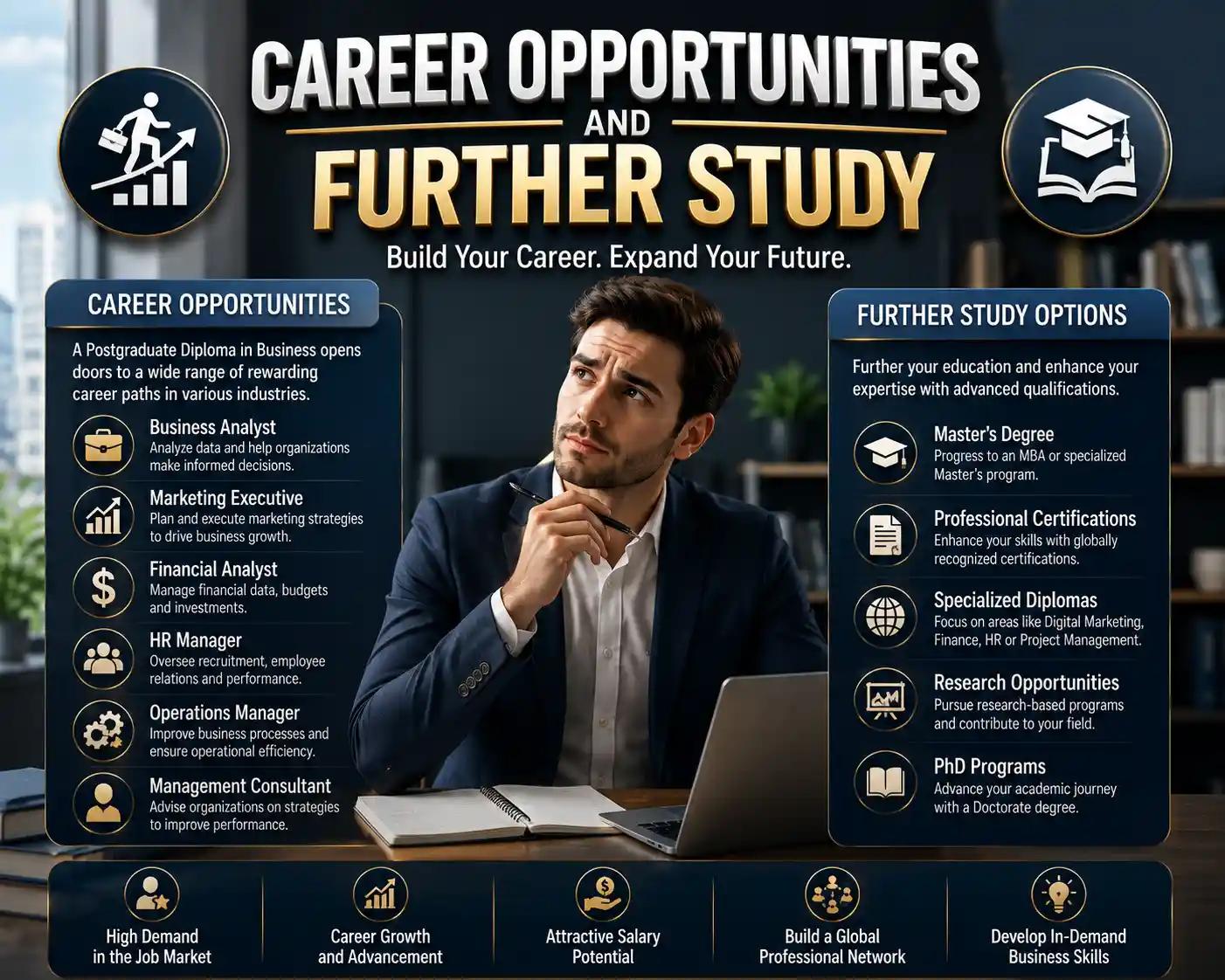
Career Opportunities
Graduates commonly move into roles such as business analyst, marketing manager, HR manager, operations manager, project manager, and business consultant.
Further Study Options benefits
A Postgraduate Diploma in Business is widely accepted as a pathway qualification, with many universities offering direct or advanced entry into MBA and Master's in Business Management programmes based on diploma results.
Expert Guidance
Based on ICT Business School's experience in guiding students towards management careers, a Postgraduate Diploma in Business is one of the most practical options for graduates and working professionals who want to develop management skills without committing to the time and cost of a full MBA from the start.
One of the key recommendations from ICT Business School is to look beyond the course content before enrolling. Always check whether the diploma is offered through a recognised institution and whether it has clear university progression pathways for MBA or Master's programmes. In our experience, this single factor can make a significant difference to your future academic opportunities and career growth.
ICT Business School also encourages students to think about their long-term career goals before selecting a specialisation. If you plan to work in leadership or general management, choose a business pathway that develops strategic and decision-making skills. If your career is focused on areas such as marketing, finance, human resources, or operations, selecting a relevant specialisation will help you gain industry-specific knowledge that employers value. Taking the time to choose the right qualification and pathway at the beginning can create better opportunities for both higher education and future employment.
For learners in Pakistan, ICT Business School offers a strong environment to build this kind of postgraduate-level foundation, alongside globally recognised programmes like CA (ICAP pathway), ACCA, CIA, CMA, and Pearson BTEC Level 7, which is directly comparable to postgraduate diploma-level study. You can explore advanced corporate and taxation courses at ICT to see how these qualifications complement each other.
For free supplementary learning, platforms like Coursera offer beginner-friendly business management courses that pair well with formal diploma study.
Frequently Asked Questions (FAQs)
What is a postgraduate diploma in business? It's an advanced qualification studied after a Bachelor's degree, offering focused, practical training in business management, usually completed in 6–12 months.
Is a postgraduate diploma equivalent to an MBA? Not exactly. It's comparable in academic level but shorter, more practical, and typically without a dissertation — often used as a pathway into an MBA rather than a replacement for one.
Who is eligible for a postgraduate diploma in business? Applicants generally need a recognised Bachelor's degree in any field; some institutes also consider significant relevant work experience.
How long does the course take? Most programmes take between 6 months and 1 year, depending on full-time or part-time study mode.
Can I study online? Yes, many institutes offer online or blended learning options, making it accessible for working professionals.
What careers can I pursue after graduation? Common roles include business analyst, marketing manager, HR manager, operations manager, and business consultant.
Is a postgraduate diploma in business worth it in 2026? For most working professionals seeking faster, more affordable postgraduate business skills — yes, particularly as a stepping stone toward an MBA or Master's degree.
Can I continue to a master's degree afterward? Yes, many universities accept a Postgraduate Diploma in Business for direct or advanced entry into MBA or Master's programmes.
Why Choose ICT Business School
ICT Business School is a trusted Pakistan-based institute offering globally recognised professional and vocational qualifications, including CA (ICAP pathway), ACCA, CIA, CMA, O/A Levels, HND (Business), and Pearson BTEC Level 3 & Level 7 programmes — many of which align closely with postgraduate business education.
Explore the Pearson BTEC Level 7 Extended Diploma as a postgraduate-equivalent alternative, or check the HND Business programme if you're starting your business education journey earlier. Meet the team on the Faculty page, browse the full course list, or read more insights on the ICT Business School blog.
Conclusion
A Postgraduate Diploma in Business is a practical, faster, and more affordable way to build genuine management-level skills after a Bachelor's degree — without committing to the full length of an MBA. Whether you're aiming for a management role now or planning to progress into an MBA later, it's a smart, career-focused investment.
Ready to move forward? Contact ICT Business School today to find the right postgraduate-level pathway for your career goals.