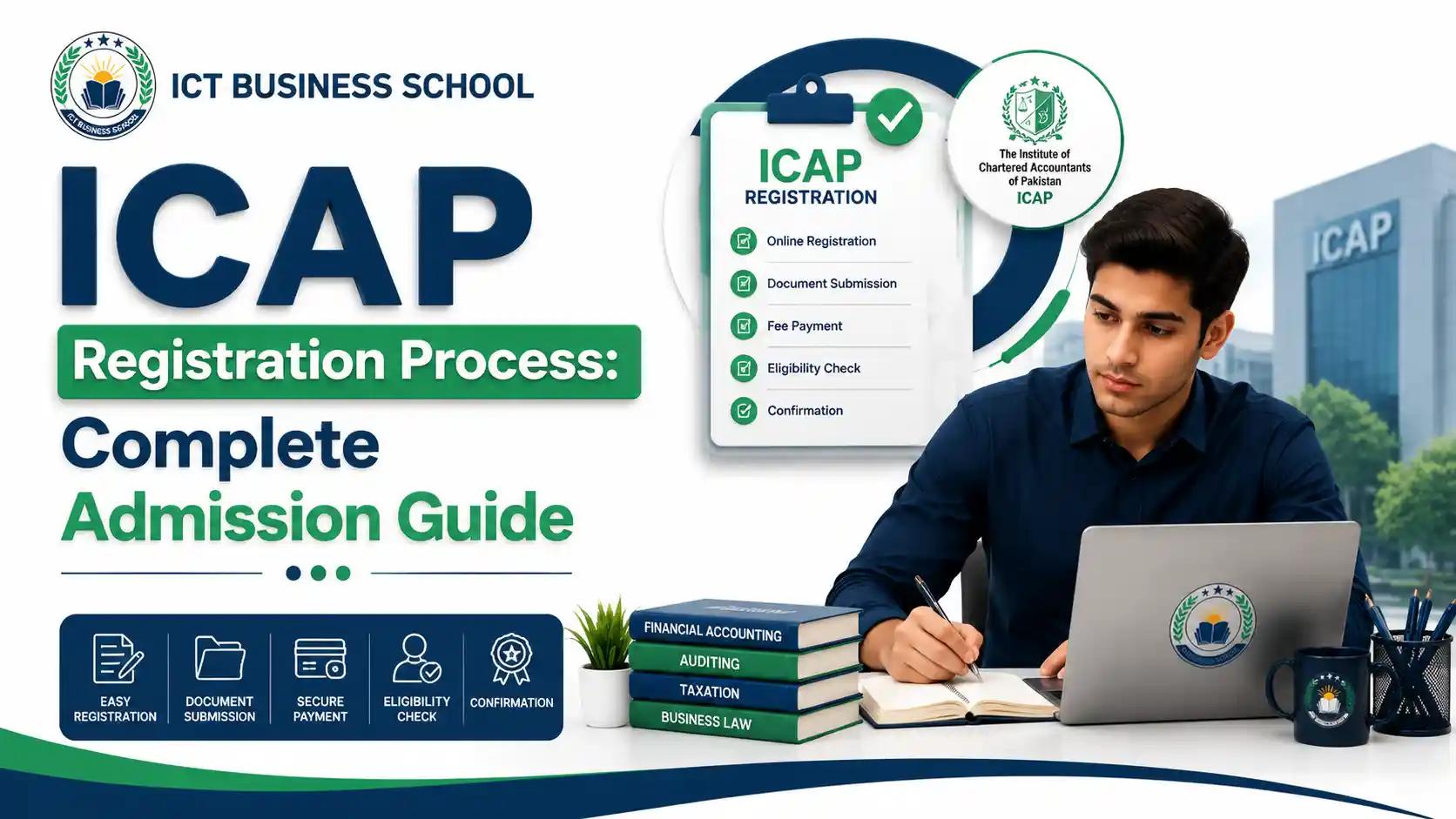
Registering with ICAP means enrolling as a Chartered Accountancy (CA) student through ICAP's official student portal. You need a minimum required score in Intermediate, A Levels, or a Bachelor's degree, along with your CNIC, academic certificates, and photographs. After submitting the online form and paying the registration fee, ICAP verifies your documents and issues a student registration number, after which you can begin the PRC and CAF stages. Explore more about accounting and business career paths at ICT Business School before you commit.
If you're planning to become a Chartered Accountant in Pakistan, the first real step isn't studying — it's registering correctly with ICAP. Many students delay this or make small mistakes on the form that cost them time later. This guide walks you through the entire ICAP registration process, step by step, so you can apply with confidence.
What Is ICAP?
The Institute of Chartered Accountants of Pakistan (ICAP) is the official regulatory body for the Chartered Accountancy profession in the country. It sets the syllabus, conducts exams, and grants the CA qualification recognized across audit firms, banks, and the corporate sector.
ICAP oversees the full CA education route — from registration through PRC, CAF, CFAP, and MSA — and also manages practical training (articleship) through its network of approved Training Organizations.
Benefits of Becoming a Chartered Accountant
- Strong recognition across the accounting profession and finance industry
- High demand from Big Four firms (Deloitte, PwC, EY, KPMG) and local audit firms
- Career paths in taxation, auditing, financial reporting, and corporate advisory
- Long-term potential to reach CFO, financial controller, or tax consultant roles
- Flexible entry — students from Intermediate, A Levels, ICom, or graduate backgrounds can all apply
- Professional credibility that supports independent practice later in your career. ICT Business School
ICAP Eligibility Criteria
Before registering, check that you meet the minimum entry requirement for your education route:
- Intermediate / FSc / ICom: Generally requires around 50% marks (any group is accepted)
- A Levels: At least three subjects, with certain exemptions available if Mathematics was studied
- Graduates (BCom / BBA / BS Accounting): Typically require around 45% marks, with possible paper exemptions
- ACCA / CMA qualified students: Eligible for partial exemptions based on papers already cleared
Because ICAP periodically updates its minimum percentage requirements and exemption rules, always confirm the current criteria on ICAP's official eligibility page before applying.
Documents Required for ICAP Registration
Keep these ready before starting your online application:
- CNIC or B-Form (for students under 18)
- Passport (for overseas applicants)
- Matric certificate
- Intermediate or A-Level equivalence certificate
- Bachelor's degree/transcript (if applying as a graduate)
- Recent passport-size photographs
- Proof of registration fee payment
Missing or unclear scanned documents are one of the most common reasons ICAP applications get delayed, so double-check file quality before uploading.
Step-by-Step ICAP Registration Process
- Visit the ICAP student portal and create your login credentials.
- Select your entry route — Intermediate, A Levels, or Graduate — based on your qualification.
- Fill out the online registration form with your personal, academic, and contact details.
- Upload required documents, including your CNIC, certificates, and photograph.
- Pay the registration fee through your preferred method (bank challan, online card payment, or wire transfer for overseas students).
- Submit the application and note your reference number for tracking.
- Wait for verification — ICAP checks your documents and eligibility before confirming registration.
- Receive your student registration number, which you'll use for all future exam and portal access.
ICAP Online Registration
ICAP has moved almost entirely to digital registration, so in most cases you no longer need to visit a regional office in person. The student portal allows you to:
- Submit your application and documents online
- Track your registration status
- Pay fees via credit/debit card, bank voucher, or wire transfer
- Receive confirmation directly via the portal or email
Overseas students can also register online, with wire transfer typically used for fee payment instead of local bank vouchers.ICT Business School
ICAP Registration Fee
ICAP's fee structure includes several components, and each is charged separately:
| Fee Type | When It Applies |
|---|---|
| Student Registration Fee | One-time fee paid at the time of initial enrollment with ICAP |
| Annual Subscription Fee | Paid every year to maintain active student membership and registration status |
| PRC / CAF / CFAP Exam Fees | Charged per paper whenever a student registers for an examination attempt |
| Exemption Fee | Applicable when claiming exemptions based on ACCA, CMA, university degree, or other approved qualifications |
| Duplicate Document Fee | Charged only when requesting reissuance of registration cards, transcripts, certificates, or other official documents |
Because fee amounts are revised periodically, always confirm the latest figures on ICAP's official fee and forms page rather than relying on older cached numbers.
Registration Deadlines
ICAP registration is generally open year-round, but you must register well before your intended exam attempt to meet eligibility timelines for that session. CAF exams are held in March and September, while CFAP and MSA exams are held in June and December — so plan your registration with enough buffer before your target exam window.
ICAP Regional Offices & Contact Information
ICAP operates through regional offices and student facilitation desks in major cities, including:
- ICAP Karachi
- ICAP Lahore
- ICAP Islamabad
- ICAP Rawalpindi
- ICAP Peshawar
- ICAP Faisalabad
- ICAP Multan
- ICAP Hyderabad
- ICAP Quetta
For contact details, helpline numbers, and office addresses, always refer to ICAP's official website, since regional contact information is updated from time to time.
Common Registration Mistakes to Avoid
- Uploading blurry or incomplete scanned documents
- Selecting the wrong entry route (Intermediate vs Graduate vs A Levels)
- Missing the registration deadline for your target exam session
- Not confirming fee payment before the last date
- Ignoring exemption eligibility and paying for papers you could have skipped
- Forgetting to save the registration reference number for trackingICT Business School
What Happens After Registration?
Once ICAP confirms your registration, you'll receive a student number and portal access. From here, you typically:
- Begin preparing for the PRC (Pre-Requisite Courses) stage
- Move into CAF (Certificate in Accounting and Finance) papers
- Start your mandatory articleship with an approved Training Organization
- Progress to CFAP and finally MSA, including the Strategic Case Study
ICAP Study Levels (PRC, CAF, CFAP & MSA)
| Stage | Focus |
|---|---|
| PRC (Pre-Requisite Courses) | English communication, MS Office, presentation skills, and professional development |
| CAF (Certificate in Accounting and Finance) | Core accounting, taxation, auditing, business law, economics, and financial management fundamentals |
| CFAP (Certified Finance and Accounting Professional) | Advanced financial reporting, strategic management, business finance, advanced auditing, and taxation |
| MSA (Multi-Subject Assessment) | Final-stage integrated case study focused on professional judgment, ethics, strategic decision-making, and practical business problem-solving |
Career Opportunities After ICAP
Once qualified, ICAP-registered Chartered Accountants can pursue roles such as:
- Audit associate or senior at Big Four and local audit firms
- Tax consultant or financial consultant
- Finance manager or financial controller in the corporate sector
- Roles connected to regulatory bodies like SECP and FBR
- Independent tax or audit practice
If you want to build additional business or finance skills alongside your CA registration, it's worth exploring advanced corporate and taxation courses at ICT (https://www.ictbusinessschool.com/courses/level-7-extended-diploma), or reviewing the HND – Higher National Diploma (https://www.ictbusinessschool.com/courses/hnd-higher-national-diploma) as a complementary qualification.
Expert Guidance
Practical advice for students going through ICAP registration for the first time:
- Register early, not last minute. Processing and verification take time — apply well before your target exam session, not right at the deadline.
- Double-check your entry route. Choosing the wrong route (e.g., applying as Intermediate when you actually qualify for graduate exemptions) can cost you time and money later.
- Keep scanned copies ready in advance. Have clear, correctly sized scans of your CNIC, certificates, and photo before you start the form — this avoids last-minute upload errors.
- Track your fee payment confirmation. Don't assume payment went through — check your portal status and keep the transaction receipt.
- Compare training organizations before articleship. Not all approved firms offer the same quality of practical training, so ask current trainees about their experience before signing a training contract.
- Consider parallel skill-building. Alongside CA registration, exploring structured programs like the Pearson BTEC Level 3 (https://www.ictbusinessschool.com/courses/pearson-btec-level-3) can strengthen your business fundamentals while you work through the CA stages.
Key Facts
- ICAP is the regulatory body overseeing Chartered Accountancy education and registration in Pakistan
- Registration is done primarily through ICAP's official online student portal
- Entry routes include Intermediate/FSc, A Levels, and Bachelor's degree holders
- Required documents include CNIC/B-Form, academic certificates, and photographs
- Fees are charged separately for registration, annual subscription, and each exam paper
- CAF exams run in March and September; CFAP/MSA exams run in June and December
- After registration, students progress through PRC, CAF, CFAP, and MSA, alongside mandatory articleship
- Overseas students can register online and pay fees via wire transfer
Explore More Before You Apply
Before finalizing your ICAP registration, it helps to compare your options. Why choose ICT Business School (https://www.ictbusinessschool.com/about) if you want a broader business foundation alongside or before CA? You can review course options at ict.edu.pk (https://ict.edu.pk) and IDT Pakistan (https://idtpakistan.pk/courses/), or check the O Level program (https://www.ictbusinessschool.com/courses/o-level-program) if you're planning your academic path from an earlier stage.
FAQs
What is the ICAP registration process? It involves creating an account on ICAP's student portal, selecting your entry route, submitting documents, paying the fee, and receiving a confirmed student registration number.
Who is eligible for ICAP registration? Students from Intermediate, A Levels, or a Bachelor's degree background can register, provided they meet ICAP's minimum marks requirement for their route.
How can I apply for ICAP online? Visit ICAP's official student portal, fill out the registration form, upload your documents, and pay the fee through the available online payment methods.
What documents are required for ICAP admission? You'll need your CNIC or B-Form, academic certificates, passport-size photographs, and proof of fee payment.
How much is the ICAP registration fee? Fees vary by component (registration, annual subscription, exam fees) and are updated periodically, so always check ICAP's official fee page for current figures.
Can I join ICAP after Intermediate? Yes, students from any Intermediate group can register directly with ICAP.
Can overseas students register for ICAP? Yes, overseas applicants can register online and typically pay fees via wire transfer.
What happens after ICAP registration? You receive a student number and begin progressing through PRC, CAF, CFAP, and MSA, alongside mandatory practical training (articleship).
Ready to Start Your CA Journey?
Getting your ICAP registration right from day one saves time and avoids unnecessary delays. If you'd like guidance on building complementary business skills alongside your CA studies, speak with ICT Business School's faculty (https://www.ictbusinessschool.com/faculty) or contact the admissions team (https://www.ictbusinessschool.com/contact). You can also browse the ICT Business School blog (https://www.ictbusinessschool.com/blog) for more guides on accounting and finance careers in Pakistan.