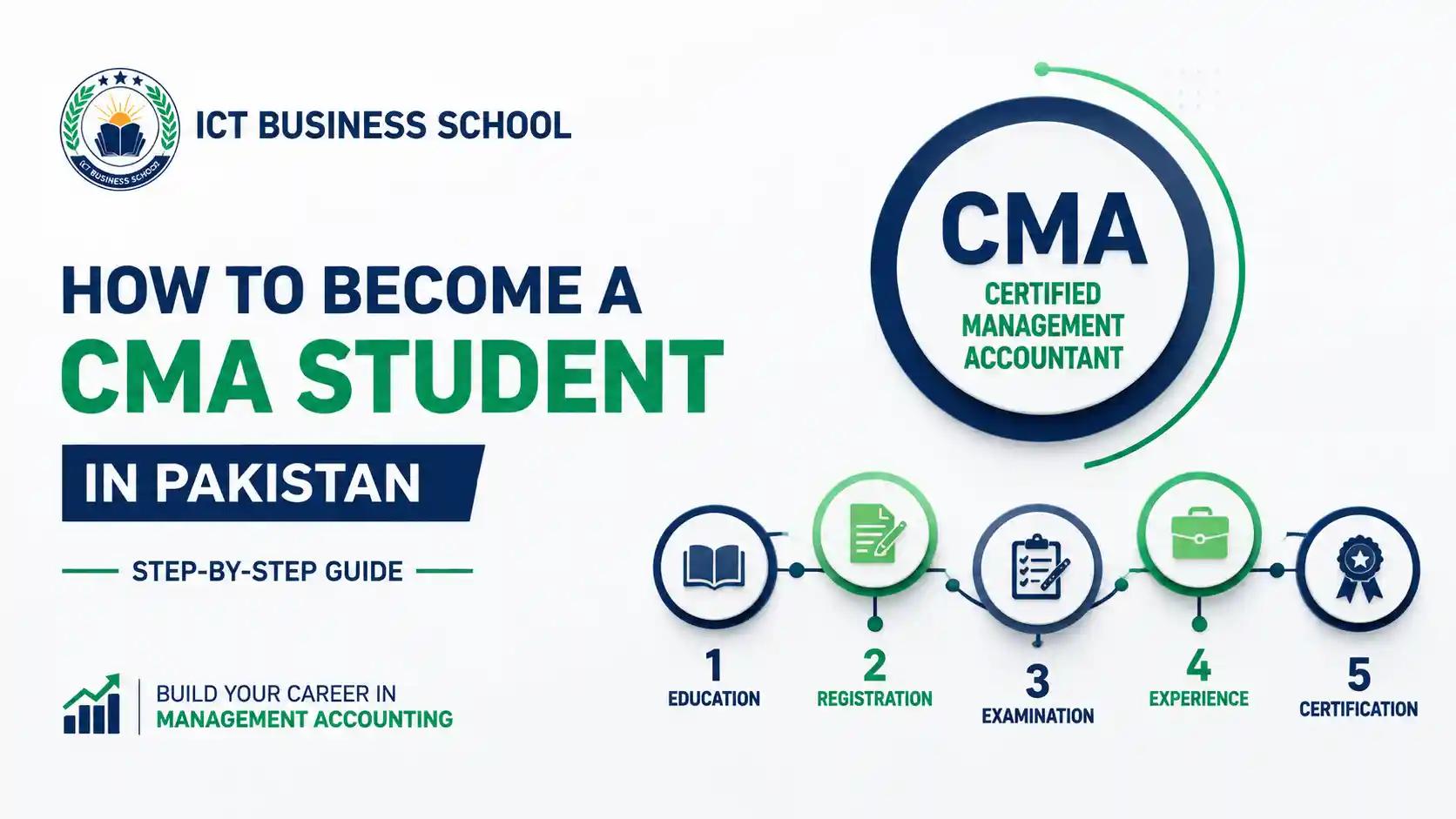
To become a CMA (Certified Management Accountant) in Pakistan, you need at least an intermediate qualification (FSc, ICom, ICS, or A-Levels) to register with ICMAP, then clear the Foundation, Operational, and Strategic levels through exams and practical training. The full course takes roughly 3–5 years depending on your entry point and study pace. You can explore related professional courses at ICT Business School if you want to compare accounting and finance pathways before you commit.
What Is CMA and Why Should You Choose It in Pakistan?
CMA stands for Certified Management Accountant. In Pakistan, this qualification is awarded by the Institute of Cost and Management Accountants of Pakistan (ICMAP), a statutory body that trains professionals in cost accounting, management accounting, financial reporting, taxation, and auditing.
A CMA is different from a general accountant. While regular accounting focuses on recording transactions, CMA training builds skills in budgeting, performance management, strategic decision-making, and financial analysis — the tools businesses use to plan for the future, not just report the past.
Pakistan's commerce and finance sector has growing demand for management accountants, especially in multinational companies, manufacturing firms, banks, and the public sector. If you're weighing your options, it helps to first visit ICT Business School (https://www.ictbusinessschool.com/about) to see how their programs align with accounting careers before choosing a specific route.
Why people choose CMA in Pakistan:
- Locally recognized and internationally respected accounting qualification
- Lower cost compared to some international certifications
- Strong job market in cost accounting, auditing, and financial management
- Flexible entry points — after matric, intermediate, or graduation
- Pathway to senior finance roles, including CFO positions ICT Business School
CMA vs Accounting: What's the Difference?
Many students confuse a general accounting degree with a CMA qualification. Both deal with numbers, but their purpose is different.
| Aspect | General Accounting | CMA (Management Accounting) |
|---|---|---|
| Focus | Recording and Reporting Past Transactions | Planning, Budgeting, and Strategic Decision-Making |
| Recognition | Degree-Based (BCom, BS Accounting) | Professional Certification (ICMAP) |
| Career Path | Bookkeeper, Accounts Officer | Finance Manager, Cost Accountant, CFO |
| Exam Structure | University Semester Exams | Foundation, Operational, and Strategic Levels |
| Global Relevance | Varies by Country | Recognized Across South Asia and Beyond |
| Practical Training | Often Optional | Mandatory Practical Experience |
If you're still deciding between a degree route and a certification route, it's worth checking ICT Business School's HND and Level 7 Extended Diploma programs (https://www.ictbusinessschool.com/courses/hnd-higher-national-diploma) as an alternative or complementary pathway.
Who Is Eligible to Become a CMA Student in Pakistan?
CMA eligibility in Pakistan is fairly flexible, which is why students from different academic backgrounds ask about it.
You can apply for CMA registration if you have:
- Passed Matric (with additional foundation-level subjects)
- Completed Intermediate — FSc, ICom, ICS, or A-Levels
- Completed a Bachelor's degree (BCom, BBA, BS Accounting, etc.)
- Completed an MBA or equivalent postgraduate qualification ICT Business School
Common eligibility questions answered:
- Can I do CMA after matric? Yes, but you'll start from the Foundation stage with extra preparatory subjects.
- Can I do CMA after FSc? Yes — FSc (pre-medical or pre-engineering) students are eligible, and mathematics is not a strict requirement.
- Can ICom or ICS students apply? Yes, both are accepted entry qualifications.
- Can graduates apply directly? Yes, and graduates may receive exemptions in some Foundation-level papers.
- Is there an age limit? ICMAP does not enforce a strict age limit for CMA registration.
Before finalizing your decision, you may also want to compare ICT Business School's Pearson BTEC Level 3 program (https://www.ictbusinessschool.com/courses/pearson-btec-level-3), which some students use as a stepping stone into commerce-related qualifications.
Step-by-Step Process to Become a CMA Student in Pakistan
- Check your eligibility based on your current academic qualification (matric, intermediate, or graduate level).
- Collect required documents — academic certificates, CNIC/B-Form copy, passport-size photographs, and domicile (if required).
- Submit the ICMAP registration form, either online or at your nearest regional office.
- Pay the admission and registration fee as per the current ICMAP fee schedule.
- Get your student ID and study material once registration is confirmed.
- Start the Foundation stage papers if you're entering after matric or intermediate.
- Progress through Operational and Strategic levels, clearing each stage's exams.
- Complete mandatory practical training/internship in an approved organization.
- Apply for CMA membership once all exams and training requirements are met. ICT Business School
Documents typically required for CMA registration:
- Attested copies of academic certificates
- CNIC or B-Form (photocopy)
- Recent passport-size photographs
- Domicile certificate (in some cases)
- Registration form duly filled
If you'd like guidance choosing subjects or planning your study roadmap, ICT Business School's faculty page (https://www.ictbusinessschool.com/faculty) lists experienced instructors who can offer direction on commerce and finance career planning.
CMA Course Structure, Subjects, and Duration in Pakistan
CMA Course Levels:
- Foundation Level — basic accounting, business economics, business communication, and quantitative methods
- Operational Level — cost accounting, taxation, financial accounting, and business law
- Strategic Level — strategic management, financial reporting (IFRS/IAS-based), corporate finance, and advanced auditing
CMA Duration:
- Foundation to Strategic level typically takes 3 to 5 years, depending on your starting qualification and study pace.
- Graduates and postgraduates may finish faster due to subject exemptions.
- Working professionals often take longer as they balance job and study.
Study Options:
- On-campus learning at ICMAP regional centers (Lahore, Karachi, Islamabad, Multan, Faisalabad, Peshawar, Quetta, and more)
- Online classes for students who cannot attend in person
- Self-study with coaching support for working students
For students who prefer a blended commerce foundation before committing fully to CMA, ICT Business School's course catalog (https://www.ictbusinessschool.com/courses) offers programs that build core business and finance skills. ICT Business School
CMA Fees, Registration Process, and Admission Requirements
CMA fees in Pakistan are generally lower than several international accounting certifications, making it an accessible option for commerce students.
Typical fee components include:
- One-time admission/registration fee
- Annual subscription fee
- Per-paper examination fee (varies by level)
- Study material charges (optional, if not self-sourced)
Fees can vary slightly by year and region, so it's best to confirm current figures directly from ICMAP's official fee schedule before applying. Many students also research additional short-term diploma options (https://www.ictbusinessschool.com/courses/level-7-extended-diploma) to strengthen their profile while completing CMA.
Tips to manage CMA fees:
- Ask about installment options at your regional ICMAP office
- Check for merit-based scholarships or fee concessions
- Compare cumulative CMA fees against ACCA or CA before deciding
Career Scope, Salary, and Job Opportunities After CMA in Pakistan
CMA scope in Pakistan continues to grow as more companies look for professionals skilled in cost control, budgeting, and financial strategy.
Common job roles after CMA:
- Cost Accountant
- Management Accountant
- Financial Analyst
- Internal Auditor
- Budget Analyst
- Finance Manager
- Corporate Finance Executive
- CFO (with experience)
Where CMAs typically work:
- Multinational companies
- Banking and financial services
- Manufacturing and textile industries
- Public sector organizations
- Audit and consultancy firms
CMA salary in Pakistan varies by experience, industry, and city, but entry-level roles generally offer a solid starting package compared to non-certified accounting staff, with steady growth as experience and additional certifications are added.
If you're exploring finance careers more broadly, it's worth reviewing ICT Business School's blog for career guidance articles on commerce and finance professions in Pakistan.
CMA vs CA vs ACCA – Which Accounting Qualification Is Best in Pakistan?
| Feature | CMA (ICMAP) | CA (ICAP) | ACCA |
|---|---|---|---|
| Focus Area | Management & Cost Accounting | Audit & Financial Accounting | Global Financial Accounting |
| Typical Duration | 3–5 Years | 4–6 Years | 2–4 Years |
| Cost | Moderate | Higher | Higher |
| Recognition | Strong in Pakistan, Growing Regionally | Strong in Pakistan | Global Recognition |
| Best For | Cost & Management Roles, CFO Track | Audit-Focused Careers | International Career Mobility |
There's no single "best" choice — it depends on your career goals. Students interested in strategic finance and cost management usually lean toward CMA, while those wanting international mobility often consider ACCA.
Expert Guidance
If you're a student trying to decide between CMA, ACCA, or CA, start by asking what kind of work excites you — reporting and audit, or planning and strategy. CMA suits students who enjoy budgeting, forecasting, and decision-support work rather than pure compliance tasks.
Don't rush the Foundation level. It builds the base for everything else, and rushing through it often causes struggles at the Operational and Strategic stages.
Practical training matters as much as exams. Try to secure an internship early, even part-time, so you can apply what you're studying in a real accounting or finance environment.
Finally, compare institutes, not just qualifications. A good coaching center or business school with strong faculty support — such as ICT Business School's faculty team (https://www.ictbusinessschool.com/faculty) — can significantly improve your pass rate and understanding. ICT Business School
Key Facts
- CMA in Pakistan is awarded by ICMAP (Institute of Cost and Management Accountants of Pakistan).
- Eligible entry points: matric, intermediate (FSc/ICom/ICS/A-Levels), or graduation.
- Course has three levels: Foundation, Operational, and Strategic.
- Typical duration: 3–5 years, depending on entry qualification.
- Mandatory practical training/internship is required before membership.
- CMA fees are generally lower than ACCA and CA.
- Career paths include cost accountant, financial analyst, auditor, and finance manager.
- CMA is recognized across Pakistan and increasingly across South Asia.
- Study options include on-campus, online, and self-study with coaching.
Frequently Asked Questions
What is CMA in Pakistan? CMA is a professional accounting certification focused on management and cost accounting, awarded by ICMAP.
Who can apply for CMA in Pakistan? Students who have passed matric, intermediate (FSc, ICom, ICS, A-Levels), or graduation can apply.
Is FSc enough for CMA? Yes, FSc (pre-medical or pre-engineering) students are eligible to register for CMA.
How much does CMA cost in Pakistan? Fees include registration, annual subscription, and per-paper exam charges; total cost is generally lower than ACCA or CA. Check ICMAP's current fee schedule for exact figures.
How long does CMA take to complete? Typically 3 to 5 years, depending on your entry qualification and study pace.
Is CMA better than ACCA or CA? It depends on your goals. CMA suits students interested in cost and management accounting, while ACCA offers broader international recognition and CA focuses heavily on audit.
Can I study CMA online? Yes, ICMAP and several coaching centers offer online classes alongside on-campus options.
What jobs can I get after CMA? Common roles include cost accountant, financial analyst, budget analyst, internal auditor, and finance manager.
Ready to Plan Your Accounting Career?
Choosing between CMA, ACCA, or CA is a big decision, and getting the right guidance early makes the process much smoother. Explore ICT Business School's full course range or visit the O-Level program page ICT Business School if you're starting your academic journey from an earlier stage. For direct queries, contact ICT Business School's team (https://www.ictbusinessschool.com/contact) to discuss which path fits your goals best.
For further reading on accounting programs and structured business courses, you can also check ICT's official course listings (https://ict.edu.pk) and resources from BACO Consultants