Want to build a successful career in internal auditing? The CIA (Certified Internal Auditor) certification is one of the world's most respected credentials for audit professionals. In this complete guide, you'll learn everything about the CIA exam structure, eligibility, exam format, passing score, preparation tips, career opportunities, and salary prospects—especially for students and professionals in Pakistan.
Quick Answer:
The Certified Internal Auditor (CIA) exam is a globally recognized three-part certification offered by the Institute of Internal Auditors (IIA). It assesses your knowledge of internal audit fundamentals, audit practices, and business knowledge for internal auditing. To become eligible, candidates generally need a bachelor's degree (or an accepted equivalent qualification) and at least 24 months of relevant internal audit or related work experience. For Pakistani students and professionals, the CIA certification is a valuable credential for careers in banks, multinational companies, audit firms, and the corporate sector.
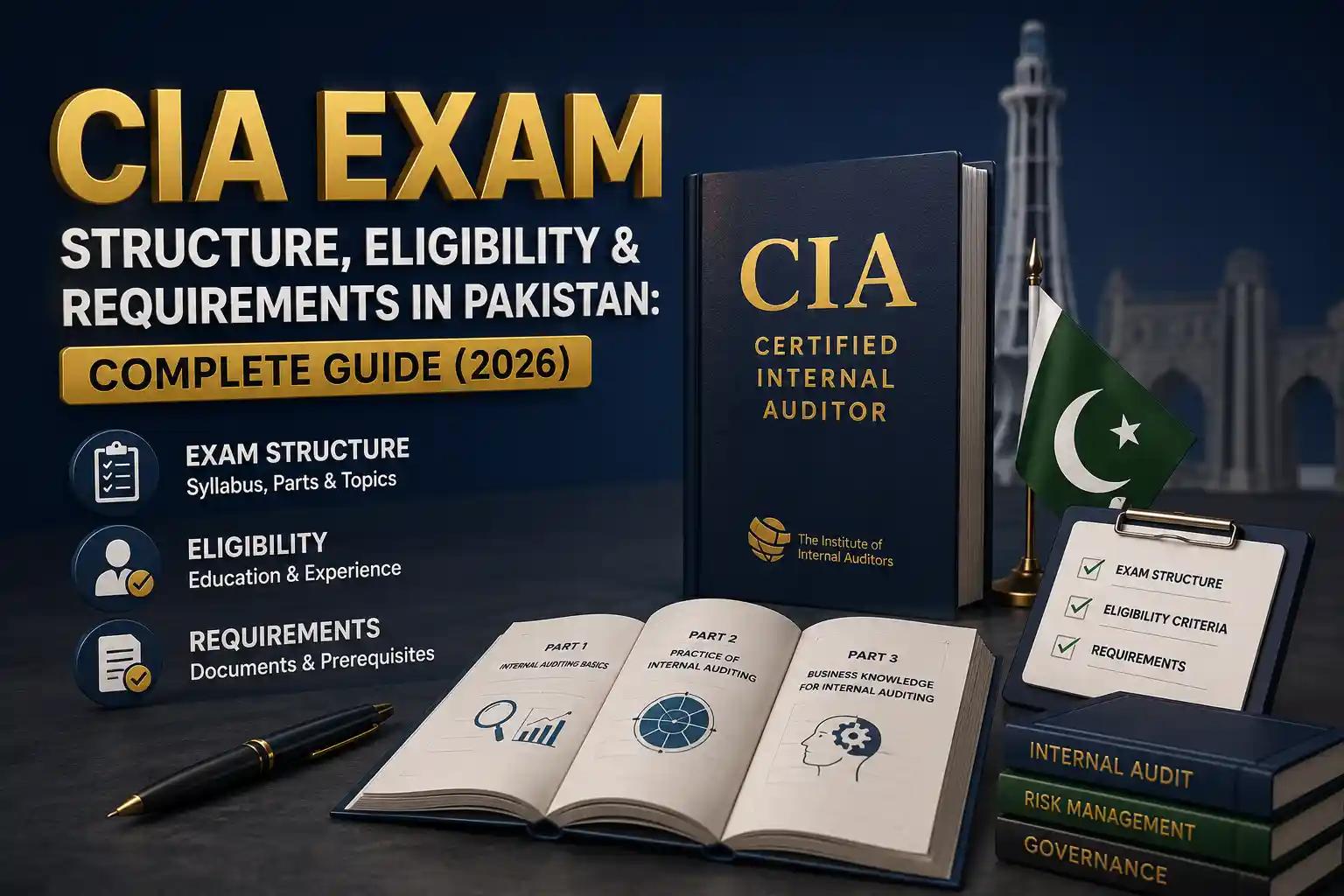
What Is CIA Exam ?
The Certified Internal Auditor (CIA) exam is the first step toward earning the globally recognized Certified Internal Auditor (CIA) designation, the only professional certification designed exclusively for internal auditors. Developed and administered by the Institute of Internal Auditors (IIA), the exam assesses the knowledge, skills, and professional competencies required to succeed in the internal auditing profession.
The CIA exam covers essential areas such as internal audit fundamentals, risk management, corporate governance, internal controls, business processes, and compliance. Recognized in more than 170 countries, the CIA certification is highly valued by multinational companies, banks, government organizations, public sector institutions, and Big Four accounting firms, making it one of the most respected internal audit credentials worldwide.
For students and finance professionals in Pakistan, the CIA certification offers excellent career opportunities across banking, financial services, multinational corporations, audit firms, and the corporate sector. Whether you have completed ACCA, CA, CMA, B.Com, BS Accounting & Finance, or another relevant qualification, the CIA exam provides a clear pathway to building a successful career in internal auditing with global recognition.
CIA Exam Structure Explained (Complete Breakdown)
The CIA exam consists of three parts, each designed to assess a different area of internal auditing knowledge and professional competence. Together, these three parts evaluate a candidate's understanding of internal audit fundamentals, audit engagements, business knowledge, governance, risk management, and internal controls. Although candidates can take the exam parts in any order, the Institute of Internal Auditors (IIA) recommends starting with Part 1 because it provides the foundational knowledge required for the remaining sections. For students and professionals in Pakistan, understanding the CIA exam structure before starting preparation can help create an effective study plan and improve the chances of passing all three parts successfully.
| Part | Title | Questions | Duration |
|---|---|---|---|
| Part 1 | Essentials of Internal Auditing | 125 MCQs | 2.5 hours |
| Part 2 | Practice of Internal Auditing | 100 MCQs | 2 hours |
| Part 3 | Business Knowledge for Internal Auditing | 100 MCQs | 2 hours |
All questions are multiple choice. There are no written or essay components.
CIA Exam Part 1 Essential Internal Audit Basics
CIA Exam Part 1, officially titled Essentials of Internal Auditing, builds the foundation for the entire CIA certification. It evaluates a candidate's understanding of the core principles, standards, and ethical responsibilities required in the internal auditing profession. This part is designed to ensure that future internal auditors have a solid understanding of governance, risk management, internal controls, and audit planning before progressing to more advanced topics.
Key topics covered in CIA Exam Part 1 include:
- IIA Mission, Code of Ethics, and International Standards
- Internal audit charter, independence, and objectivity
- Governance, risk management, and internal control
- Fraud risks and the control environment
- Audit planning and audit engagement fundamentals
- Assurance services and ethical auditing practices
Part 1 contains 125 multiple-choice questions and must be completed within 2.5 hours, making it the longest section of the CIA exam. For students and professionals in Pakistan, developing a strong understanding of Part 1 is essential because it provides the knowledge required to succeed in the remaining exam parts and build a career in internal auditing.s.
CIA Exam Part 2 – Internal Audit Practice
CIA Exam Part 2, officially titled Internal Audit Practice, focuses on the practical application of internal auditing throughout the audit engagement process. This section assesses a candidate's ability to plan, perform, document, and communicate audit engagements while applying professional standards in real-world business environments. It emphasizes practical audit procedures and decision-making rather than theoretical concepts.
Key topics covered in CIA Exam Part 2 include:
- Managing internal audit engagements
- Conducting audit fieldwork and gathering audit evidence
- Communicating audit findings and recommendations
- Audit methodology and documentation
- Quality Assurance and Improvement Program (QAIP)
- Coordinating with external auditors and other assurance providers
Part 2 consists of 100 multiple-choice questions with a 2-hour time limit. Candidates who have practical experience in internal auditing often find this section more manageable because it focuses on applying audit knowledge in real business situations. For professionals in Pakistan, mastering Part 2 helps develop the practical skills required by banks, audit firms, multinational companies, and other organizations.
CIA Exam Part 3 – Business Knowledge for Internal Auditors
CIA Exam Part 3, officially titled Business Knowledge for Internal Auditing, expands beyond traditional audit concepts by focusing on business, finance, technology, and strategic management. This section evaluates a candidate's ability to apply internal audit knowledge within a broader organizational context and understand how business operations, financial performance, and technology influence audit decisions.
Key topics covered in CIA Exam Part 3 include:
- Business acumen, organizational structure, and corporate strategy
- Financial management and management accounting
- Information technology and data analytics in internal auditing
- Enterprise Risk Management (ERM)
- Regulatory compliance and Sarbanes-Oxley (SOX) concepts
- Environmental, Social, and Governance (ESG) considerations
Part 3 includes 100 multiple-choice questions with a 2-hour time limit. Candidates with a background in accounting, finance, or business studies often find this section easier because many of the concepts are already familiar. For Pakistani students pursuing ACCA, CA, CMA, B.Com, or BS Accounting & Finance, Part 3 provides valuable business knowledge that is directly applicable to careers in internal audit, risk management, compliance, and corporate governance.
CIA Exam Requirements and Eligibility Criteria
Before registering for the CIA exam, candidates must meet the eligibility requirements established by the Institute of Internal Auditors (IIA). These requirements ensure that applicants have the necessary academic qualifications, professional experience, and ethical standards to earn the globally recognized Certified Internal Auditor (CIA) certification.
Education Requirement
- A bachelor's degree (or an equivalent qualification) from an accredited institution is generally required.
- Candidates holding a master's degree may qualify with 12 months of relevant work experience instead of the standard 24 months, subject to the IIA's current eligibility requirements.
Work Experience Requirement
- A minimum of 24 months of internal audit or equivalent professional experience is required.
- Relevant experience may include internal auditing, external auditing, risk management, compliance, quality assurance, finance, or other related fields.
- Candidates can begin taking the CIA exam before completing the required work experience, provided they fulfill the experience requirement within the eligibility period.
Character Reference
Applicants must submit one professional reference from an IIA member, employer, supervisor, manager, or university professor who can verify their professional character and integrity.
CIA Exam Eligibility Period
After joining the CIA program, candidates have up to four years to successfully pass all three exam parts. Once an individual exam part is approved, it must be completed within its 180-day eligibility window.
Who Can Apply for the CIA Exam?
The CIA certification is suitable for:
- Accounting and finance graduates
- Internal and external auditors
- Risk management and compliance professionals
- ACCA, CA, CMA, and CPA members or students (where applicable under IIA policies)
- Fresh graduates planning to complete the required work experience within the eligibility period
For students in Pakistan, qualifications such as ACCA, CA, B.Com, BS Accounting & Finance, ADP Commerce, and other recognized business or finance degrees can provide a strong academic pathway toward the CIA certification. Students pursuing qualifications like the Pearson BTEC Level 3, Higher National Diploma (HND), or Level 7 Extended Diploma can also build relevant knowledge before progressing toward a bachelor's degree and meeting the CIA eligibility requirements.
If you are currently studying toward a professional qualification, programs like the HND Higher National Diploma, Level 7 Extended Diploma, or Pearson BTEC Level 3 at ICT Business School provide strong academic foundations for CIA eligibility.
The CIA exam is conducted in a computer-based testing (CBT) format and consists entirely of multiple-choice questions (MCQs). There are no essay questions, written responses, or practical assessments, allowing candidates to focus on demonstrating their knowledge through objective-based questions. The exam is administered by the Institute of Internal Auditors (IIA) and delivered worldwide through Pearson VUE authorized test centers, including locations accessible to candidates from Pakistan.
CIA Exam Format
- Computer-Based Testing (CBT)
- Multiple-choice questions (MCQs) only
- No essay questions or written components
- Conducted at authorized Pearson VUE test centers worldwide
- Candidates can schedule each exam part separately within their eligibility period
CIA Exam Passing Score
To pass the CIA exam, candidates must achieve a scaled score of at least 600 out of 750 for each exam part. The IIA uses a scaled scoring system rather than a fixed percentage, so the required percentage of correct answers may vary slightly depending on the exam version. Candidates typically receive their unofficial result immediately after completing the exam at the Pearson VUE test center, while the official score is updated later in their IIA certification portal.
CIA Exam Fees (Approximate):
| Region | IIA Member Fee (Per Part) | Non-Member Fee (Per Part) |
|---|---|---|
| USA | $280–$370 | $375–$460 |
| Pakistan | Lower regional pricing applies | Slightly higher |
| UAE / Saudi Arabia | Mid-range regional pricing | Standard international rate |
| India | Regional pricing available | Standard rate |
Exact CIA certification fees in Pakistan should be confirmed through the IIA Global portal, as regional pricing is updated periodically. For current CIA certification cost in the UK, UAE, or Canada, the IIA website provides updated fee schedules.
CIA Exam Retake Policy:
- If a candidate fails, they must wait 90 days before retaking the same part
- A retake fee applies for each additional attempt
How to Prepare for CIA Exam :Study Plan and Preparation Tips
Passing the CIA exam requires a well-planned study strategy, consistent practice, and the right preparation resources. Since the exam covers a broad range of internal auditing concepts, creating a structured study plan can significantly improve your chances of passing all three exam parts on your first attempt. Most successful candidates dedicate 8–12 hours of study per week and complete each exam part within 3 to 6 months, depending on their experience and schedule.
Recommended CIA Exam Preparation Strategy
- Start with Part 1: Build a strong understanding of internal audit fundamentals before moving to the more practical and business-focused exam parts.
- Use official and trusted study materials: IIA learning resources, Wiley CIA Exam Review, and Gleim CIA Review are among the most widely used preparation materials.
- Practice MCQs every day: Since the CIA exam is entirely multiple-choice, regular question practice is essential to improve accuracy and time management.
- Follow a realistic study schedule: Plan 8–12 study hours per week and aim to complete one exam part every 3–6 months.
- Review weak topics regularly: Analyze your practice test results and spend extra time on topics where your performance is below your target score.
- Join a study group or online community: Learning with other candidates can improve motivation, consistency, and overall exam preparation.
Historically, CIA Exam Part 1 has one of the lowest pass rates, making disciplined preparation especially important before attempting the remaining exam parts.
Free and Paid CIA Exam Preparation Resources
- IIA Candidate Handbook and official learning resources (Free)
- Wiley CIA Exam Review (Paid)
- Gleim CIA Review (Paid)
- Online learning platforms such as Coursera for internal auditing, governance, and risk management fundamentals
For students and professionals in Pakistan, combining internationally recognized study resources with a consistent study routine can significantly improve your chances of passing the CIA exam and building a successful career in internal auditing.
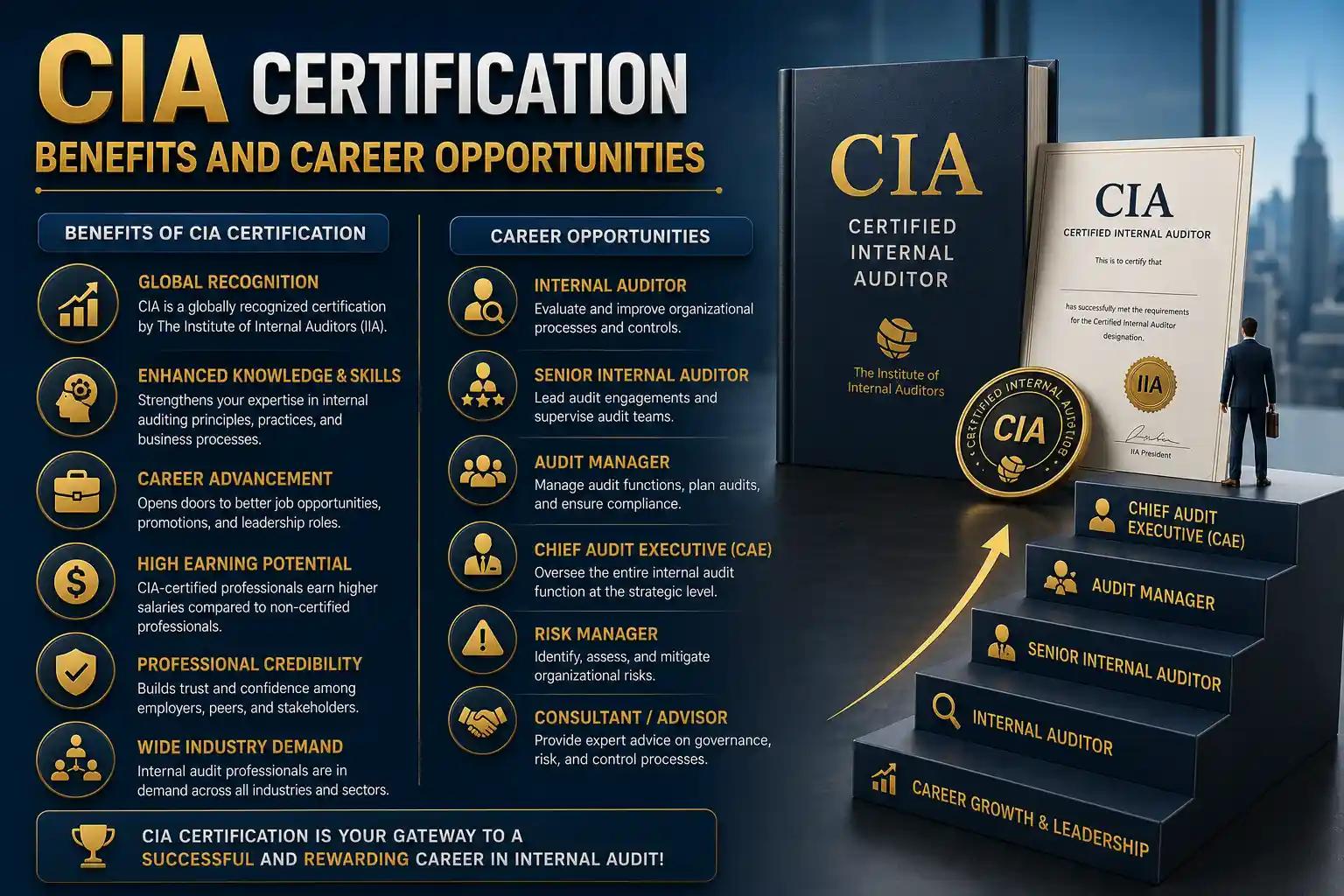
CIA Certification Benefits And Career Opportunities
Benefits of CIA Certification
The Certified Internal Auditor (CIA) certification is one of the most respected professional qualifications for internal auditors worldwide. Recognized in more than 170 countries, it validates your expertise in internal auditing, governance, risk management, and internal controls. Employers across banking, multinational companies, government organizations, and consulting firms prefer CIA-certified professionals because the qualification demonstrates internationally recognized knowledge and professional competence.
Key Benefits of CIA Certification
- Globally recognized certification accepted in over 170 countries
- Enhances expertise in internal auditing, governance, risk management, and compliance
- Improves professional credibility and career advancement opportunities
- Preferred qualification for senior internal audit and risk management roles
- Recognized by Big Four firms, multinational corporations, financial institutions, and public sector organizations
- Opens career opportunities in Pakistan and internationally
Career Opportunities and Salary After CIA Certification
Earning the CIA certification can open the door to a wide range of career opportunities in internal auditing, risk management, compliance, and corporate governance. CIA-certified professionals are employed by commercial banks, multinational companies, manufacturing organizations, consulting firms, government institutions, and Big Four accounting firms around the world.
Popular Job Roles After CIA Certification
- Internal Auditor
- Senior Internal Auditor
- Audit Manager
- Chief Audit Executive (CAE)
- Risk Analyst
- Enterprise Risk Manager
- Compliance Officer
- Compliance Manager
- Forensic Auditor
- Fraud Examiner
- IT Auditor (with additional certifications such as CISA)
CIA Salary in Pakistan
In Pakistan, the salary of a CIA-certified professional depends on experience, industry, job role, and employer. Entry-level internal auditors generally earn competitive salaries, while experienced professionals working as Audit Managers, Risk Managers, or Chief Audit Executives can earn significantly higher compensation packages. CIA certification is particularly valued by commercial banks, multinational companies, Big Four firms, and large corporate organizations.
For additional career planning tools and resources, platforms like BACO Consultants and Mega Free Tools can support professionals at various stages of their audit career.
ICT Business School offers a full suite of professional certifications including CIA, ACCA, CA (ICAP pathway), CMA, and HND programs. If you are exploring where to start, visit the courses page or read career insights on the ICT Business School blog.
CIA Exam Difficulty Level (Is It Hard?)
any candidates ask, "Is the CIA exam difficult?" The answer is yes—the CIA exam is considered moderately to highly challenging, but it is achievable with consistent preparation and the right study strategy. Rather than testing memorization alone, the exam evaluates your understanding of internal auditing concepts, professional judgment, risk management, governance, and the practical application of audit principles.
The overall difficulty varies depending on your academic background and professional experience. Candidates with qualifications such as ACCA, CA, CMA, CPA, B.Com, or BS Accounting & Finance often find topics related to auditing, finance, and risk management more familiar. However, candidates from non-audit backgrounds may need additional time to understand the IIA standards and internal audit methodology.
For students and professionals in Pakistan, the CIA exam can be challenging, especially if you have limited practical audit experience. However, following a structured study plan, practicing MCQs regularly, and using trusted study resources such as the IIA Learning System, Gleim, or Wiley can significantly improve your chances of passing on the first attempt.
CIA Exam Difficulty Compared to Other Certifications:
| Certification | Difficulty Level | Focus Area |
|---|---|---|
| CIA | Moderate–High | Internal Audit, Risk, Governance |
| CPA | High | Financial Accounting, Tax, Audit |
| ACCA | High | Broad Accounting and Finance |
| CMA | Moderate–High | Management Accounting, Finance |
| CISA | Moderate | IT Audit and Information Systems |
Why CIA Is Challenging:
- Part 1 has a global pass rate of approximately 40–45%
- The content covers IIA standards in deep detail
- Candidates must apply knowledge, not just memorize facts
- English-language exam for most international candidates
Why Candidates Succeed:
- Consistent MCQ practice (minimum 3,000–5,000 questions recommended)
- Clear understanding of IIA Standards and CIA syllabus
- Real internal audit work experience before or during exam preparation
- Proper time management across all three parts
For students coming from an O Level, A Level, or BTEC background, enrolling in foundational programs at ICT Business School before pursuing the CIA is a practical path. The O Level Program and business diploma programs build the academic discipline and analytical thinking that CIA candidates need.
Expert Guidance
From experienced audit professionals and certification advisors:
- Start with CIA Exam Part 1, even if you already have an ACCA, CA, CMA, or CPA background, as it builds the foundation for Parts 2 and 3.
- Give extra attention to Part 1 because it is generally considered the most challenging section and has one of the lowest pass rates among the three exam parts.
- Register with the Institute of Internal Auditors (IIA) as a student or associate member before applying, as membership may help reduce examination fees depending on your eligibility.
- Practice at least 1,500–2,000 multiple-choice questions (MCQs) for each exam part to improve your understanding, speed, and confidence.
- If you hold professional qualifications such as ACCA, CA, or CPA, check whether you are eligible for the CIA Challenge Exam, which may provide an alternative certification pathway under the IIA's current policies.
- If you are preparing for the CIA exam in Pakistan, stay connected with the IIA Pakistan Chapter for updates on exam registration, authorized test centers, membership information, and local fee structures.
- Try to gain practical experience in internal auditing, risk management, or compliance while preparing for the exam so you can meet the CIA work experience requirement more efficiently.
- If you need professional guidance on the CIA certification or want to explore related qualifications, ICT Business School can help you understand suitable learning pathways and career options.
- For career planning support, reach out to ICT Business School for professional guidance on CIA and related certification pathways
Key Facts
- CIA stands for Certified Internal Auditor — awarded by the Institute of Internal Auditors (IIA)
- The CIA exam has 3 parts, all in MCQ format
- Passing score is 600 out of 750 per part
- Part 1 has 125 questions in 2.5 hours; Parts 2 and 3 have 100 questions each in 2 hours
- Eligibility requires a bachelor's degree and 24 months of relevant experience
- The 4-year eligibility window begins once you register with the IIA
- CIA is recognized in 170+ countries
- Global pass rate for Part 1 is approximately 40–45%
- Exam is administered via Pearson VUE test centers worldwide
- CIA-certified professionals earn 20–30% more than non-certified peers in equivalent roles
- ACCA and CA holders may qualify for the CIA challenge exam with reduced requirements
CIA Exam FAQs
What is the structure of the CIA exam? The CIA exam has three parts: Part 1 covers internal audit basics, Part 2 covers audit practice, and Part 3 covers business knowledge. All parts are multiple choice, delivered at Pearson VUE test centers.
What are the eligibility requirements for CIA certification? You need a bachelor's degree and 24 months of internal audit or equivalent work experience. A character reference from an IIA member or supervisor is also required.
How many parts are in the CIA exam? There are three parts. Candidates can take them in any order, but Part 1 is generally recommended first as it covers foundational IIA standards and concepts.
What is the passing score for the CIA exam? The passing score is 600 out of 750 for each part, which represents approximately an 80% scaled score. Results are given immediately after the exam.
Is the CIA exam difficult to pass? It is moderately to highly difficult. Part 1 has a global pass rate of around 40–45%. However, with consistent MCQ practice and structured preparation over 3–6 months per part, most candidates pass.
How long does it take to complete CIA certification? Most candidates complete all three parts within 12–24 months. The IIA allows a maximum of 4 years from registration to complete all parts.
Can fresh graduates take the CIA exam? Yes. Fresh graduates can register and sit for the exams, but the CIA designation is only awarded after they complete 24 months of relevant work experience.
What is the CIA exam fee in Pakistan? Regional pricing applies. Fees are generally lower than the standard US rates. Check the IIA Global website for current CIA certification fees in Pakistan. IIA membership further reduces exam costs.
Conclusion
The CIA exam is one of the most valuable and globally respected certifications available to accounting and finance professionals today. With a clear three-part structure, well-defined eligibility criteria, and a direct pathway to high-demand internal audit careers, the CIA designation offers a strong return on investment for anyone serious about the internal audit profession.
Whether you are a fresh graduate planning ahead, an ACCA or CA professional looking to specialize, or an experienced accountant targeting senior audit leadership roles, the CIA certification is a smart and strategic career move. The exam is challenging but absolutely achievable with the right study plan, consistent MCQ practice, and real-world audit experience.
In Pakistan, the UAE, Saudi Arabia, the UK, and beyond, demand for CIA-certified professionals continues to grow. Companies across banking, manufacturing, government, and multinational sectors are actively seeking candidates who carry the CIA designation alongside their accounting qualifications.
If you are ready to take the next step, ICT Business School offers expert guidance, professional programs, and a supportive learning environment to help you succeed. Explore all available courses, connect with the faculty, or contact the team today to begin your CIA certification journey with confidence.