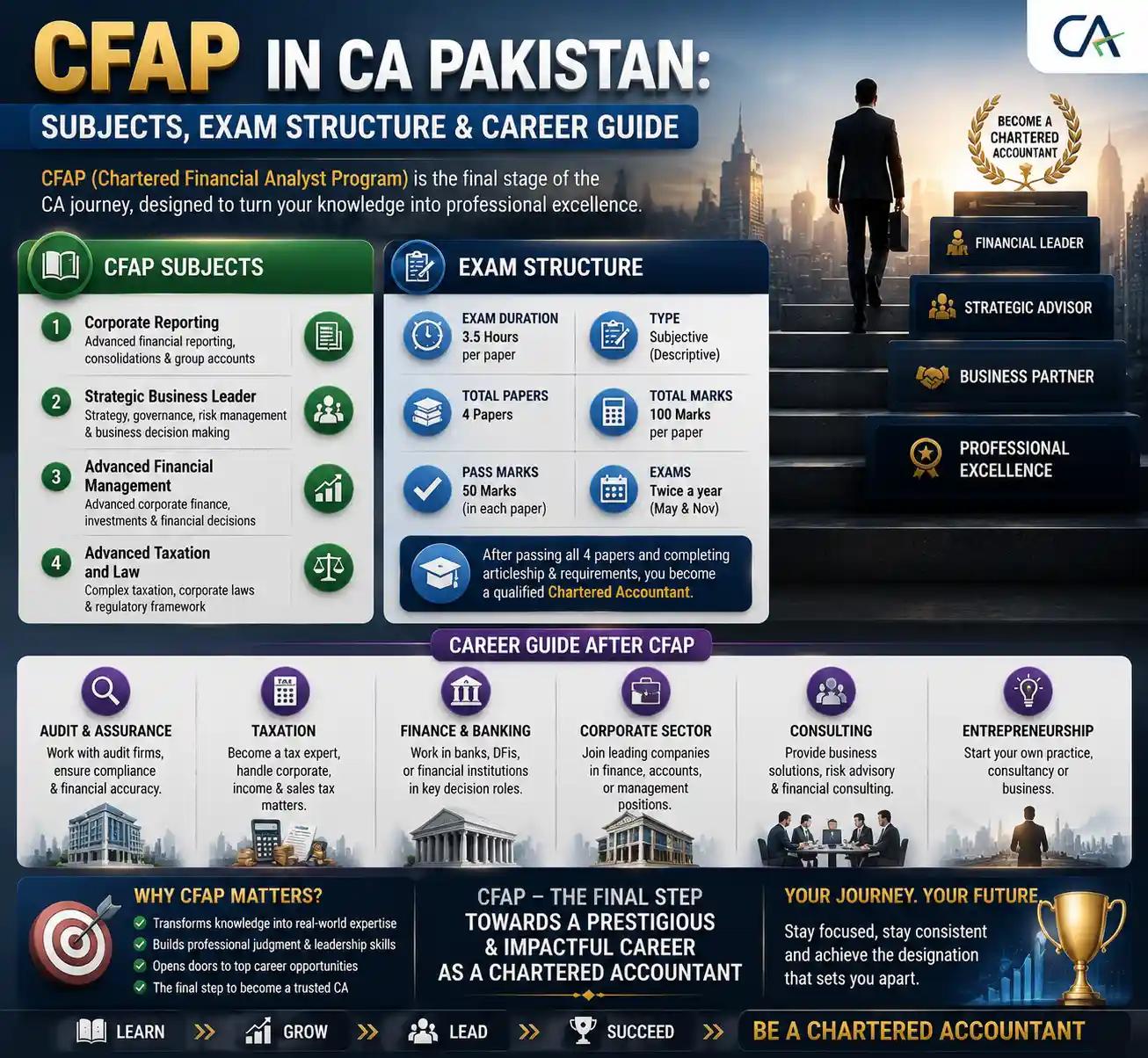
Quick Answer
CFAP (Certificate in Finance, Accounting and Reporting) is the final professional stage of the ICAP Chartered Accountancy (CA) qualification in Pakistan. It develops advanced skills in financial reporting, audit, taxation, corporate laws, and strategic business decision-making. After completing CFAP, passing the required examinations, and fulfilling ICAP requirements, candidates move closer to becoming fully qualified Chartered Accountants.
Introduction
You have completed AFC, cleared CAF Group A and CAF Group B, and progressed through the challenging stages of the ICAP Chartered Accountancy journey. Now you have reached the final professional stage — CFAP (Certificate in Finance, Accounting and Reporting).
CFAP in CA Pakistan is the stage where students move beyond learning accounting concepts and begin applying professional judgment to complex business situations. At this level, knowledge of financial reporting, taxation, auditing, corporate laws, and strategic finance comes together to prepare future Chartered Accountants for real-world professional responsibilities.
Unlike earlier stages, CFAP focuses heavily on analytical thinking, decision-making, and practical application. Students are expected to understand not only what accounting rules are, but also why and how they are applied in professional environments.
In this complete guide, you will learn everything about CFAP subjects, exam structure, eligibility, difficulty level, preparation strategy, passing criteria, and career opportunities after completing the final stage of the CA qualification in Pakistan.
For students seeking structured guidance during their CA journey, ICT Business School provides professional education and preparation support for CA and other accounting qualifications.
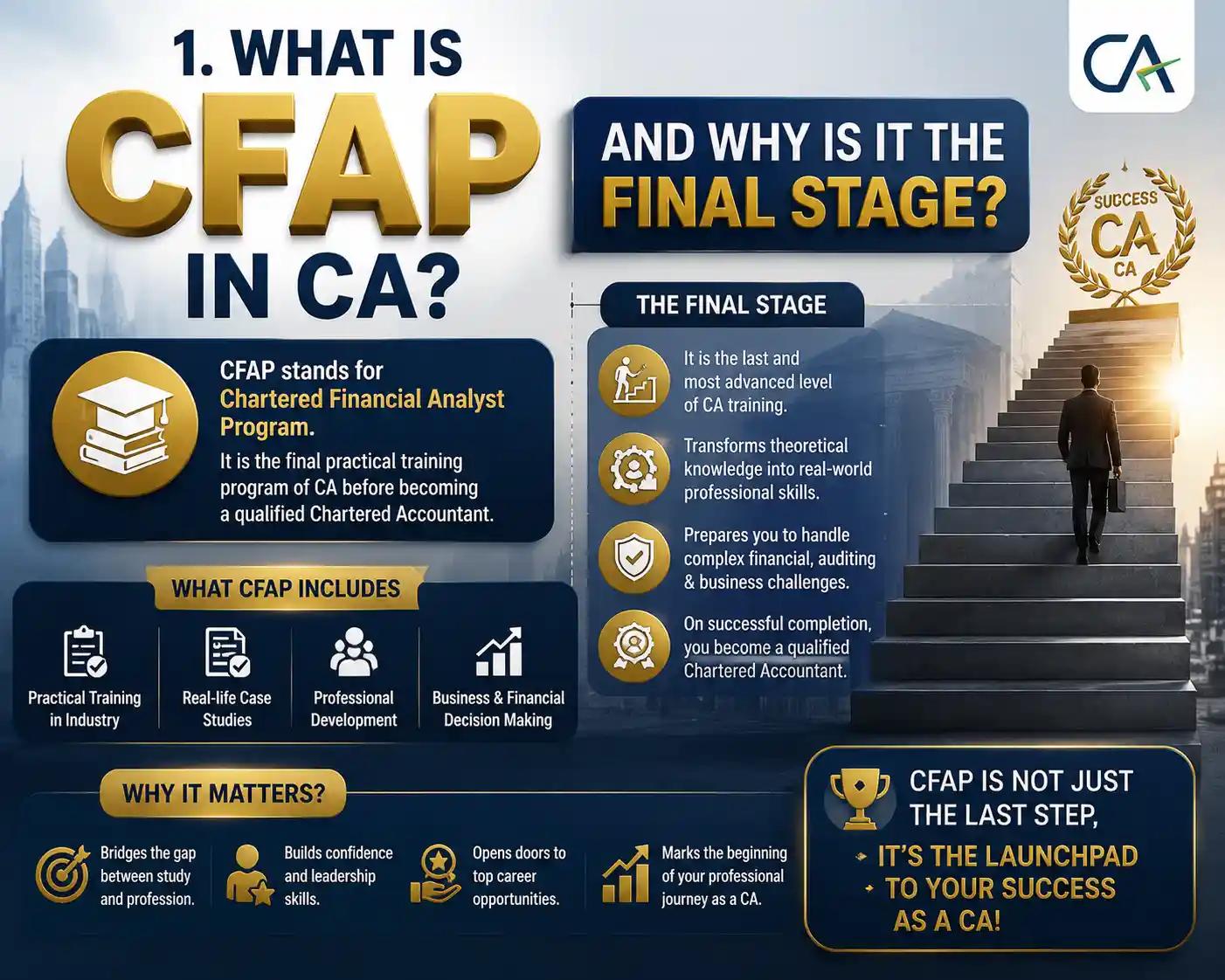
1. What is CFAP in CA and Why is it the Final Stage?
CFAP (Certificate in Finance, Accounting and Reporting) is the final professional examination stage of the ICAP Chartered Accountancy (CA) qualification in Pakistan. After successfully completing CFAP examinations, fulfilling practical training requirements, and meeting ICAP's membership criteria, candidates can progress toward becoming qualified Chartered Accountants.
CFAP is considered the final stage because it tests the highest level of technical knowledge, analytical ability, and professional judgment required in the CA pathway. While earlier stages such as CAF Group A and CAF Group B focus on building foundational and intermediate accounting concepts, CFAP prepares students to handle complex professional situations.
At the CFAP level, students are expected to apply advanced knowledge of areas such as financial reporting, audit and assurance, taxation, corporate laws, and strategic financial decision-making. The focus shifts from simply understanding concepts to analyzing real business scenarios and making professional judgments.
The purpose of CFAP is to ensure that future Chartered Accountants possess the technical competence and practical thinking required to work in senior accounting, audit, finance, and advisory roles. It represents the transition from a student learning accounting concepts to a professional capable of applying those concepts in real-world business environments.
For CA students in Pakistan, CFAP is the final academic milestone of the ICAP qualification journey and plays a critical role in preparing candidates for professional careers in accounting, finance, audit, and business advisory.
CA Qualification Stages Before and After CFAP
To understand the importance of CFAP in CA, it is important to first understand where it fits within the complete ICAP Chartered Accountancy pathway in Pakistan. The CA qualification is designed in progressive stages, where each level develops the knowledge and skills required for the next step.
Stage 1 — AFC (Assessment of Fundamental Competencies)
The AFC stage introduces students to the basic concepts required for starting their CA journey. It develops foundational understanding in areas such as accounting, business, and quantitative concepts.
Depending on their academic background and eligibility criteria, some students may receive exemptions from certain entry-level requirements.
Stage 2 — CAF (Certificate in Accounting and Finance)
The CAF stage is the intermediate level of the ICAP CA qualification. It is divided into:
- CAF Group A
- CAF Group B
During CAF, students build professional knowledge in areas including:
- Financial accounting
- Cost and management accounting
- Taxation
- Audit
- Business law
- Information technology
CAF creates the foundation required to move toward the advanced professional stage.
Stage 3 — CFAP (Certificate in Finance, Accounting and Reporting)
CFAP is the final professional examination stage of the CA qualification. At this level, students study advanced areas of accounting, finance, reporting, audit, taxation, and professional decision-making.
CFAP focuses on applying knowledge to complex business situations and developing the professional judgment expected from future Chartered Accountants.
After completing the required examinations and practical training requirements, candidates can progress toward ICAP membership and qualification as Chartered Accountants.
Stage 4 — MSA (Multi-Subject Assessment)
After completing the required professional stages, candidates may proceed to further assessments and requirements as prescribed under the current ICAP education scheme. These advanced stages help develop broader professional and strategic skills.
Practical Training Contract
Alongside the examination journey, CA students must complete practical training with an ICAP-approved training organization. This experience allows students to apply their academic knowledge in real professional environments, including audit, taxation, financial reporting, and advisory services.
Practical training is a vital part of becoming a Chartered Accountant because it develops workplace skills, professional ethics, and industry understanding.
For students in Pakistan, understanding the complete CA pathway helps them plan their journey more effectively. Each stage builds upon the previous one, and CFAP represents the transition from academic learning toward advanced professional competence.
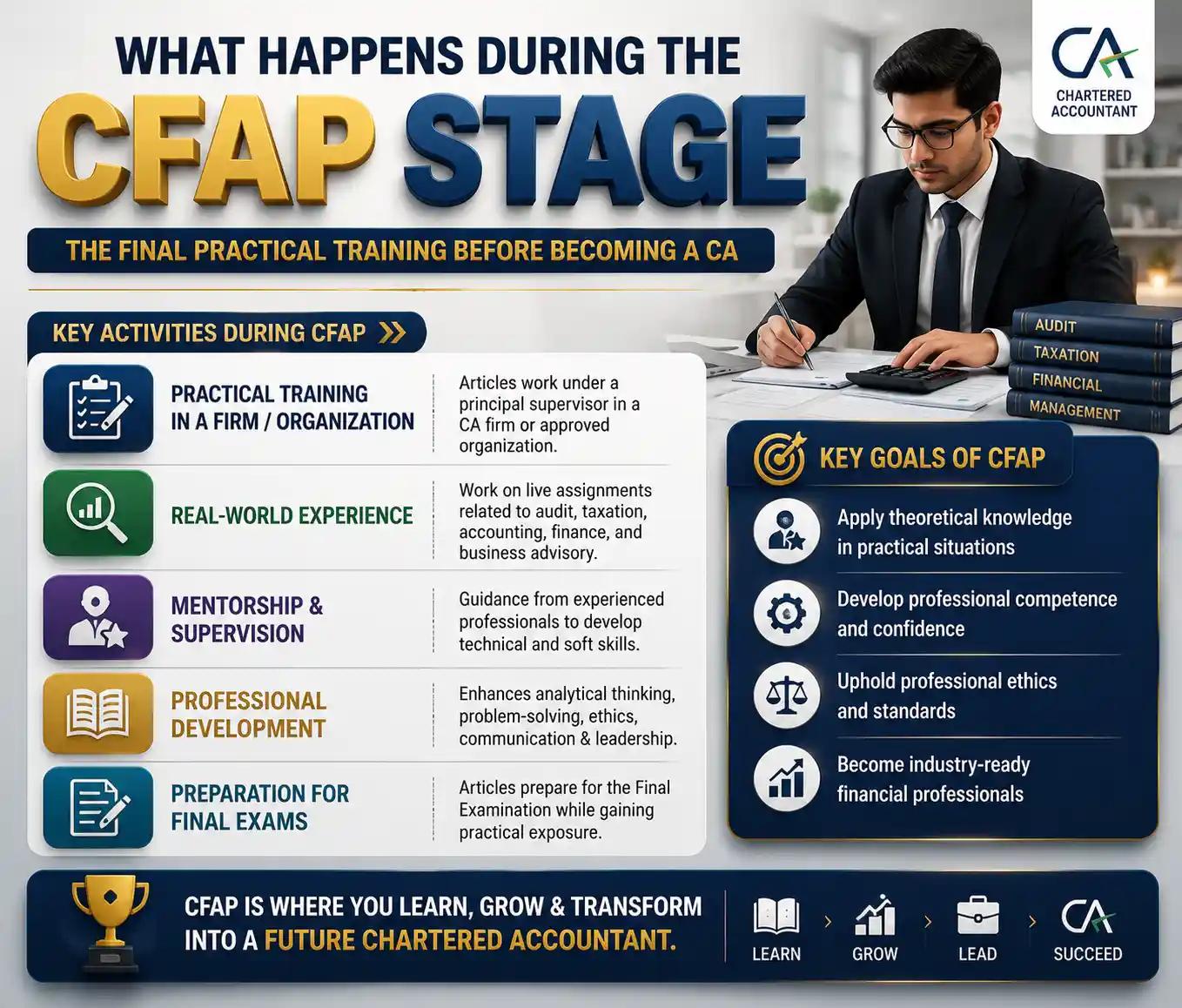
What Happens During the CFAP Stage in CA?
The CFAP stage is where the ICAP Chartered Accountancy journey reaches its highest level of professional learning. At this stage, students move beyond fundamental accounting concepts and develop the advanced technical knowledge, analytical ability, and professional judgment required from future Chartered Accountants.
Unlike earlier levels, CFAP examinations focus heavily on practical application. Students are expected to analyze complex business situations, apply relevant accounting and legal frameworks, evaluate professional risks, and provide well-supported recommendations.
CFAP consists of advanced professional papers that cover areas such as:
- Advanced financial reporting
- Corporate laws
- Taxation
- Audit and assurance
- Strategic financial management
- Professional decision-making
Each paper is designed to test more than theoretical knowledge. The examination approach requires students to demonstrate how they would apply concepts in real professional situations.
Alongside CFAP preparation, students continue gaining practical experience through their ICAP-approved training contract. This practical exposure plays a significant role because many concepts tested at the CFAP level are connected with real accounting, audit, taxation, and financial reporting scenarios.
ICAP structures the CFAP stage to develop professionals who can think critically, analyze business problems, and make informed financial decisions. Students are expected to combine their examination knowledge with practical experience to develop the professional competence required in senior accounting and finance roles.
By reaching the CFAP level, a student is no longer focused only on learning accounting rules—they are developing the judgment, analytical skills, and professional mindset required to work as a future Chartered Accountant.
4. CFAP Subjects and Paper Overview
The CFAP stage consists of advanced professional papers designed to develop the technical knowledge, analytical ability, and professional judgment required from future Chartered Accountants.
Unlike CAF-level subjects, CFAP papers focus more on practical application, complex business scenarios, and decision-making. Each paper represents an important area of professional accounting and finance.
CFAP-1 — Advanced Accounting and Financial Reporting
This paper focuses on advanced financial reporting concepts and the application of international accounting standards in complex situations.
Key areas include:
- Advanced IFRS application
- Group accounts and consolidation
- Complex financial reporting issues
- Specialized accounting treatments
Due to its technical nature and requirement for strong conceptual understanding, many students consider CFAP-1 one of the more challenging papers in the qualification.
CFAP-2 — Corporate Laws
CFAP-2 develops advanced understanding of corporate legal frameworks and their application in business environments.
The paper covers areas such as:
- Company law
- Corporate regulations
- Governance principles
- Legal decision-making in organizations
Students need both strong theoretical understanding and the ability to apply legal concepts to practical scenarios.
CFAP-3 — Strategy and Performance Management
This paper focuses on the role of finance professionals in strategic planning and business decision-making.
Major areas include:
- Strategic management
- Performance measurement
- Management control systems
- Business analysis
It helps students understand how financial information supports organizational strategy and long-term decision-making.
CFAP-4 — Audit, Assurance and Related Services
CFAP-4 builds upon earlier audit concepts and develops advanced professional audit skills.
The paper covers:
- Complex audit engagements
- Audit risks
- Assurance services
- Professional ethics
- Auditor responsibilities
Students are expected to analyze scenarios and apply professional judgment rather than rely only on memorized concepts.
CFAP-5 — Taxation
CFAP-5 focuses on advanced taxation concepts and practical application of Pakistan's tax framework.
Key areas include:
- Income tax
- Sales tax
- Tax planning
- Tax compliance
- Application of tax legislation
Since taxation rules and regulations continue to evolve, students need to stay updated with the latest requirements during their preparation.
CFAP-6 — Management Accounting
This paper develops advanced skills in management accounting and financial decision-making.
Topics include:
- Advanced cost management
- Budgeting
- Decision analysis
- Performance evaluation
- Financial planning
The subject is particularly useful for students interested in corporate finance, management roles, and strategic decision-making positions.
Understanding the nature of each CFAP subject helps students plan their preparation more effectively. Every paper requires a different approach, and success depends on developing both technical knowledge and the ability to apply concepts in professional situations.
5.CFAP Final Exam Pattern and Structure
| Topic | Details |
|---|---|
| Exam Structure | Each CFAP paper is worth 100 marks and has a duration of 3 hours. Papers are subjective and written (no MCQs). Questions are mostly scenario-based, requiring analysis and application. |
| Question Pattern | Papers include compulsory questions (must attempt) and optional questions (choose the required number). Compulsory questions usually cover high-weight topics. |
| Exam Sessions | ICAP conducts CFAP exams twice a year: Summer (June) and Winter (December). |
| Registration & Schedule | Exam registration, fee submission, and admit cards follow a fixed schedule published by ICAP before each session. |
| Exam Updates Source | ICT Business School blog provides updates on CFAP schedules, date sheets, and deadlines. |
| Marking Scheme | Focuses on structured answers, professional presentation, analysis, and judgment rather than memorization. |
| Result Timeline | Results are announced 6–8 weeks after exams via the ICAP portal, with subject-wise marks and pass/fail status. |
| Distinction | Students scoring 75 or more marks in a paper receive distinction status on their ICAP profile. |
| Passing Criteria | Minimum passing mark is 50 out of 100 per paper. There is no aggregate system; each paper must be passed individually. |
| Permanent Credit | Once a paper is passed, it remains valid permanently and does not need to be retaken. |
Understanding the CFAP Exam Structure
The CFAP exam structure is designed to test professional-level understanding rather than simple theoretical knowledge. At this stage, students are expected to analyze complex scenarios, apply accounting and business principles, and present well-supported professional judgments.
Unlike earlier CA levels, CFAP papers require a deeper understanding of concepts and strong answer presentation skills. Students should focus on practicing past papers, understanding examiner expectations, and improving their ability to solve scenario-based questions.
Each CFAP paper requires a different preparation approach. Technical papers demand extensive practice, while analytical papers require strong conceptual clarity and professional judgment. A balanced study plan helps students manage the workload effectively and improve their chances of success.
CFAP Eligibility Criteria in CA Pakistan
Before attempting CFAP in CA Pakistan, students must fulfill certain requirements defined under the ICAP Chartered Accountancy pathway. Since CFAP is the final professional stage of CA, students are expected to complete the earlier qualification requirements and gain sufficient academic and practical preparation.
Completion of CAF Requirements
The first requirement for entering the CFAP stage is completing the required CAF level requirements. Students must successfully progress through the foundational and intermediate stages of the CA qualification before moving toward advanced CFAP examinations.
CAF provides the technical foundation required for CFAP subjects, including financial reporting, taxation, audit, and business concepts.
Practical Training Requirements
Practical experience is an essential part of the CA journey. Students must fulfill the required training requirements under ICAP's approved framework before completing the qualification process.
This practical exposure helps students connect theoretical concepts with real professional situations in areas such as:
- Audit and assurance
- Taxation
- Financial reporting
- Business advisory
CFAP Paper Registration
Students must register for their selected CFAP examinations according to ICAP's announced examination schedule and registration requirements.
It is important to check the latest ICAP guidelines regarding:
- Examination registration deadlines
- Paper attempts
- Applicable requirements
Paper Attempt Requirements
Certain CFAP papers may have specific sequencing or prerequisite requirements under the current ICAP scheme. Students should always confirm the latest rules before planning their examination attempts.
Academic Requirements
Students must also fulfill the educational requirements applicable at the time of their initial registration with ICAP. Candidates entering through different routes must meet the eligibility criteria defined by ICAP for their respective pathway.
Understanding these requirements before starting CFAP helps students plan their CA journey effectively and avoid delays during the final stage of qualification.
CFAP Exemptions in CA Pakistan
Students often ask whether they can receive exemptions in CFAP in CA Pakistan based on previous qualifications such as ACCA, CIMA, ICAEW, or other recognized professional credentials.
Exemption policies depend on the current rules and recognition arrangements defined by ICAP. Candidates should always verify the latest exemption criteria directly from ICAP before planning their qualification pathway.
ACCA and Professional Qualification Exemptions
Students who have completed other professional accounting qualifications, such as ACCA, may be eligible for certain exemptions or recognition benefits depending on the current ICAP policies and agreements.
This is particularly relevant for students who pursue multiple accounting qualifications because previous knowledge in areas such as:
- Financial reporting
- Audit
- Taxation
- Management accounting
can provide a strong academic advantage during the CA journey.
Recognition of Other Accounting Qualifications
Candidates holding qualifications from internationally recognized accounting bodies may also have opportunities under applicable ICAP recognition arrangements.
Since these agreements and exemption policies can be updated over time, students should confirm the latest requirements before making decisions about their qualification route.
Important Note About CFAP Exemptions
An exemption means that a candidate is not required to attempt a specific paper if they meet the applicable criteria set by ICAP. However, students should understand that exemptions do not replace the overall qualification requirements.
Before applying for any exemption, always review:
- Current ICAP regulations
- Eligibility requirements
- Applicable documentation
- Latest exemption announcements
Understanding exemption opportunities can help students plan a more efficient pathway toward completing their CA qualification in Pakistan.
CFAP Difficulty Level and How to Pass on Your First Attempt
The CFAP stage is considered one of the most challenging levels of the ICAP Chartered Accountancy qualification in Pakistan. This difficulty exists because CFAP is designed to test professional-level understanding, analytical thinking, and decision-making skills rather than simple theoretical knowledge.
At this stage, students are expected to analyze complex business situations, apply accounting and financial principles, and provide solutions from a professional perspective. The challenge is not only the amount of syllabus but also the ability to connect concepts and apply them under examination pressure.
Which CFAP Papers Are Considered More Challenging?
CFAP-1 — Advanced Accounting and Financial Reporting
Many students consider CFAP-1 one of the most demanding papers in the CA qualification. The paper requires strong command over advanced financial reporting concepts, accounting standards, and complex reporting scenarios.
Students need to develop the ability to:
- Apply IFRS concepts practically
- Analyze complex accounting treatments
- Solve detailed financial reporting questions
- Manage time effectively during examinations
Consistent practice and conceptual clarity are essential for success in this paper.
CFAP-5 — Taxation
CFAP-5 is another paper that students often find challenging because taxation requires both technical understanding and continuous awareness of changes in Pakistan's tax framework.
To perform well, students need to:
- Understand tax concepts clearly
- Practice different scenarios
- Stay updated with applicable tax regulations
- Improve calculation accuracy
How to Pass CFAP in Your First Attempt
Students who successfully clear CFAP papers usually follow a structured preparation approach rather than relying on last-minute study.
Start Preparation Early
For demanding papers, begin preparation several months before the examination session. Advanced CFAP topics require time for understanding, practice, revision, and past paper analysis.
Focus on Conceptual Understanding
CFAP is not a memorization-based level. Students should focus on understanding:
- Why a concept works
- How it applies in professional situations
- How to present a solution logically
Practice ICAP Past Papers
Past papers with suggested answers are among the most valuable resources for CFAP preparation.
Students should practice:
- Complete papers under exam conditions
- Answer presentation techniques
- Time management
- Examiner expectations
Develop Professional Answer Writing
At CFAP level, marks are not only awarded for correct knowledge but also for how effectively you analyze and present your answer.
Strong answers usually include:
- Clear reasoning
- Professional recommendations
- Logical structure
- Relevant technical references
Expert Guidance
The key difference between students who struggle and students who succeed in CFAP is consistency. A realistic study plan, regular practice, and continuous improvement are more effective than studying large amounts of content without direction.
Treat CFAP as professional training, not just an examination. The skills you develop during this stage will directly support your future career as a Chartered Accountant
Career Opportunities After Completing CFAP and CA Qualification
Completing the CFAP stage and fulfilling the requirements of the ICAP Chartered Accountancy qualification opens the door to some of the most respected career opportunities in accounting, finance, audit, and business advisory.
A qualified Chartered Accountant is valued because of the combination of technical knowledge, practical training, analytical ability, and professional judgment developed throughout the CA journey.
Accounting and Audit Firms
Many qualified CAs begin or continue their careers with leading accounting and professional services firms. These roles provide exposure to different industries, complex financial assignments, and professional advisory work.
Career opportunities include:
- Audit Manager
- Tax Manager
- Advisory Consultant
- Financial Reporting Specialist
- Transaction Advisory Professional
Working in professional firms provides valuable experience and creates strong opportunities for long-term career growth.
Corporate Finance and CFO Career Track
One of the most attractive career paths for Chartered Accountants is corporate finance. Organizations across Pakistan value CAs for their expertise in financial reporting, planning, compliance, and strategic decision-making.
A typical career progression may include:
- Finance Manager
- Senior Finance Manager
- Financial Controller
- Head of Finance
- Chief Financial Officer (CFO)
Many senior finance leaders in Pakistan's corporate sector have built their careers through the ICAP CA pathway.
Banking, Investment and Financial Advisory
The analytical skills developed during CFAP are highly relevant for careers in:
- Banking
- Financial advisory
- Corporate finance
- Investment analysis
- Mergers and acquisitions
CA professionals are valued in these areas because they understand financial statements, business performance, risk analysis, and decision-making.
Taxation and Business Advisory
Advanced taxation knowledge gained during the CA journey creates opportunities in tax consulting, compliance, and business advisory roles.
Qualified CAs can work with:
- Accounting firms
- Corporate tax departments
- Advisory organizations
- Independent consulting practices
Entrepreneurship and Independent Practice
Many Chartered Accountants choose to build their own professional careers by establishing:
- Accounting firms
- Tax consultancy practices
- Financial advisory businesses
- Business consulting services
The credibility and professional recognition associated with the CA qualification provide a strong foundation for entrepreneurship.
For students in Pakistan, completing CFAP is not just the end of an examination journey—it is the beginning of a professional career with opportunities across multiple industries, organizations, and international markets.
Expert Guidance
One important thing every CA student in Pakistan should understand is that completing CFAP is not only about clearing the final examinations — it is about developing the mindset of a professional Chartered Accountant. At this stage, students should shift their focus from simply preparing for papers to building the skills that will define their future careers.
A strong CFAP preparation approach requires three things: technical knowledge, practical exposure, and professional thinking. Do not study subjects like Financial Reporting, Taxation, or Audit only from an examination perspective. Try to understand how these concepts are applied in real businesses, because this is the same approach expected from qualified CAs in professional roles.
Students who perform well at the CFAP level usually focus on understanding concepts deeply, practicing scenario-based questions, improving answer presentation, and learning from professional experience gained during training. Your articleship or practical training should not be treated as just a requirement — it is where you develop the confidence to handle real accounting and business challenges.
Remember, CFAP is the stage where you transition from being a CA student to thinking like a future finance professional. The knowledge, discipline, and professional judgment you develop during this phase will continue to support you throughout your career.
Why Choose ICT Business School for Your CA and CFAP Journey?
ICT Business School at https://www.ictbusinessschool.com/ is one of Pakistan's most trusted educational institutes for professional accounting, finance, and business qualifications. Our programs include CA (ICAP pathway), ACCA, CIA (Internal Audit), CMA, HND (Business) at https://www.ictbusinessschool.com/courses/hnd-higher-national-diploma, Pearson BTEC Level 3 at https://www.ictbusinessschool.com/courses/pearson-btec-level-3, Pearson BTEC Level 7 at https://www.ictbusinessschool.com/courses/level-7-extended-diploma, and O-Level programs at https://www.ictbusinessschool.com/courses/o-level-program.
Our experienced faculty at https://www.ictbusinessschool.com/faculty brings real-world professional expertise to every session, ensuring students develop both the theoretical knowledge and the applied judgment that CFAP demands. We offer structured coaching batches, regular mock exams, detailed performance feedback, and a genuinely student-first learning environment.
Explore advanced corporate and taxation courses at ICT — from CAF preparation to full CFAP coaching — at https://www.ictbusinessschool.com/courses. Learn more about who we are at https://www.ictbusinessschool.com/about. For more educational guidance and resources, also visit ict.edu.pk at https://ict.edu.pk and idtpakistan.pk at https://idtpakistan.pk/courses/.
FAQs About CFAP in CA
Q: What is CFAP in CA? CFAP stands for Certificate in Finance, Accounting and Reporting Practices. It is the final examination stage of the ICAP CA qualification in Pakistan. Clearing all six CFAP papers, combined with completing the mandatory training contract, leads to full Chartered Accountant membership with ICAP.
Q: How many papers are in CFAP? CFAP consists of six papers: CFAP-1 (Advanced Accounting and Financial Reporting), CFAP-2 (Corporate Laws), CFAP-3 (Strategy and Performance Management), CFAP-4 (Audit, Assurance and Related Services), CFAP-5 (Taxation), and CFAP-6 (Management Accounting).
Q: Is CFAP the final stage of CA in Pakistan? Yes, CFAP is the final examination stage of the ICAP CA qualification. After clearing all six CFAP papers and fulfilling the mandatory training contract requirements, a student achieves full CA membership with ICAP and becomes a qualified Chartered Accountant.
Q: How difficult is CFAP compared to CAF? CFAP is significantly more difficult than CAF. Where CAF papers test foundational and intermediate knowledge, CFAP papers test advanced professional judgment in complex, scenario-based formats. CFAP-1 in particular is widely regarded as the hardest paper in the entire CA qualification. However, with structured preparation and experienced coaching, students do pass CFAP papers in their first attempt.
Q: What is the passing mark for CFAP papers? The passing mark for each CFAP paper is 50 out of 100. Papers are passed individually with no group aggregate system. Once a paper is passed, the credit is permanent. Scoring 75 or above earns distinction status.
Q: How long does CFAP take to complete? Most students spread their CFAP papers across three to four exam sessions, which translates to roughly 18 months to 2 years for the examination stage alone. Combined with training contract requirements, the total CA qualification from AFC entry to full membership typically takes 5 to 6 years for most students. Students with exemptions can complete the journey faster.
Q: Which CFAP subject is the hardest? CFAP-1 (Advanced Accounting and Financial Reporting) is consistently rated the hardest paper in CFAP and in the entire CA qualification. CFAP-5 (Taxation) is the second most challenging paper. CFAP-3 (Strategy and Performance Management) and CFAP-6 (Management Accounting) are generally considered the most approachable papers in the CFAP series.
Q: Can I get exemptions in CFAP? Yes, ICAP grants exemptions from certain CFAP papers to candidates holding qualifying professional credentials, including ACCA and other recognized international accounting qualifications. Contact ICT Business School's admissions team at https://www.ictbusinessschool.com/contact for guidance on exemptions relevant to your specific situation.
Conclusion
CFAP in CA is the final and most demanding stage of the ICAP Chartered Accountancy qualification in Pakistan. It is the stage where everything you have studied and practiced across years of effort comes together into a professional credential that is recognized, respected, and genuinely valuable across Pakistan and internationally.
The six CFAP papers — covering advanced financial reporting, corporate laws, strategy, audit, taxation, and management accounting — test not just knowledge but the ability to think and act like a true professional. Clearing them requires early preparation, deep conceptual understanding, consistent past paper practice, and the kind of guided support that experienced coaching provides.
For students at every stage of this journey — whether you are just deciding to pursue CA, currently working through CAF, or actively preparing for CFAP — ICT Business School is here to support you every step of the way. Our comprehensive programs in CA (ICAP pathway), ACCA, CIA, CMA, HND, and Pearson BTEC qualifications make us a complete one-stop educational partner for your entire professional development journey in accounting and finance.
Take the next step today. Explore all programs at https://www.ictbusinessschool.com/courses or contact our team at https://www.ictbusinessschool.com/contact to discuss your CA and CFAP preparation plan. Your journey to becoming a Chartered Accountant — and the extraordinary career it unlocks — starts with one decision. Make it today.