
Looking to build a successful career in accounting and finance? The Certified Management Accountant (CMA) certification is one of the most valuable professional qualifications for finance professionals in Pakistan. In this complete guide, you'll discover the best career opportunities after CMA, expected salary in Pakistan, top job roles, career growth, and why the CMA qualification can help you achieve long-term success in the finance industry.
Quick Answer:
The Certified Management Accountant (CMA) certification opens the door to rewarding career opportunities in accounting, finance, management accounting, financial planning, budgeting, auditing, and business strategy. Recognized by employers in Pakistan and around the world, the CMA qualification helps professionals build careers in multinational companies, banks, manufacturing organizations, consulting firms, and the corporate sector. With the right experience, CMA professionals can pursue high-paying roles, strong career growth, and international job opportunities.
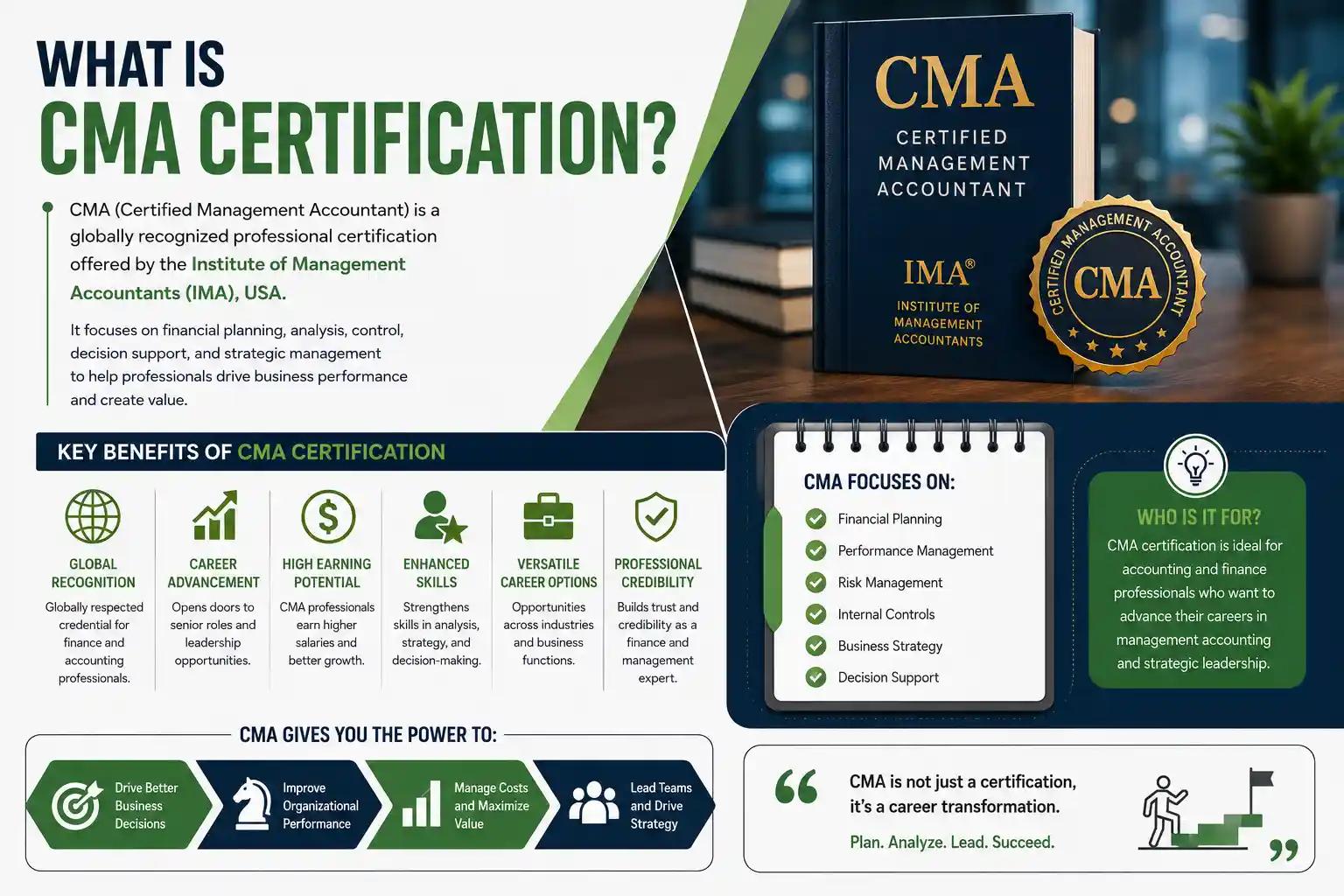
What is CMA Certification?
The Certified Management Accountant (CMA) certification is a globally recognized professional qualification designed for individuals pursuing careers in management accounting, financial management, business strategy, and corporate finance. Awarded by the Institute of Management Accountants (IMA), USA, the CMA certification validates your expertise in financial planning, performance management, budgeting, cost management, strategic decision-making, internal controls, and financial analysis.
The CMA certification consists of two exam parts, each focusing on the practical knowledge and skills required for modern finance professionals:
- Part 1 – Financial Planning, Performance, and Analytics
- Part 2 – Strategic Financial Management
Earning the CMA certification prepares professionals for leadership roles in accounting, finance, budgeting, business analysis, and financial management. For students and professionals in Pakistan, the CMA qualification provides a strong pathway to careers in multinational companies, banks, manufacturing organizations, consulting firms, and global finance roles.
To become a CIA-certified professional, candidates must meet specific CIA certification requirements including a relevant degree, work experience in internal auditing, and a character reference. Students interested in how to become a certified internal auditor can explore the full eligibility and CIA certification process step by step at ICT Business School's Courses Page.
Key Facts About CMA Certification
- CMA certification is awarded by the Institute of Management Accountants (IMA), USA, one of the world's leading professional accounting organizations.
- The CMA qualification is globally recognized and respected by employers across accounting, finance, banking, manufacturing, consulting, and multinational companies.
- The CMA exam consists of two parts, covering financial planning, performance management, business analytics, financial management, and strategic decision-making.
- Candidates generally need a bachelor's degree and two years of relevant professional experience to earn the CMA certification (experience can be completed before or within the allowed certification period according to IMA requirements).
- The CMA qualification is ideal for professionals pursuing careers in management accounting, financial analysis, budgeting, business finance, cost management, and corporate leadership.
- In Pakistan, the total CMA certification cost varies depending on IMA membership, entrance fees, exam fees, and preparation expenses.
- CMA-certified professionals often enjoy strong career growth, competitive salaries, and international job opportunities compared to non-certified finance professionals.
- For students and professionals in Pakistan, ICT Business School provides guidance and preparation pathways for individuals planning to pursue the CMA certification.
Job Opportunities After CMA Certification In Pakistan
One of the most frequently asked questions is, "What jobs can I get after CMA certification?" The good news is that CMA-certified professionals are in high demand across accounting, finance, banking, manufacturing, consulting, and multinational organizations. The CMA qualification equips you with expertise in financial management, strategic planning, budgeting, cost management, and business decision-making, making you a strong candidate for leadership and management roles in Pakistan and internationally.
Accounting and Finance Roles
- Management Accountant
- Cost Accountant
- Financial Accountant
- Senior Accountant
- Finance Executive
- Finance Manager
- Financial Controller
Financial Planning and Analysis (FP&A)
- Financial Analyst
- Senior Financial Analyst
- FP&A Analyst
- Budget Analyst
- Business Finance Analyst
Management and Leadership Roles
- Finance Manager
- Commercial Finance Manager
- Chief Financial Officer (CFO)
- Corporate Finance Manager
- Business Controller
Audit and Risk Management Roles
- Internal Auditor
- Internal Audit Manager
- Risk Analyst
- Risk Manager
- Compliance Officer
- Internal Controls Specialist
Banking and Corporate Sector
- Credit Analyst
- Investment Analyst
- Treasury Analyst
- Banking Operations Manager
- Corporate Finance Executive
Consulting and Advisory
- Financial Consultant
- Business Consultant
- Strategy Consultant
- ERP Finance Consultant
- Performance Management Consultant
Students preparing for these roles can also explore related programs like CA (ICAP), ACCA, and CMA at ICT Business School to build a multi-dimensional accounting and finance career path.
Salary and Earning Potential After CIA Certification
One of the biggest reasons professionals choose the Certified Management Accountant (CMA) qualification is its strong earning potential and global career opportunities. CMA-certified professionals are highly valued for their expertise in financial management, strategic planning, budgeting, and business decision-making. Salaries vary depending on factors such as experience, industry, job role, employer, and country. In Pakistan, experienced CMA professionals can earn competitive salaries in multinational companies, banks, manufacturing firms, and large corporate organizations, while international markets often offer significantly higher compensation packages.
The table below provides an estimated comparison of CMA salaries across different experience levels and countries. Actual salaries may vary based on qualifications, industry, and employer.
| Country | Entry Level (0–2 Years) | Mid-Level (3–7 Years | Senior Level (8+ Years) |
|---|---|---|---|
| Pakistan | PKR 80,000–180,000/month | PKR 180,000–400,000/month | PKR 400,000+/month |
| United Kingdom | £35,000–£50,000/year | £50,000–£75,000/year | £75,000+/year |
| United States | USD 70,000–95,000/year | USD 95,000–130,000/year | USD 130,000+/year |
The CIA certified salary in Pakistan is growing rapidly, particularly in the banking sector, telecom, and manufacturing industries. For professionals aiming at the salary of CIA certified professionals in Dubai and USA, the earning potential is considerably higher compared
Is CIA Certification Worth It for Your Career In Pakistan ?
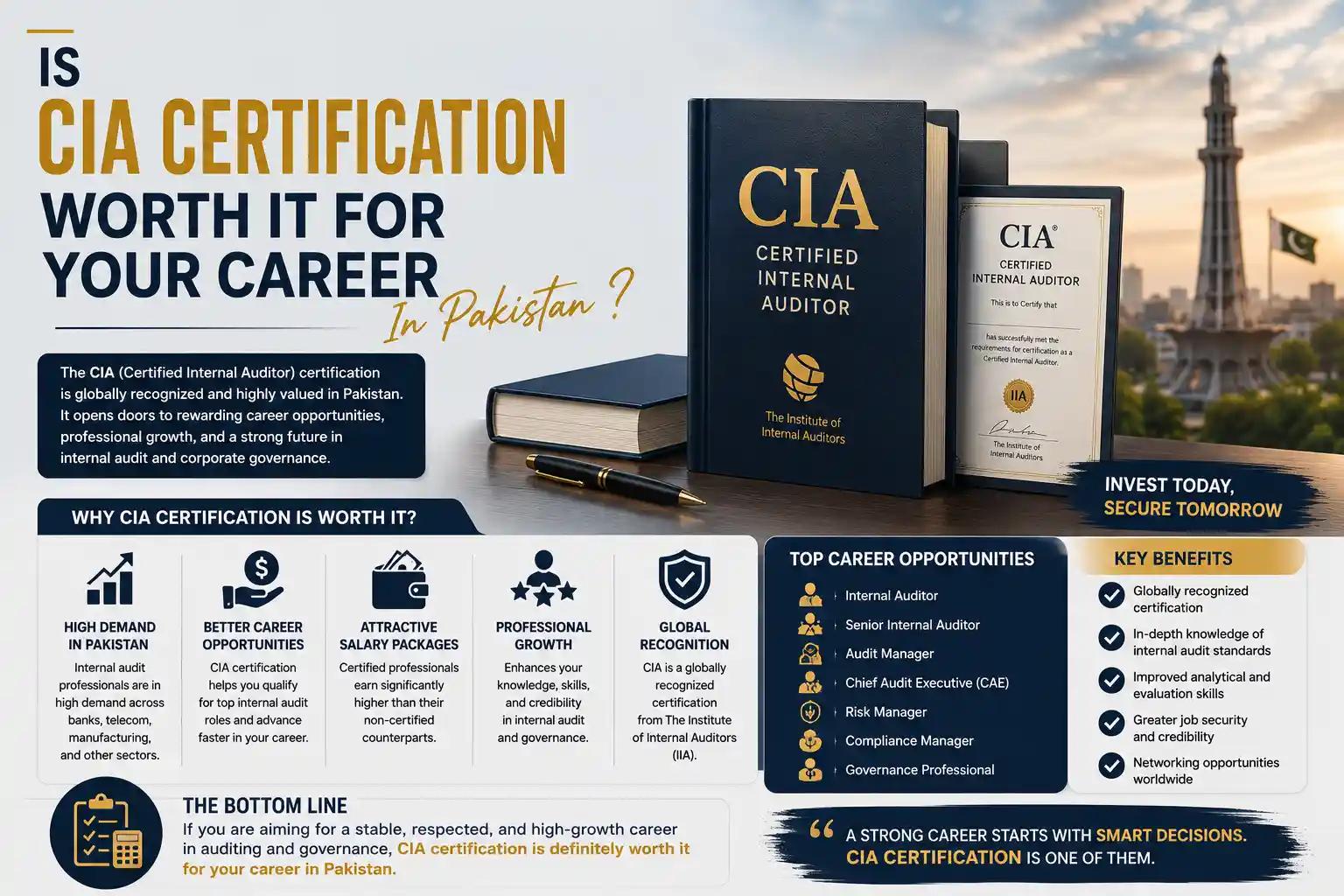
For most accounting and finance professionals, the answer is yes. The Certified Management Accountant (CMA) certification is a valuable investment for individuals who want to build a successful career in management accounting, financial management, business strategy, and corporate finance. It equips professionals with practical skills that are highly sought after by employers in Pakistan and around the world.
The CMA qualification is particularly beneficial for students and professionals who want to advance into leadership roles, increase their earning potential, and access international career opportunities. Whether your goal is to work in multinational companies, commercial banks, manufacturing organizations, consulting firms, or the public sector, the CMA certification can strengthen your professional profile and improve your long-term career prospects.
For professionals in Pakistan, the demand for skilled management accountants continues to grow as organizations focus more on financial planning, performance management, cost optimization, and strategic decision-making. Combined with relevant work experience and strong technical skills, the CMA certification can provide a competitive advantage in both the local and international job market.
CMA vs ACCA Comparison
| Feature | CMA | ACCA |
|---|---|---|
| Primary Focus | Management Accounting & Financial Management | Financial Accounting, Audit & Taxation |
| Best Career Roles | Finance Manager, Cost Accountant, FP&A Analyst, CFO | Auditor, Tax Consultant, Financial Accountant, Audit Manager |
| Top Industries | Manufacturing, FMCGs, Banking, Multinationals | Audit Firms, Big Four, Banking, Tax & Consulting |
| Global Recognition | High (IMA USA) | Very High (UK & Global) |
| Career Growth | Corporate Finance & Leadership | Audit, Accounting & Finance |
| Best For | Professionals aiming for management and leadership roles | Professionals interested in audit, taxation, and financial reporting |
Both qualifications complement each other. Many professionals pursue ACCA first and then add CIA to specialize in internal audit. ICT Business School offers both ACCA and CIA programs, making it easy to plan a dual-qualification career path.
Career Path After CMA Certification
CMA Salary in Pakistan
One of the biggest advantages of earning the CMA certification is its strong earning potential in Pakistan. CMA-qualified professionals are highly valued by multinational companies, commercial banks, manufacturing organizations, FMCG companies, consulting firms, and large corporate groups. Salaries vary depending on experience, industry, and job role. As professionals move from entry-level positions to Finance Manager, Financial Controller, and Chief Financial Officer (CFO) roles, their earning potential increases significantly.
Jobs After CMA Certification
The CMA certification prepares professionals for a wide range of finance and accounting careers in Pakistan. Popular job roles include Management Accountant, Cost Accountant, Financial Analyst, Budget Analyst, Finance Executive, Internal Auditor, Finance Manager, Financial Controller, Head of Finance, and Chief Financial Officer (CFO). These roles are available in commercial banks, manufacturing companies, FMCG organizations, healthcare, telecommunications, consulting firms, and other corporate sectors across Pakistan.
Expert Guidance
Choosing the Certified Management Accountant (CMA) qualification is a smart career decision for students and finance professionals who want to build a successful future in accounting, financial management, and business leadership. The following practical tips can help you maximize the value of your CMA certification and accelerate your career growth in Pakistan.
- Build a strong understanding of financial planning, cost management, budgeting, performance management, and strategic decision-making before attempting the CMA exams.
- Follow a structured study plan and use official IMA-approved study materials along with regular mock exams and practice questions.
- Gain practical experience in accounting, finance, budgeting, auditing, or financial analysis while pursuing the CMA qualification to strengthen both your knowledge and employability.
- Develop advanced skills in Microsoft Excel, ERP systems (SAP, Oracle, Odoo), Power BI, and financial analysis, as these are highly valued by employers in Pakistan.
- Stay updated with financial reporting standards, corporate governance, taxation, budgeting, and business analytics to remain competitive in today's finance industry.
- Build a professional network by participating in finance seminars, workshops, and accounting events in Pakistan to expand your career opportunities.
- If you are planning a long-term career in finance and leadership, consider combining the CMA qualification with other professional certifications such as ACCA or CA, depending on your career goals.
- If you need professional guidance for CMA preparation or career planning, ICT Business School provides training and support to help students and professionals achieve their career objectives.
Courses at ICT Business School
ICT Business School is one of Pakistan's most trusted educational institutes for professional accounting, audit, and business qualifications. Whether you are starting from scratch or advancing your career, ICT Business School provides structured, expert-led programs:
- CIA (Certified Internal Auditor) — Full preparation support for all three CIA exam parts
- CA (ICAP Pathway) — Pakistan's top chartered accountancy qualification
- ACCA — Globally recognized accounting and finance certification
- CMA — Cost and management accounting for corporate finance roles
- HND (Higher National Diploma in Business) — Explore HND here
- Pearson BTEC Level 3 — Explore BTEC Level 3 here
- Pearson BTEC Level 7 Extended Diploma — Explore Level 7 here
- O Level and A Level Language Courses — Explore O Level Programs
The faculty at ICT Business School brings real-world audit and finance experience into the classroom. Meet the faculty and understand why thousands of students choose ICT for their professional certifications.
For more career-focused learning insights, visit the ICT Business School Blog.
How to Learn: Free and Paid Options
Whether you have a budget or prefer free resources, there are multiple options to prepare for the CIA certification:
Paid Options
- ICT Business School CIA preparation classes (highly recommended for Pakistan-based students)
- IIA Learning Center — official CIA study materials and mock exams
- Gleim CIA Review — one of the most popular CIA prep courses globally
- Wiley CIA Exam Review — comprehensive study books and online access
For further external support and professional development resources, explore ICT's partner network at ict.edu.pk and BACO Consultants for industry-level advisory and tools at Mega Free Tools.
FAQs
What is the career scope after CMA certification in Pakistan?
The CMA certification offers excellent career opportunities in Pakistan across accounting, finance, banking, manufacturing, FMCG, consulting, healthcare, and the corporate sector. CMA-qualified professionals can work in roles such as Management Accountant, Financial Analyst, Cost Accountant, Finance Manager, Financial Controller, and Chief Financial Officer (CFO).
Is CMA certification in demand in Pakistan?
Yes. The demand for CMA-certified professionals is increasing in Pakistan as organizations seek experts in financial management, budgeting, cost control, business strategy, and performance management. Multinational companies, commercial banks, and large corporate organizations actively recruit CMA-qualified professionals.
What jobs can I get after CMA certification?
After earning the CMA certification, you can work as a Management Accountant, Cost Accountant, Financial Analyst, Budget Analyst, Finance Executive, Internal Auditor, Finance Manager, Financial Controller, Business Finance Manager, or Chief Financial Officer (CFO), depending on your experience and skills.
What is the salary after CMA certification in Pakistan?
The salary of a CMA-certified professional in Pakistan depends on experience, industry, and employer. Entry-level professionals generally receive competitive salaries, while experienced Finance Managers, Financial Controllers, and CFOs earn significantly higher compensation packages, particularly in multinational companies and large corporate organizations.
Which industries hire CMA-certified professionals in Pakistan?
CMA professionals are employed in commercial banks, manufacturing companies, FMCG organizations, healthcare, telecommunications, consulting firms, logistics companies, technology firms, and the public sector. Their expertise in financial planning and business strategy makes them valuable across multiple industries.
Is CMA better than ACCA?
The right qualification depends on your career goals. CMA is ideal for professionals interested in management accounting, financial planning, business strategy, and corporate leadership. ACCA is a broader qualification that focuses on financial accounting, auditing, taxation, and finance. Both qualifications offer excellent career opportunities in Pakistan.
Can I get a job in multinational companies after CMA?
Yes. Many multinational companies operating in Pakistan hire CMA-certified professionals for finance, accounting, budgeting, cost management, financial analysis, and business planning roles. The qualification is highly respected by employers looking for strong financial management professionals.
How long does it take to complete the CMA certification?
The time required depends on your study schedule and exam preparation. Most candidates complete the CMA qualification within 12 to 18 months, although the duration may vary based on individual circumstances and exam success.
Is CMA certification worth it in Pakistan?
Yes. The CMA certification is considered a valuable investment for students and professionals who want to build a successful career in accounting, finance, and corporate management. It improves job opportunities, supports long-term career growth, and enhances earning potential in Pakistan.
Conclusion
The Certified Management Accountant (CMA) certification is an excellent choice for students and professionals who want to build a successful career in accounting, finance, and business management. From entry-level finance roles to senior leadership positions such as Finance Manager, Financial Controller, and Chief Financial Officer (CFO), the CMA qualification provides a clear path for career growth, higher earning potential, and long-term professional success in Pakistan.
Whether your goal is to work in commercial banks, multinational companies, manufacturing organizations, FMCG companies, consulting firms, or the corporate sector, the CMA certification equips you with the practical knowledge and strategic financial skills that employers value. Combined with relevant work experience and continuous professional development, CMA can help you achieve faster promotions and stronger career prospects.
If you're ready to advance your career in finance and management accounting, now is the ideal time to start your CMA journey. ICT Business School offers expert guidance, structured preparation, and professional support to help you achieve your certification and build a successful career in Pakistan.
Take the first step today. Contact ICT Business School to enroll in the CMA and begin your journey toward a globally recognized internal audit career. Explore all available courses at ictbusinessschool.com/courses and let Pakistan's most trusted institute guide your professional future.