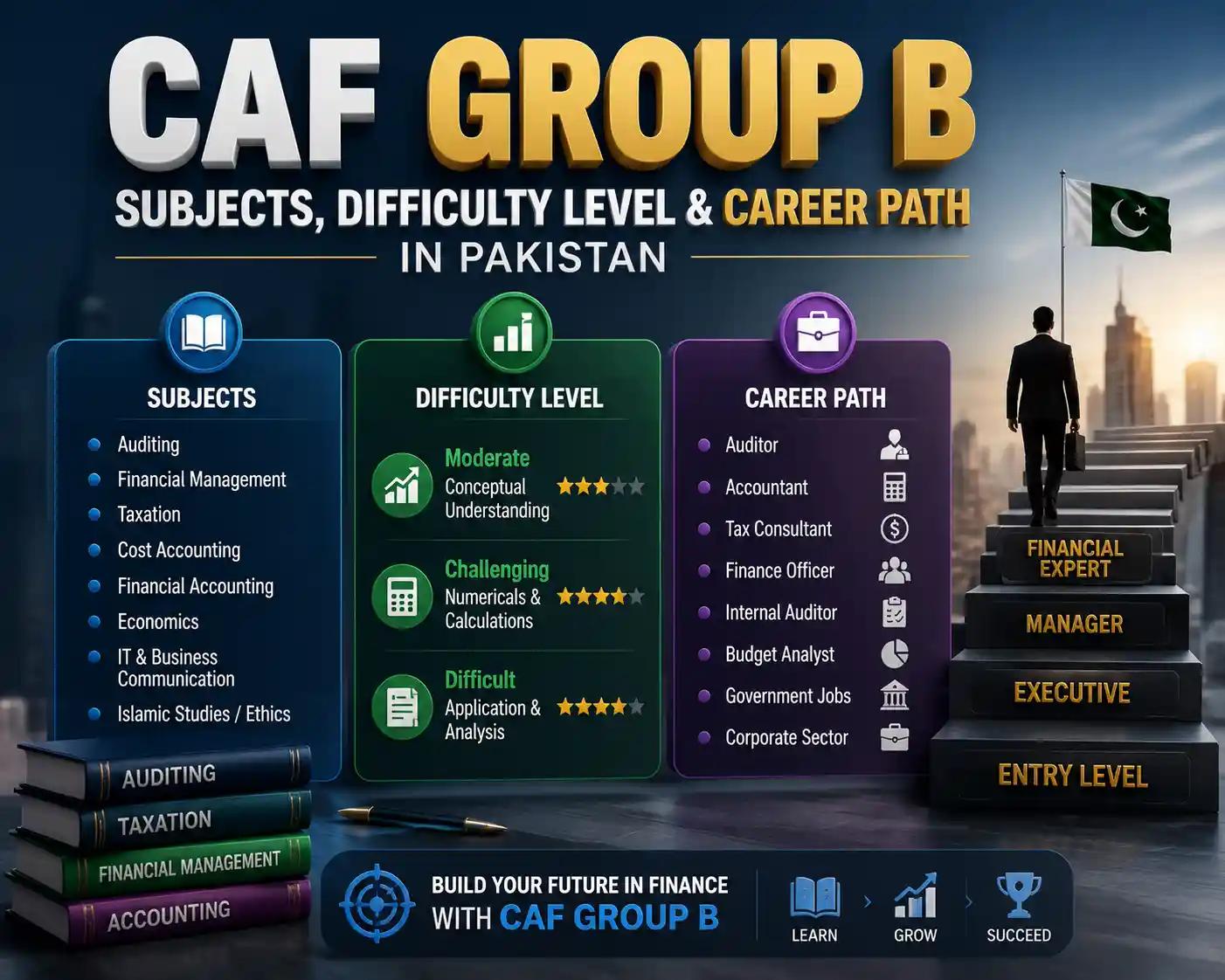
Many CA students believe that clearing CAF Group A means the hardest part of the journey is over. But CAF Group B is where the real professional thinking begins. The subjects become more technical, the approach changes completely, and one wrong preparation strategy can delay your progress. Before starting CAF Group B, every CA student in Pakistan should know these important facts.
Quick Answer
CAF Group B is the second stage of the Certificate in Accounting and Finance (CAF) qualification offered by the Institute of Chartered Accountants of Pakistan (ICAP). It consists of advanced accounting, taxation, auditing, and business-related subjects that prepare students for the next stages of the Chartered Accountancy journey.
Compared with CAF Group A, Group B is considered more technical and application-based because it requires students to apply accounting concepts to practical business situations. With consistent preparation, proper guidance, and regular practice, students in Pakistan can successfully complete CAF Group B and move forward in their CA pathway.
Introduction
If you have successfully completed CAF Group A, you have already crossed the first major milestone of the Chartered Accountancy journey in Pakistan. The next important stage is CAF Group B, where the level of technical knowledge and practical application increases significantly.
CAF Group B is the second part of the ICAP Certificate in Accounting and Finance (CAF) qualification. It builds upon the concepts learned in Group A and introduces students to more advanced areas including financial reporting, taxation, auditing, business analysis, and information technology.
For many CA students in Pakistan, understanding the CAF Group B difficulty level, subjects, exam structure, and future career opportunities before starting preparation is extremely valuable. It helps students create a realistic study plan and approach this stage with the right mindset.
In this complete guide, you will learn what CAF Group B is, how challenging it really is, the subjects you will study, preparation strategies, and the career opportunities available after progressing through this important stage of the ICAP CA pathway.

What is CAF Group B?
CAF Group B is the second group of papers in the Certificate in Accounting and Finance (CAF) qualification offered by the Institute of Chartered Accountants of Pakistan (ICAP). It comes after CAF Group A and takes students from foundational accounting concepts toward more advanced areas of professional accounting.
While CAF Group A focuses on building basic knowledge of accounting, business law, management, and quantitative concepts, CAF Group B introduces students to more technical and practical subjects that are directly connected with the daily responsibilities of professional accountants.
CAF Group B consists of four papers:
- CAF-5: Financial Accounting and Reporting II
- CAF-6: Principles of Taxation
- CAF-7: Audit and Assurance
- CAF-8: Information Technology
These subjects represent an important transition in the CA journey because they introduce areas such as taxation, auditing, advanced financial reporting, and technology in accounting. Unlike Group A, where students mainly build their foundation, Group B focuses more on applying accounting knowledge to practical business situations.
For CA students in Pakistan, successfully completing CAF Group B is a major milestone as it prepares them for the next stages of the ICAP CA qualification and develops skills that are highly relevant in accounting, audit, taxation, and finance careers.
Why Is CAF Group B is Important In CA Journey?
The CAF Group B stage plays a crucial role in the ICAP Chartered Accountancy pathway because it connects basic accounting knowledge with the advanced professional skills required in later stages. At this level, students move beyond fundamental concepts and start developing practical understanding of areas that are directly related to professional accounting work.
The Institute of Chartered Accountants of Pakistan (ICAP) designed CAF Group B to prepare students for more advanced levels such as CFAP (Certificate in Finance, Accounting and Reporting) and other professional stages of the CA qualification. The subjects introduced at this level help students understand how financial reporting works in practice, how taxation systems operate, how audits are performed, and how technology supports modern accounting processes.
For students pursuing CA in Pakistan, completing CAF Group B is a major achievement because it demonstrates that they have developed the technical foundation required to move toward advanced studies and professional training. It also strengthens their profile for future opportunities in audit firms, taxation, financial reporting, corporate finance, and business advisory roles.
Benefits Of Completing CAF Group B
Completing CAF Group B is an important milestone for students following the ICAP Chartered Accountancy pathway in Pakistan. This stage does not only fulfill an essential requirement of the CA qualification but also helps students develop practical accounting skills that are valuable in professional environments.
One of the biggest benefits of completing CAF Group B is that it strengthens your understanding of advanced areas such as financial reporting, taxation, auditing, and information technology. These skills provide a strong foundation for the higher stages of the CA journey and help students better understand real-world accounting practices.
For many students, successfully completing CAF Group B also improves career opportunities before completing the full CA qualification. Students can become eligible for trainee and entry-level roles in audit firms, accounting departments, corporate organizations, and financial institutions, where they can gain valuable practical exposure.
CAF Group B also complements other professional accounting studies. Students who are exploring qualifications like ACCA may find that their knowledge of areas such as Audit and Assurance and Financial Reporting becomes stronger due to the concepts covered during the CAF stage.
Overall, CAF Group B is not just another examination stage—it is a step that develops the technical knowledge, confidence, and professional mindset required for a successful career in accounting and finance.
You can explore all available programs at ICT Business School at https://www.ictbusinessschool.com/courses, including CA, ACCA, CIA, CMA, HND, and Pearson BTEC programs.
2. CAF Group B Difficulty Level
Is CAF Group B Difficult?
The honest answer is that CAF Group B is more challenging than CAF Group A, but it is completely manageable with the right preparation strategy. The difficulty increases because students move from basic concepts toward more specialized areas such as financial reporting, taxation, auditing, and information technology.
Many students find CAF Group B more demanding because the subjects require deeper understanding, stronger analytical skills, and the ability to apply concepts to practical situations. Papers like CAF-5 (Financial Accounting and Reporting II) and CAF-6 (Principles of Taxation) usually require significant practice because they involve complex scenarios and detailed calculations.
However, considering CAF Group B as "extremely difficult" would not be accurate. Every year, thousands of CA students in Pakistan successfully clear these papers through consistent preparation, proper planning, and focused study. The purpose of this stage is not just to test memory but to ensure students develop the professional knowledge required for future accounting and finance roles.
CAF Group B Requires More Conceptual Understanding
One major difference between CAF Group A and CAF Group B is the shift from memorization-based learning toward practical application and conceptual understanding.
While some Group A subjects involve more theoretical learning, CAF Group B requires students to understand how accounting concepts work in real business situations.
- CAF-5 (Financial Accounting and Reporting II) requires students to apply financial reporting principles and accounting standards to complex business scenarios.
- CAF-6 (Principles of Taxation) focuses on understanding Pakistan's taxation system and applying tax rules accurately in practical situations.
- CAF-7 (Audit and Assurance) develops professional judgment by teaching students how to identify risks, evaluate controls, and design appropriate audit procedures.
- CAF-8 (Information Technology) introduces students to IT systems, governance, controls, and the role of technology in modern accounting environments.
Students who rely only on memorization usually find CAF Group B challenging. Those who focus on understanding concepts, practicing questions, and connecting topics with real-world applications generally perform much better.
The key to success in CAF Group B is changing your study approach—from simply learning information to understanding how professional accountants use that knowledge in practice.
3. CAF Group B Subjects
The CAF Group B stage consists of four papers, each designed to develop advanced accounting, taxation, auditing, and technology-related skills required for the next stages of the ICAP Chartered Accountancy pathway.
Unlike CAF Group A, where students mainly build foundational knowledge, these subjects require more practical application, analytical thinking, and professional judgment. Understanding the nature of each paper helps students create a better preparation strategy.
CAF-5 — Financial Accounting and Reporting II
CAF-5 builds upon the concepts learned in CAF-1 and introduces students to more advanced areas of financial reporting. The paper focuses on complex accounting treatments, financial reporting standards, and practical application of accounting concepts.
Major areas include:
- Advanced financial reporting concepts
- Application of accounting standards
- Group accounts
- Complex financial reporting scenarios
CAF-5 is generally considered one of the most technically demanding papers in CAF Group B because it requires strong conceptual understanding and extensive question practice.
CAF-6 — Principles of Taxation
CAF-6 introduces students to the fundamentals of Pakistan's taxation system and develops their ability to apply tax concepts in practical situations.
The paper covers areas such as:
- Income tax principles
- Sales tax concepts
- Withholding taxes
- Tax calculations
- Application of tax rules
Students need both theoretical understanding and numerical practice to perform well in this paper. Regular practice of taxation scenarios is essential for success.
CAF-7 — Audit and Assurance
CAF-7 introduces students to the basic principles and practices of auditing. It develops the professional thinking required to evaluate risks, understand internal controls, and apply audit procedures.
Key areas include:
- Audit planning
- Risk assessment
- Internal controls
- Audit evidence
- Audit reporting
This paper requires students to move beyond memorization and develop the ability to analyze situations from an auditor's perspective.
CAF-8 — Information Technology
CAF-8 focuses on the role of technology in modern accounting and business environments. It helps students understand how information systems support financial processes and organizational decision-making.
Topics include:
- IT systems
- Database concepts
- Information security
- Cybersecurity basics
- IT controls
- Technology in accounting functions
Compared with other CAF Group B papers, CAF-8 is generally considered more conceptual and approachable, especially for students who develop a clear understanding of IT-related concepts.
CAF Group B Easy and Difficult Subjects
Every student experiences the CAF Group B papers differently depending on their academic background, preparation style, and understanding of concepts. However, based on general student experience in Pakistan, some subjects are considered more challenging because they require deeper analysis, extensive practice, and stronger application skills.
Understanding the relative difficulty of each paper can help students plan their preparation time more effectively.
Most Difficult: CAF-5 — Financial Accounting and Reporting II
CAF-5 is generally considered one of the most challenging papers in CAF Group B because it requires strong accounting concepts and the ability to apply financial reporting principles to complex situations.
The paper becomes demanding due to areas such as:
- Advanced financial reporting concepts
- Complex accounting treatments
- Consolidated financial statements
- Application of multiple accounting standards
Students usually need significant practice and conceptual clarity to perform well in CAF-5. Rather than memorizing solutions, understanding the reasoning behind accounting treatments is the key to success.
Moderately Difficult: CAF-6 and CAF-7
CAF-6 (Principles of Taxation) and CAF-7 (Audit and Assurance) are generally considered moderate-to-high difficulty papers.
CAF-6 can be challenging because students must understand Pakistan's taxation framework and apply tax rules accurately in different scenarios. Regular practice of tax calculations and keeping concepts clear is essential.
CAF-7 requires a different approach because it introduces students to professional audit thinking. Instead of only remembering concepts, students must learn how to analyze risks, evaluate controls, and apply professional judgment.
Most Approachable: CAF-8 — Information Technology
CAF-8 (Information Technology) is often considered one of the more approachable papers in CAF Group B. The subject focuses mainly on conceptual understanding of IT systems, controls, security, and technology in accounting environments.
With focused preparation, regular revision, and proper understanding of concepts, many students find CAF-8 easier to manage compared with other Group B papers.
How to Plan Your CAF Group B Preparation
Understanding subject difficulty helps you create a smarter study strategy. If you plan to attempt all four papers together, allocate extra preparation time to CAF-5 because of its technical complexity.
If you are attempting papers in different sessions, consider balancing your workload by combining challenging papers with comparatively manageable ones. The most important factor is not which subject you start with, but whether your preparation time matches the difficulty and requirements of each paper.
A realistic study plan, consistent practice, and strong conceptual understanding can make even the toughest CAF Group B subjects achievable.
4. Challenges Faced by Students in CAF Group B
Time Management Issues
One of the biggest challenges students face in CAF Group B is managing time effectively. Although each paper has a fixed examination duration, the complexity of questions—especially in subjects like CAF-5 (Financial Accounting and Reporting II) and CAF-6 (Principles of Taxation)—requires both speed and accuracy.
Many students struggle because they spend too much time on one difficult question and are unable to complete the remaining sections. The solution is not only solving past papers but practicing them under actual examination conditions.
A better approach is to:
- Attempt past papers within the complete exam time.
- Track how much time is spent on each question.
- Improve speed without compromising accuracy.
- Practice completing full-length papers before the examination.
Developing this exam discipline can make a significant difference in passing CAF Group B papers.
Building Conceptual Understanding
A common reason students struggle with CAF Group B is that the learning approach required at this stage is different from CAF Group A. Group B demands deeper understanding and practical application rather than relying only on memorized concepts.
For example, in CAF-7 (Audit and Assurance), students may be given a business scenario and asked to identify audit risks or recommend suitable audit procedures. Such questions cannot be answered through memorization alone—you need to understand the principles behind auditing and apply them to different situations.
Similarly, papers like CAF-5 and CAF-6 require students to understand the logic behind accounting treatments and taxation rules instead of simply remembering formulas or examples.
Building conceptual clarity through lectures, self-study, practice questions, and case-based learning helps students develop the analytical skills required at this level.
Exam Pressure
The increasing difficulty level of CAF Group B can create pressure for many students, especially those who are already concerned about progressing through the CA journey in Pakistan. Managing multiple technical subjects while preparing for examinations can feel overwhelming without a proper routine.
The best way to handle exam pressure is to create consistency in your preparation. Students who follow a structured timetable, revise regularly, attempt mock exams, and evaluate their weak areas usually perform with greater confidence.
Instead of focusing only on the final result, focus on daily progress. A disciplined study routine, realistic planning, and continuous improvement can help you approach CAF Group B with greater confidence.
5.How To Prepare For CAF Group B Successfully
Smart Preparation Strategy
tart your CAF Group B preparation at least three to four months before the examination session, especially if you plan to attempt multiple papers together. Begin by studying the official ICAP study texts and focus on developing conceptual clarity before moving toward intensive practice.
For technical papers like:
- CAF-5 (Financial Accounting and Reporting II)
- CAF-6 (Principles of Taxation)
dedicate more time to understanding concepts, practicing calculations, and solving different scenarios.
For:
- CAF-7 (Audit and Assurance)
- CAF-8 (Information Technology)
focus on building strong concepts, improving answer presentation, and regularly revising important areas.
The goal should not be to complete the syllabus quickly, but to understand how concepts are applied in examination scenarios.
Revision Technique
At the CAF Group B level, simply reading notes repeatedly is not enough. Effective revision requires active learning techniques.
Some useful methods include:
- Solving questions without looking at answers first.
- Explaining difficult concepts in your own words.
- Creating short revision notes for important topics.
- Revisiting completed chapters regularly.
For CAF-5, students can create summary sheets for important accounting standards, including their application, measurement rules, and presentation requirements.
For CAF-6, maintaining practice templates for taxation calculations helps students improve speed and accuracy during examinations.
For theory-based areas such as CAF-7 and CAF-8, regular revision and practicing structured answers can significantly improve performance.
Importance of Past Papers Practice
One of the most effective preparation methods for CAF Group B is solving ICAP past papers with suggested answers.
Past papers help students understand:
- Question patterns
- Examiner expectations
- Answer presentation style
- Time management requirements
- Frequently tested concepts
Do not just check whether your answer is correct or incorrect. Analyze the suggested answers carefully and understand how marks are awarded.
For example, in CAF-7 (Audit and Assurance), students should learn how to structure answers by identifying risks, explaining their impact, and suggesting appropriate audit procedures. Understanding this approach can significantly improve examination performance.
Exam Preparation Planning
A practical three-month preparation plan can look like this:
Three Months Before Exam
- Complete the first detailed study of all targeted papers.
- Build conceptual understanding.
- Prepare topic-wise notes and summaries.
Two Months Before Exam
- Start solving past papers.
- Review suggested answers.
- Identify weak areas.
- Focus on improving difficult topics.
One Month Before Exam
- Attempt complete papers under timed conditions.
- Practice exam-style questions.
- Revise important concepts and frequently tested areas.
The final weeks should focus on improving confidence, speed, and accuracy rather than learning completely new topics.
Final Preparation Advice
The biggest difference between students who struggle and students who succeed in CAF Group B is consistency. Regular study, continuous practice, and proper revision create much better results than irregular preparation.
If additional guidance is required, students can benefit from structured coaching programs, mock exams, and expert feedback to improve their preparation approach
Revision Technique
For CAF Group B, passive revision — re-reading notes — is not enough. Active revision is essential. This means working through solved examples, explaining concepts out loud to yourself, and identifying the underlying principle behind every question you practice.
For CAF-5, create summary tables of each IFRS standard you study, including when it applies, how it is measured, and what disclosures it requires. This structured approach transforms abstract standards into practical reference points you can apply quickly in an exam.
For CAF-6, build a running tax calculation template that you update as you learn each new provision. Being able to construct a complete income tax computation from scratch under exam time pressure is a skill you build through repeated practice, not reading.
Practice Importance
ICAP past papers with suggested answers are your most important revision resource at the CAF Group B level. Solve every available past paper for CAF-5, CAF-6, and CAF-7 under timed conditions. Review the suggested answers critically — do not just check whether your answer was right or wrong, understand why ICAP's model answer is structured the way it is.
Pay particular attention to the mark allocation in past paper questions. In CAF-7, a 10-mark audit risk question typically expects you to identify risks and link them to specific assertions or audit procedures. Understanding this structure from past papers will dramatically improve your marks in the real exam.
ICAP past papers and suggested answers are available on the official ICAP portal. Additional analysis and solved examples are available through ICT Business School's blog at https://www.ictbusinessschool.com/blog.
Exam Preparation Planning
Three months before your exam session: Complete the full reading of all targeted papers. Build concept maps for each major topic area.
Two months before your exam session: Begin solving past papers chapter by chapter. Review suggested answers after every practice session. Identify your weak areas and schedule targeted revision for them.
One month before your exam session: Shift entirely to full-paper past paper practice under timed conditions. Attempt at least 2 to 3 full past papers per subject. Use the final week for targeted revision of your most problematic topics.
For students who want professional guidance through this process, ICT Business School offers structured CAF Group B coaching with regular mock exams and faculty-led doubt sessions. Contact ICT Business School at https://www.ictbusinessschool.com/contact to enquire about upcoming batch schedules.
You can also supplement your preparation with free accounting and finance resources on Coursera (https://www.coursera.org) to strengthen your conceptual base in financial reporting and auditing before diving into ICAP-specific material.

6. CAF Group B Career Path
Completing CAF Group B is an important milestone in the ICAP Chartered Accountancy journey and opens the door to practical training and early career opportunities in accounting and finance. While students continue progressing toward the complete CA qualification, completing the CAF stage demonstrates that they have developed a strong foundation in areas such as financial reporting, taxation, auditing, and information technology.
For students in Pakistan, CAF-qualified candidates are valued by accounting firms, corporate organizations, banks, and financial institutions. Major cities including Karachi, Lahore, Islamabad, Rawalpindi, and other business hubs offer opportunities for students who want to gain professional experience alongside their CA studies.
The knowledge gained during CAF Group B directly supports roles related to audit, taxation, financial reporting, and corporate finance, making it a valuable stage for building professional skills before qualification as a Chartered Accountant.
For career guidance resources, bacoconsultants.com (https://bacoconsultants.com/) provides consulting and advisory services that can help CAF-qualified professionals plan their next career steps effectively.
Articleship and Practical Training Opportunities
One of the most important steps after progressing through the ICAP CA pathway is gaining practical experience through a training contract (articleship) with an approved organization.
During articleship, students work with experienced professionals and gain practical exposure in areas such as:
- Audit engagements
- Tax assignments
- Financial reporting
- Internal controls
- Business advisory services
Many CA students aim to complete their training with leading accounting firms, including the Big 4, because it provides exposure to diverse clients, professional mentorship, and strong career growth opportunities.
A strong performance during articleship can significantly improve future employment opportunities after completing the CA qualification.
Job Opportunities After CAF
Students who have completed the CAF stage can explore various entry-level and trainee roles in Pakistan's accounting and finance sector.
Common career opportunities include:
Junior Auditor / Audit Associate
These roles are commonly available in accounting firms and involve assisting with audit procedures, preparing working papers, reviewing financial information, and supporting senior audit teams.
Tax Associate / Tax Analyst
With knowledge of taxation gained through CAF-6 (Principles of Taxation), students can pursue opportunities in tax departments of accounting firms and corporate organizations. These roles involve tax compliance, research, and preparation of tax-related documentation.
Accounts Officer / Finance Assistant
Corporate organizations across manufacturing, banking, services, and retail sectors hire candidates for finance support roles involving:
- Accounting records
- Bank reconciliations
- Financial reporting assistance
- Transaction processing
Financial Reporting Analyst
Students with strong knowledge of CAF-5 (Financial Accounting and Reporting II) can explore opportunities in financial reporting departments of banks and large organizations. These roles involve preparing, analyzing, and reviewing financial information according to accounting standards.
Long-Term Career Growth After CA
CAF Group B is only one stage of the complete Chartered Accountancy journey. As students progress through higher levels, complete practical training, and qualify as Chartered Accountants, they can move into senior positions such as:
- Audit Manager
- Tax Consultant
- Finance Manager
- Financial Controller
- Head of Finance
- Chief Financial Officer (CFO)
The skills developed during the CAF stage create the foundation for a successful career in accounting, finance, auditing, taxation, and business advisory.
If you are also considering broadening your academic credentials, ICT Business School offers the HND (Higher National Diploma) in Business at https://www.ictbusinessschool.com/courses/hnd-higher-national-diploma, Pearson BTEC Level 3 at https://www.ictbusinessschool.com/courses/pearson-btec-level-3, and Pearson BTEC Level 7 (Extended Diploma) at https://www.ictbusinessschool.com/courses/level-7-extended-diploma — all of which complement the CAF qualification and strengthen your overall academic and professional profile.
CAF Group B Salary in Pakistan
One of the common questions students ask after completing CAF Group B is, "How much salary can I expect in Pakistan?" The answer depends on several factors, including the organization, city, practical experience, and whether you are continuing toward the complete ICAP CA qualification.
At the CAF-qualified level, students usually start their careers through articleship, trainee positions, audit firms, or junior finance roles. The salary at this stage is mainly influenced by the employer and the experience you gain. Candidates working with reputed accounting firms, multinational companies, banks, or large corporate organizations generally have better growth opportunities.
As you progress further in the CA journey, complete your practical training, and move toward qualification, your earning potential increases significantly. The real value of CAF Group B is not only the starting salary but the strong professional foundation it creates for long-term careers in audit, taxation, financial reporting, corporate finance, and management roles.
Scope of CAF Group B in Pakistan
The scope of CAF Group B in Pakistan is closely linked with the growing demand for skilled accounting and finance professionals. By completing this stage of the ICAP Chartered Accountancy pathway, students develop practical knowledge in areas such as financial reporting, taxation, auditing, and information technology—skills that are highly relevant in today's business environment.
CAF Group B provides a strong foundation for students who want to build careers in audit firms, corporate finance departments, banks, multinational companies, consulting firms, and financial institutions across Pakistan. As businesses become more focused on accurate reporting, compliance, taxation, and financial decision-making, professionals with structured accounting knowledge continue to find valuable opportunities.
For CA students in Pakistan, CAF Group B should be viewed as an important career-building stage rather than just an examination level. The technical understanding gained here supports future progress in the CA qualification and helps students develop the professional skills required for long-term careers in accounting, finance, audit, and advisory roles.
Expert Guidance
A common mistake many CA students in Pakistan make at the CAF Group B level is focusing only on passing the examinations rather than building the professional skills that will support their future career. At this stage, students should start thinking beyond marks and develop the ability to apply accounting concepts in real business situations.
A strong approach is to treat every subject as a professional skill. For example, CAF-5 should not be studied only as an accounting paper but as a foundation for understanding financial reporting, while CAF-6 should help you develop practical tax problem-solving skills. Similarly, CAF-7 requires an auditor's mindset, where understanding risks and applying judgment is more important than memorizing standard answers.
Students who maintain consistency, practice past papers regularly, and focus on conceptual clarity usually find the transition to higher CA levels much smoother. CAF Group B is not just another examination stage—it is the point where you begin developing the thinking approach required from a future accounting professional.
Why Choose ICT Business School for CAF Group B?
ICT Business School is one of Pakistan's most trusted educational institutes for professional accounting and finance qualifications. Whether you are pursuing CA (ICAP pathway), ACCA, CIA, CMA, or complementary programs like HND and Pearson BTEC, ICT Business School provides expert faculty, structured coaching, regular mock exams, and a proven track record of student success.
Learn more about ICT Business School at https://www.ictbusinessschool.com/about and explore advanced corporate and taxation courses at ICT across all available programs. For admissions and batch schedules, contact ICT Business School at https://www.ictbusinessschool.com/contact.
FAQs About CAF Group B
Q: Is CAF Group B exam easy or difficult? CAF Group B is moderately to highly difficult, depending on the paper. CAF-5 (Financial Accounting and Reporting II) is generally considered the hardest paper in the entire CAF qualification due to its advanced IFRS content. CAF-8 (Information Technology) is the most approachable. Overall, CAF Group B is harder than Group A but fully achievable with structured preparation.
Q: What is the difficulty level of CAF Group B compared to other exams? Within Pakistan's professional accounting education system, CAF Group B is comparable in difficulty to intermediate-level papers in ACCA. It is significantly more demanding than entry-level accounting certifications but less complex than CFAP-level papers. Students with strong conceptual foundations and consistent practice routines consistently pass CAF Group B papers.
Q: Can beginners or average students clear the CAF Group B exam? Yes, students of all academic backgrounds can clear CAF Group B with the right approach. The keys are starting preparation early, understanding concepts deeply rather than memorizing, solving past papers under timed conditions, and seeking guidance from qualified coaching faculty. Many average students clear CAF Group B papers in their first attempt through disciplined preparation.
Q: What are the career opportunities after CAF Group B? Clearing CAF Group B opens opportunities in audit, taxation, financial reporting, and corporate finance roles across Pakistan. Common job titles include Junior Auditor, Tax Associate, Accounts Officer, and Finance Analyst. Long-term, CAF Group B is a stepping stone toward the full CA qualification, ACCA, CIA, or CMA credentials, all of which lead to senior finance and leadership roles.
Q: What is the passing mark for CAF Group B papers? The passing mark for each CAF Group B paper is 50 out of 100. Each paper must be passed independently with no group aggregate. Once a paper is passed, the credit is permanent — there is no expiry regardless of how long your overall CAF journey takes.
Q: How many months are required for CAF Group B preparation? Most students need 3 to 4 months of focused preparation for CAF Group B, assuming they are attempting two to four papers per session. Students attempting only one or two papers can prepare effectively in 6 to 8 weeks with intensive daily study. The preparation timeline depends heavily on your starting knowledge level and how consistently you practice past papers.
Q: Is CAF Group B a good career investment for students in Pakistan? Yes, absolutely. The CAF qualification is recognized by employers across Pakistan and internationally. It creates a direct pathway to the full CA qualification, provides ACCA exemptions, and equips students with the taxation, audit, and financial reporting knowledge that is in constant demand across every sector of Pakistan's economy. The career growth potential for CAF-qualified and subsequently CA-qualified professionals in Pakistan is very strong.
Q: Who can apply for CAF Group B? Students who have cleared CAF Group A papers (CAF-1 to CAF-4) are eligible to attempt CAF Group B papers. ICAP also allows students to attempt Group A and Group B papers simultaneously once they have registered with ICAP, subject to eligibility criteria. Check the latest eligibility rules on the official ICAP portal or through ICT Business School's admissions team at https://www.ictbusinessschool.com/contact.
7. Conclusion
CAF Group B is a challenging but genuinely rewarding stage of the ICAP CA qualification journey. The four papers — Financial Accounting and Reporting II, Principles of Taxation, Audit and Assurance, and Information Technology — build the technical and professional knowledge that defines a competent accounting and finance professional in Pakistan.
Yes, the difficulty level is higher than Group A. Yes, CAF-5 in particular requires serious dedication. But the career path that opens up after completing CAF Group B makes every hour of study effort worthwhile. From Big 4 internships and audit roles to corporate finance careers and long-term progression toward full Chartered Accountant status, the opportunities are real and substantial.
The students who succeed are not necessarily the most naturally gifted — they are the most disciplined and strategic. Start early, understand deeply, practice relentlessly, and get the right guidance from day one.
ICT Business School (https://www.ictbusinessschool.com/) is here to support your entire journey — from CAF Group B coaching to ACCA, CIA, CMA, HND, O-Level programs (https://www.ictbusinessschool.com/courses/o-level-program), and Pearson BTEC qualifications. Our experienced faculty, structured programs, and student-first approach have helped hundreds of students across Pakistan achieve their accounting and finance career goals.
Take the next step in your professional journey today. Explore all courses at https://www.ictbusinessschool.com/courses or reach out to us directly at https://www.ictbusinessschool.com/contact. Your CAF Group B success story starts here.