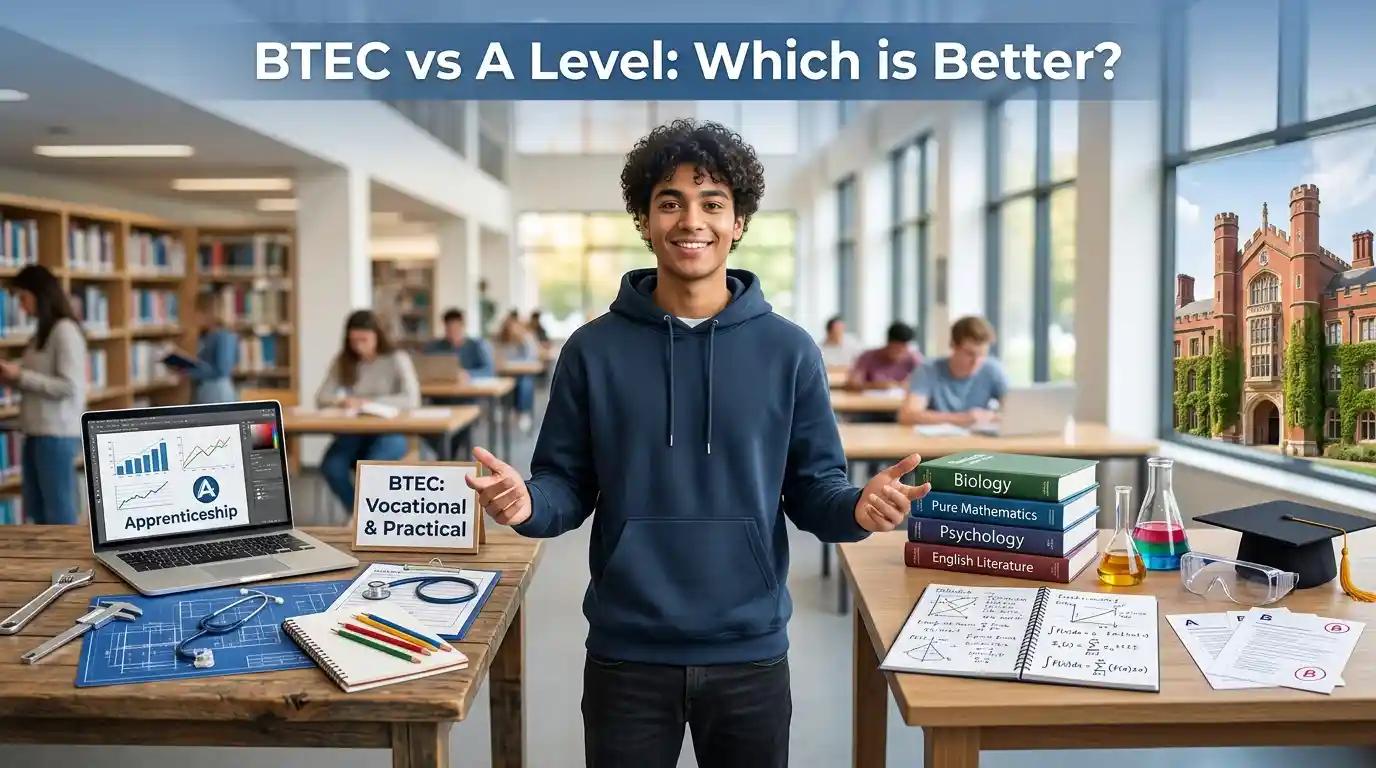
if you're confused about choosing between BTEC and A Levels, you're not alone. Here's everything you need to know to make the right decision.
Quick Answer:
BTEC Level 3 is a vocational, coursework-based qualification ideal for students who prefer practical, career-focused learning, while A Levels are academic, exam-based qualifications better suited for students aiming at traditional university degrees. Both are Level 3 qualifications accepted by UK universities, but the right choice depends on your learning style, career goals, and the subject you want to study at higher education.
Introduction
Choosing between BTEC Level 3 and A Levels is one of the biggest decisions students face after completing their GCSEs or O Levels. Both are recognized Level 3 qualifications in the UK education system, and both can lead to university, college, or direct employment.
But they are built very differently. A Levels focus on written examinations and academic theory. BTEC focuses on coursework, assignments, and practical, real-world skills.
This guide breaks down everything you need to know — grading, exams, university acceptance, career paths, and which qualification fits your goals best. If you're in Pakistan or planning to study abroad, this guide also explains how to access BTEC and A Level programs locally through ICT Business School.
Understanding BTEC Level 3 and A Levels
What Is BTEC Level 3?
BTEC stands for Business and Technology Education Council. It is a Pearson BTEC vocational qualification designed for students who learn best through practical, hands-on coursework rather than timed written exams.
Key facts about BTEC Level 3:
- It is a Level 3 qualification, equivalent in level to A Levels.
- Assessment is mostly through coursework, projects, and assignments.
- It is designed to build practical skills and industry knowledge.
- Available as a BTEC Diploma or BTEC Extended Diploma, depending on size and UCAS points value.
- Regulated by Ofqual and awarded by Pearson.
BTEC suits students who want a more applied, work-related approach to learning, including those planning vocational qualification routes into business, engineering, IT, or health-related careers.
What Are A Levels?
A Levels (Advanced Levels) are traditional academic qualifications studied in sixth form colleges and schools across the UK.
Key facts about A Levels:
- Assessed mainly through written examinations at the end of the course.
- Require strong independent study and revision skills.
- Subjects are studied in depth, usually 3 A Level subjects over two years.
- Widely accepted for university entry requirements, including by Oxford and Cambridge.
- Each grade (A*–E) converts into UCAS points for university applications.
A Levels suit students who enjoy theory-based learning, exams, and want maximum flexibility when applying to competitive university courses like medicine, law, or engineering.
Key Differences Between BTEC Level 3 and A Levels
| Feature | BTEC Level 3 | A Levels |
|---|---|---|
| Learning Style | Practical, coursework-based | Academic, exam-based |
| Assessment | Continuous assessment, assignments | Written examinations |
| Subjects | Career-focused units | Traditional academic subjects |
| Best For | Vocational/practical careers | University, academic careers |
| University Acceptance | Yes, widely accepted | Yes, widely accepted |
| Grading | Pass, Merit, Distinction | A* to E |
| Flexibility for Degrees | Best for related-field degrees | Best for any degree subject |
Course Requirements and Structure
Eligibility Criteria
Most colleges require students to have completed their GCSEs or O Levels before starting either BTEC Level 3 or A Levels. Specific grade requirements vary by institute and subject combination.
Admission Requirements
- BTEC Level 3: Usually requires GCSE/O Level passes in core subjects (English, Maths).
- A Levels: Often requires stronger grades in subjects directly related to the chosen A Level subjects (e.g., good grades in Maths for A Level Maths).
- Both routes are part of standard further education progression after secondary school.
Subjects Offered
A Level subjects typically include Mathematics, Physics, Chemistry, Biology, English Literature, Economics, Business Studies, and Psychology.
BTEC pathways are organized around vocational sectors such as Business, IT, Engineering, Health & Social Care, and Applied Science.
Course Structure
A Levels are structured around subject-specific modules, tested through final exams. BTEC is structured into units, each assessed through assignments, projects, presentations, or practical tasks — a strong fit for students who prefer practical learning over classroom learning-only formats.
Course Duration
Both BTEC Level 3 and A Levels typically take two years to complete when studied full-time, matching the standard sixth form or college timeline in the UK education system.
Exam Structure and Assessment Methods
Teaching and Learning Style
A Levels rely heavily on classroom teaching, textbook study, and independent study outside class. BTEC blends classroom learning with project work, group tasks, and applied scenarios — making it ideal for students who build critical thinking and practical skills through doing, not just reading.
Exam Structure
| Paper / Unit | BTEC Level 3 (Duration & Marks | A Level (Duration & Marks) |
|---|---|---|
| Paper 1 – Core Theory | 1–1.5 hours, 50–80 marks | 1.5 hours, 80–100 marks |
| Paper 2 – Applied/Written | 1–2 hours, 60–90 marks | 1.5–2 hours, 80–100 marks |
| Paper 3 – Practical/Project-Based | 2 hours, 70–100 marks | 2–3 hours, 90–100 marks |
- A Levels: End-of-course written exams, usually 80–100% of the final grade.
- BTEC: Mostly internally assessed coursework; some pathways include limited external exams or tests depending on the unit.
Coursework vs Final Examinations
This is the core difference in the BTEC vs A Level debate:
- A Levels reward strong exam technique, memory recall, and revision under pressure.
- BTEC rewards consistent time management, steady coursework quality, and continuous assessment across the year.
Neither is automatically "easier" — they simply test different strengths.
University Admission and Career Opportunities

UCAS Points and University Acceptance
Both qualifications carry UCAS points, and most UK universities accept BTEC Extended Diplomas alongside A Levels for university entry requirements. Many universities list BTEC qualifications directly in their entry criteria, especially for business, computing, and applied science degrees.
Do Oxford and Cambridge accept BTEC? In practice, these universities almost always require A Levels, particularly for highly academic or medicine-related courses, and rarely accept BTEC alone for entry. For most other UK universities, BTEC is a recognized and respected route.
Career Opportunities
A Levels open doors to a wide range of degree preparation options since they aren't tied to one career sector. BTEC builds direct industry experience and is well suited to fields where practical competence matters as much as theory — business, IT, finance, and technical professions.
Which Qualification Is Better for Career Growth?
There's no single winner. For BTEC vs A Level for business or BTEC vs A Level for computer science, BTEC's applied approach often gives a head start into the workplace. For BTEC vs A Level for medicine or BTEC vs A Level for law, A Levels remain the safer, more widely required route.
Courses at ICT Business School
If you're deciding between vocational and academic Level 3 routes, ICT Business School offers both pathways under one roof, alongside globally recognized professional qualifications.
- Pearson BTEC Level 3 — a strong vocational qualification entry point
- Pearson BTEC Level 7 — for advanced, postgraduate-level vocational study
- HND (Higher National Diploma) in Business — a respected progression route toward degree-level study
- O Level and A Level programs — full academic pathway support
- CA (ICAP pathway), ACCA, CIA (Internal Audit), and CMA — professional qualifications for students aiming at finance and accounting careers
Why choose ICT Business School — the institute combines experienced faculty, structured study support, and clear progression routes from O/A Level all the way to professional certifications like ACCA and CMA.
Students who complete BTEC Level 3 at ICT Business School can also explore advanced corporate and taxation courses at ICT to build a complete career-ready profile.
Job Scope & Salary
Both qualifications are stepping stones rather than final career destinations — but they shape different early career paths:
- A Level holders typically move into university degrees, then graduate-level roles.
- BTEC holders often move into apprenticeship programs, Foundation Degree courses, HND programs, or directly into entry-level technical and business roles.
- Long-term salary outcomes depend more on the final degree, professional certification (like ACCA or CMA), and work experience than on the Level 3 qualification alone.
For students in Pakistan and other regions, pairing a Level 3 qualification with internationally recognized certifications — such as ACCA, CMA, or CIA — significantly improves employment opportunities and starting salary potential.
How to Learn (Free + Paid Options)
Students preparing for BTEC or A Level subjects can combine structured college study with free and paid online resources:
- Free options: Khan Academy, BBC Bitesize, and free YouTube subject explainers for foundational revision.
- Paid/structured options: Platforms like Coursera offer supplementary courses in business, IT, and analytical skills that complement BTEC or A Level study.
- Local structured programs: Enrolling in a recognized institute ensures proper exam registration, study skills support, and exam-ready coursework guidance.
Self-study alone is rarely enough for either qualification — structured guidance from qualified instructors makes a measurable difference in academic performance and student success.
Benefits and Drawbacks
Benefits of BTEC Level 3
- Strong focus on practical skills and real-world application
- Less pressure from single, high-stakes final exams
- Builds a portfolio of coursework that demonstrates competence
- Good preparation for vocational degrees, HND, and Foundation Degree routes
- Widely accepted by many UK universities
Benefits of A Levels
- Maximum flexibility for choosing any higher education degree subject
- Strongly preferred by top universities, including for medicine and law
- Develops strong exam technique and independent academic discipline
- Well understood and respected by employers and universities worldwide
- Clear, standardized A Level grading system for easy comparison
Limitations of Both Qualifications
- BTEC: Less recognized for highly competitive academic degrees and some elite universities.
- A Levels: High dependency on exam performance; less suited to students who struggle with timed written tests.
- Both: Require commitment over a full two-year college qualification cycle, with limited flexibility to change direction halfway through.
Choosing the Right Qualification
Who Should Choose BTEC Level 3?
Choose BTEC if you:
- Prefer assignments, projects, and practical learning over timed exams
- Already know your career direction (business, IT, engineering, etc.)
- Want continuous assessment instead of one final exam
- Plan to progress toward an HND, Foundation Degree, or vocational degree
Who Should Choose A Levels?
Choose A Levels if you:
- Are unsure of your exact degree subject and want flexibility
- Are aiming for competitive courses like medicine, law, or engineering at top universities
- Perform well in written exams and structured revision
- Want the most widely recognized academic education pathway
Factors to Consider Before Making Your Decision
- Your preferred learning style — practical vs theoretical
- Your target degree and its specific entry requirements
- Whether your target universities list BTEC as an accepted qualification
- Your strengths in coursework versus exam conditions
- Long-term career goals and required professional certifications
It's worth noting that some students also explore whether they can do BTEC and A Levels together — this is possible at certain colleges, though most students focus on one pathway for consistency.
Final Verdict
There is no universal answer to "which is better, BTEC or A Level." A Levels offer the widest route into university admissions, especially for competitive academic degrees. BTEC offers a practical, coursework-driven path that suits students who already have a career direction in mind.
The smarter approach is matching the qualification to your learning style and goals — not following what's popular. Institutes like ICT Business School support both pathways, helping students choose confidently and progress smoothly into university, HND, or professional qualifications like ACCA and CMA.
Key Facts
- BTEC and A Levels are both Level 3 qualifications, equal in academic level.
- BTEC is assessed mainly through coursework; A Levels mainly through final written exams.
- Both qualifications carry UCAS points for university applications.
- Most UK universities accept BTEC; Oxford and Cambridge generally require A Levels.
- BTEC suits practical learners; A Levels suit theory-focused, exam-ready students.
- Pakistani students can study Pearson BTEC Level 3 and Level 7 locally through ICT Business School.
Expert Guidance
If you're still unsure, here's practical advice: don't choose a qualification based on what your friends are doing.
Look at your target degree's entry requirements first. If your dream course explicitly asks for A Levels, don't risk it with BTEC alone. If you already know you want a hands-on career in business, IT, or a technical field, BTEC's coursework structure will likely suit you better and feel less stressful day to day.
Talk to a study advisor before enrolling. A short conversation with an experienced counselor — available through ICT Business School's faculty — can save you from switching paths halfway through the two-year program.
FAQs
Is BTEC equal to A Levels? Yes, BTEC Level 3 and A Levels are both Level 3 qualifications and hold equal academic standing, though they are assessed differently.
Is BTEC harder than A Level? Neither is universally harder. BTEC demands consistent coursework discipline; A Levels demand strong exam performance under pressure.
Can I get into university with BTEC? Yes. Most UK universities accept BTEC Extended Diplomas, especially the BTEC, for relevant degree subjects.
Do Oxford and Cambridge accept BTEC? Rarely. These universities typically require A Levels, particularly for highly competitive or academic courses.
Can I switch from BTEC to A Levels? It's possible early in the course at some colleges, but switching becomes harder after the first term due to differing content and assessment styles.
Is BTEC accepted internationally? Yes, Pearson BTEC is internationally recognized, including across Pakistan, the UAE, and other regions, making it a solid option for students planning to study or work abroad.
Which qualification is best after GCSE? It depends on your learning style and target degree — BTEC for practical, career-focused learners; A Levels for academic, exam-strong students aiming at competitive degrees.
Conclusion
Both BTEC Level 3 and A Levels are strong, respected qualifications — the right choice comes down to how you learn best and where you want to go next. Whether you lean toward A Levels' academic depth or BTEC's hands-on approach, getting expert guidance early makes all the difference.
Ready to choose the right path? Explore Pearson BTEC Level 3, check out the O Level program, or browse the full HND in Business and Level 7 Extended Diploma options at ICT Business School. Contact our admissions team today to find the qualification that fits your goals — or visit our blog for more guidance on choosing your education pathway.