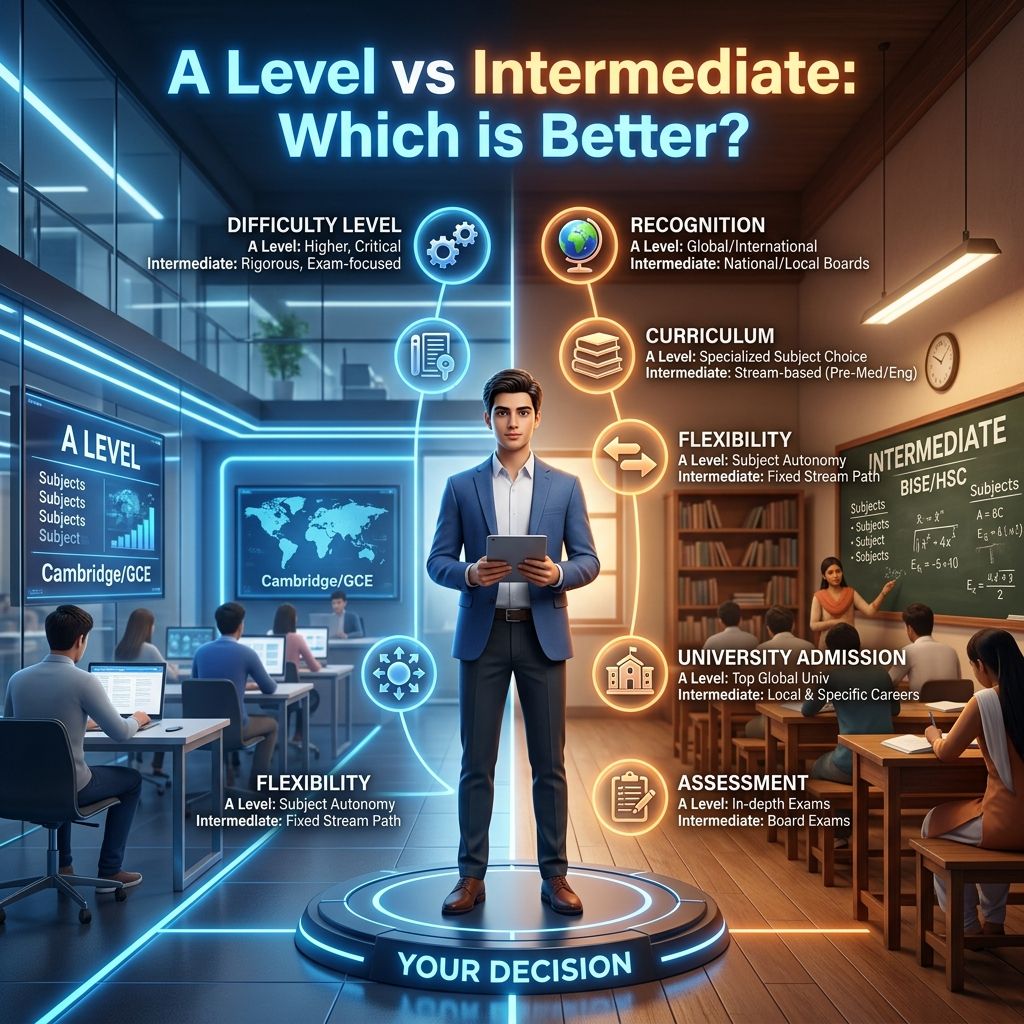
Quick Answer: A Level is a UK-based Cambridge qualification known for conceptual learning, global recognition, and flexibility, while Intermediate (FSc/FA) is Pakistan's board-based system that's affordable and widely accepted by local universities. A Level suits students aiming for foreign degrees or international career paths, while Intermediate works best for students targeting Pakistani medical, engineering, or government institutions on a tighter budget.
What is A Level?
A Level (Advanced Level) is part of the Cambridge International curriculum, originally developed in the UK. It's a two-year program — AS Level in year one and A2 Level in year two — built around critical thinking rather than memorization.
Students typically choose 3 to 4 subjects based on their intended career path, which gives more room for specialization compared to local boards.
What is Intermediate?
Intermediate, commonly known as FSc, FA, ICS, or ICom depending on the subject group, is a two-year program run by Pakistani education boards such as BISE Lahore, BISE Karachi, and the Federal Board.
It follows a fixed syllabus set by the board, with annual exams and a strong focus on theory-based study aligned with local university admission requirements.
Key Differences Between Both Systems
| Feature | A Level | Intermediate (FSc/FA) |
|---|---|---|
| Curriculum | Cambridge (British) | Pakistani Board |
| Learning style | Conceptual, analytical | Theoretical, memorization-based |
| Subjects | 3–4, flexible choice | Fixed group (Pre-Medical, Pre-Engineering, etc.) |
| Grading | Letter grades (A*–E) | Percentage/marks |
| Recognition | Global | Strong in Pakistan, needs equivalence abroad |
| Cost | Higher fees | Comparatively low cost |
| Best for | Studying abroad, global universities | Local medical/engineering colleges, government jobs |
This A Level vs Intermediate comparison shows that the right choice depends heavily on your future goals — local admissions or international study.
Admission Process for A Level and Intermediate
Admission Requirements for A Level
- Completion of O Levels or Matric with good grades
- Minimum subject-specific grade requirements (varies by school)
- English proficiency is usually expected
- Some private A Level schools also require an entry test or interview
Admission Requirements for Intermediate
- Matriculation (Matric) certificate from a recognized board
- Minimum marks requirement set by the college (often 60%+ for science groups)
- Domicile and other documents as required by the college
- Merit-based seat allocation in government colleges
How Application Process Works in Both Systems
A Level admissions are usually rolling, meaning you can apply directly to private institutes once O Level results are out. ICT Business School runs structured intake cycles for its O/A Level programs with personalized academic counseling.
Intermediate admissions, on the other hand, follow a strict merit-list system through government and private colleges, with online application portals and fixed deadlines set by each board.
Eligibility Criteria: A Level vs Intermediate
A Level Eligibility Requirements
- O Level certificate (minimum 5 subjects, including English and Math) or Matric equivalent
- Subject-specific prerequisites (e.g., O Level Math for A Level subjects requiring it)
- Age limit is rarely strict but generally aligns with O Level completion age
Intermediate Eligibility Requirements
- Matric certificate with required subject combination (Science group for FSc)
- Minimum aggregate percentage set by the college or board
- Domicile certificate (for government college admission in some provinces)
Minimum Academic Background Comparison
A Level
Intermediate
| Requirement | A Level | Intermediate |
|---|---|---|
| Prior qualification | O Level / Matric | Matric only |
| Subject prerequisite | Strict for sciences | Group-based (Science / Arts / Commerce) |
| English requirement | High emphasis | Moderate emphasis |
Subjects Offered in A Level and Intermediate
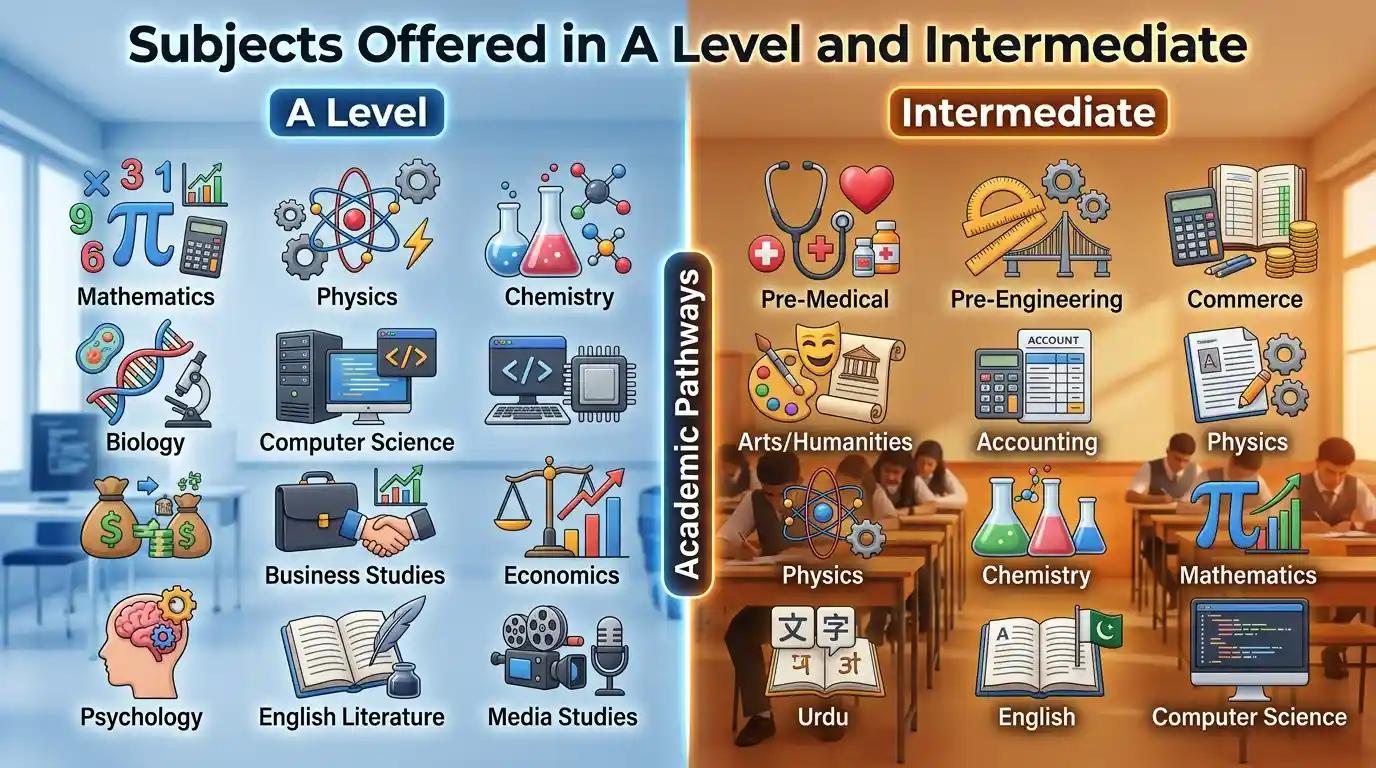
A Level Subject Options (Science, Arts, Commerce)
A Level offers flexible subject selection across:
- Sciences: Physics, Chemistry, Biology, Mathematics, Further Mathematics, Computer Science
- Commerce/Business: Business Studies, Economics, Accounting
- Arts/Humanities: Sociology, Psychology, History, Law, English Literature
Intermediate Subject Groups (FSc, FA, ICS, ICom)
Intermediate is organized into fixed subject groups:
- FSc Pre-Medical: Physics, Chemistry, Biology
- FSc Pre-Engineering: Physics, Chemistry, Mathematics
- ICS: Computer Science, Mathematics, Physics
- ICom: Accounting, Business Studies, Economics
- FA: Humanities-based subjects like Civics, History, Urdu, Islamic Studies
Flexibility of Subject Selection in Both Systems
A Level allows students to mix subjects across disciplines (e.g., Math with Sociology), offering subject selection flexibility that Intermediate's fixed-group structure doesn't allow.
Syllabus Comparison: A Level and Intermediate
A Level Syllabus Structure (Cambridge System)
The Cambridge A Level syllabus is internationally standardized, reviewed regularly, and structured around application-based learning, case studies, and practical problem-solving.
Intermediate Syllabus Structure (Board System)
Intermediate syllabus content is set locally (often via the Smart Syllabus initiative) and tends to follow textbook-based instruction prescribed by provincial textbook boards.
Difficulty Level Comparison
There's no universal answer to "which is more difficult, A Level or Intermediate" — it depends on learning style:
- A Level demands strong analytical and English writing skills
- Intermediate demands strong memorization and exam-paper practice under board exam pressure
Practical vs Theoretical Learning Style
A Level leans toward conceptual, critical-thinking-based learning, while Intermediate relies more on rote learning and repetitive practice from board-prescribed textbooks.
Examination Pattern in A Level and Intermediate
A Level Exam Pattern (Paper Style & Grading System)
- Conducted by Cambridge (CAIE) twice a year — May/June and Oct/Nov
- Multiple papers per subject (MCQs, structured/essay-type, practicals)
- Graded on letter grades A* to E
Intermediate Exam Pattern (Annual/Board Exams)
- Conducted once a year by the respective Board of Intermediate and Secondary Education
- Subjective and objective (MCQ) papers combined
- Result declared in percentage and marks (e.g., out of 1100)
Assessment Methods in Both Systems
A Level assessment is heavily exam-based with some coursework subjects; Intermediate assessment relies mostly on the annual board exam, with limited internal assessment weight.
Marks System vs Grading System
This is one of the clearest GPA vs percentage system differences: A Level uses letter grades that universities abroad easily interpret, while Intermediate uses a numeric percentage that's standard for Pakistani university admission requirements.
Duration: How Long Does A Level or Intermediate Take?
Duration of A Level Program
A Level typically takes 2 years: 1 year for AS Level, 1 year for A2 Level. Exams can be split across sessions, giving some students flexibility to finish slightly earlier or later.
Duration of Intermediate Program
Intermediate is also a 2-year program (Part 1 and Part 2), with annual board exams marking the end of each year.
Which Takes More Time?
Both systems officially take 2 years. However, A Level students sometimes need extra months for retakes or improvement exams since Cambridge offers more exam sessions per year compared to the once-a-year Intermediate board exam.
Career Scope After A Level and Intermediate
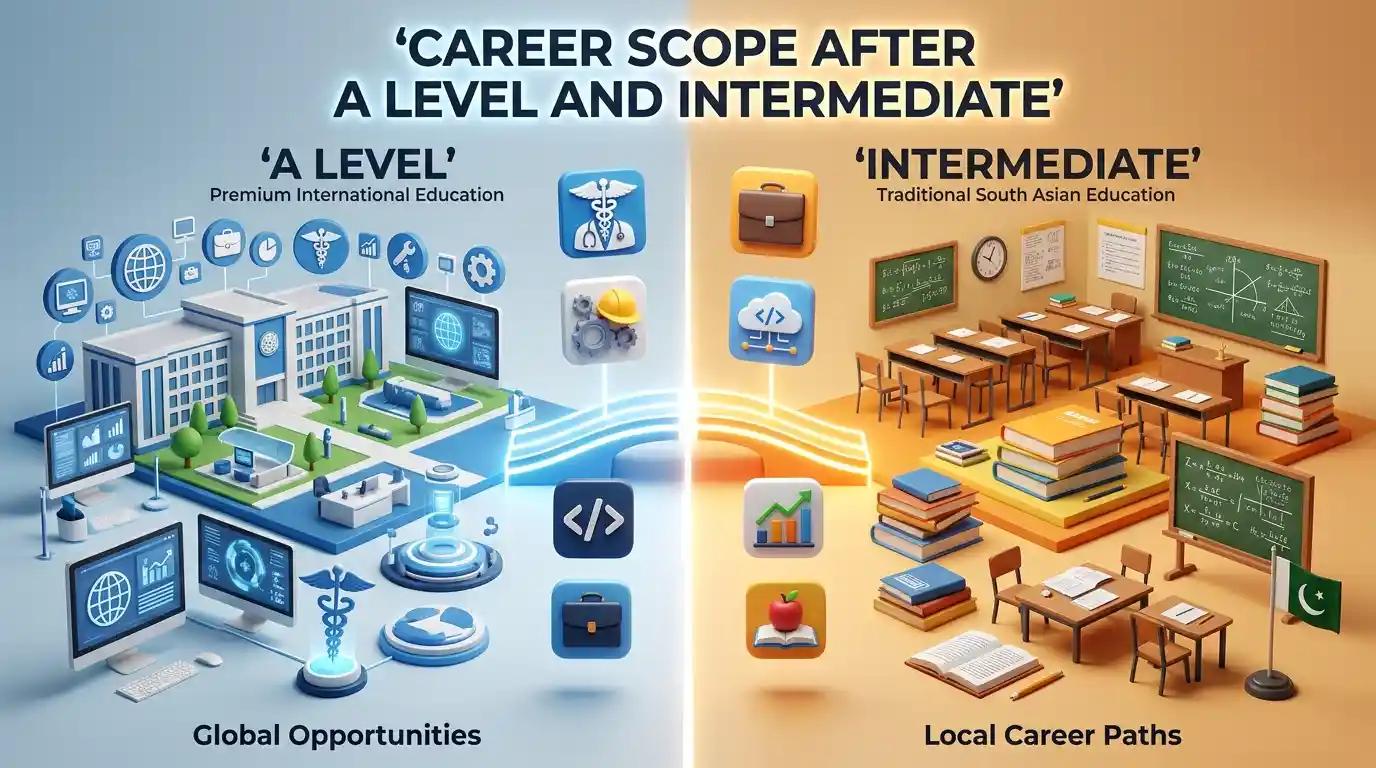
Career Options After A Level
- Direct entry to foreign universities (UK, Canada, Australia, etc.)
- Strong foundation for O/A Level teaching, research-based careers
- Easier transition into international scholarship programs
- Pathway into professional courses like ACCA, CIA, or CFA
Career Options After Intermediate
- Direct entry into Pakistani medical and engineering universities (via MDCAT/ECAT)
- Government job eligibility (many require Intermediate as minimum qualification)
- Entry into Pakistan Army, Navy, and Air Force programs after Intermediate
- Admission into Pakistani business and commerce degree programs
Higher Education Opportunities
A Level graduates often pursue international undergraduate degrees, while Intermediate graduates commonly proceed to local universities, medical colleges, and engineering institutions through entrance tests.
After either system, students can explore professional qualifications. Explore advanced corporate and taxation courses at ICT Business School, including CA (ICAP pathway), ACCA, CIA, and CMA — all strong career options after A Level or Intermediate.
International Study Opportunities
A Level is widely accepted by universities abroad without needing equivalence certificates in most cases. Intermediate students wanting to study abroad usually need an IBCC equivalence certificate to convert their marks into an internationally recognized format.
Which is Better for Career Growth: A Level or Intermediate?
There's no single right answer — it depends on your goals:
- Choose A Level if: you're targeting foreign universities, want a globally recognized qualification, or plan to pursue international scholarships.
- Choose Intermediate if: you're targeting Pakistani medical/engineering colleges, government jobs, or want a more budget-friendly path with strong local recognition.
Both paths can lead to strong professional careers when paired with the right qualification afterward. Why choose ICT Business School for the next step? Because it offers a direct bridge from O/A Levels or Intermediate into globally recognized finance and business credentials — CA, ACCA, CIA, CMA, HND, and Pearson BTEC Level 3 & Level 7 — all under one roof in Islamabad.
Skills & Benefits
- A Level: critical thinking, independent research, strong English communication, global exposure
- Intermediate: disciplined exam preparation, strong subject-specific theory knowledge, local university readiness
- Both systems build the academic foundation needed before specializing in CA, ACCA, CIA, CMA, HND, or O/A Level programs
Courses at ICT Business School
After completing A Level or Intermediate, students at ICT Business School can pursue:
- O Level Program and A Level Programs
- CA (ICAP pathway) and ACCA for chartered accountancy careers
- CIA (Certified Internal Auditor) and CMA (Certified Management Accountant)
- HND (Higher National Diploma) in Business
- Pearson BTEC Level 3 and Level 7 Extended Diploma
Check the full Courses page for details on each program, or meet the instructors on the Faculty page.
Job Scope & Salary
- A Level + ACCA/CA graduates often start in finance, audit, and corporate roles with strong entry-level salary potential
- Intermediate + local degree graduates commonly enter medicine, engineering, teaching, and government sectors
- Professional certifications (CA, ACCA, CMA, CIA) significantly boost salary potential regardless of which system you started with
How to Learn (Free + Paid Options)
- Free resources: Khan Academy, YouTube tutorials, past papers on PapaCambridge
- Paid/structured learning: Coursera offers foundational business and finance courses — explore options on Coursera
- Institute-based learning: Structured classroom programs at ICT Business School combine exam prep with career guidance
For broader program listings, you can also check ICT.edu.pk courses.
Expert Guidance
If you're unsure which path to choose, ask yourself one question first: where do you want to study after this? If the honest answer is "abroad" or "an international-style university," A Level will save you equivalence headaches later.
If you're aiming for a Pakistani medical or engineering seat, Intermediate keeps you aligned with the exact syllabus those entrance tests are built on — switching to A Level won't help there and may even put you at a disadvantage in MDCAT/ECAT prep.
Cost is a real factor too. A Level fees in Pakistan run noticeably higher than Intermediate college fees, so don't choose A Level purely for prestige if it strains the family budget unnecessarily — Intermediate from a good college, followed by a strong professional certification, works just as well for long-term career growth.
Key Facts
- A Level is a Cambridge International qualification; Intermediate is a Pakistani board qualification
- Both are 2-year programs (AS/A2 for A Level; Part 1/Part 2 for Intermediate)
- A Level uses letter grading (A*–E); Intermediate uses percentage/marks
- Intermediate students need IBCC equivalence for foreign university applications
- A Level fees are generally higher than Intermediate college fees
- Both qualifications can lead into CA, ACCA, CIA, CMA, HND, or Pearson BTEC programs afterward
- Government jobs and armed forces commissions in Pakistan commonly accept Intermediate as the minimum qualification
FAQs
Is A Level better than Intermediate? Neither is universally "better" — A Level suits students aiming for foreign universities, while Intermediate suits those targeting Pakistani medical, engineering, or government career paths.
Which is more difficult, A Level or Intermediate? A Level demands stronger analytical and English skills; Intermediate demands heavier memorization and board-exam-style practice. Difficulty depends on your personal learning style.
Can I go to university after Intermediate? Yes. Intermediate (FSc/FA/ICom/ICS) is the standard entry qualification for Pakistani universities, medical colleges, and engineering institutions.
Is A Level accepted in Pakistani universities? Yes, most Pakistani universities accept A Level results after an IBCC equivalence certificate converts grades into a percentage format.
Can I switch from Intermediate to A Level? Direct mid-program switching is uncommon, but students sometimes complete Intermediate and later pursue A Level subjects privately, or vice versa, depending on the institute's policy.
Which is better for studying abroad, A Level or Intermediate? A Level is generally smoother for studying abroad since it's already in an internationally recognized format; Intermediate students need equivalence certification first.
Is A Level expensive compared to Intermediate? Yes, A Level programs typically cost more due to Cambridge registration fees and private school structures, while Intermediate college fees are comparatively lower.
Which system is better for medical or engineering? Intermediate (FSc Pre-Medical or Pre-Engineering) aligns directly with MDCAT and ECAT syllabi, making it the more straightforward path for local medical and engineering admissions.
Conclusion
Choosing between A Level and Intermediate isn't about which system is objectively superior — it's about matching your qualification to your future goals. If international study is the plan, A Level offers a smoother path. If local medical, engineering, or government careers are the target, Intermediate keeps you aligned with the right entrance exams and admission requirements.
Whichever path you choose, the right professional qualification afterward makes all the difference. Visit ICT Business School today to explore O/A Level programs, CA, ACCA, CIA, CMA, HND, and Pearson BTEC Level 3 & 7 — and take the next confident step in your career. Browse more guides on the ICT Business School blog.