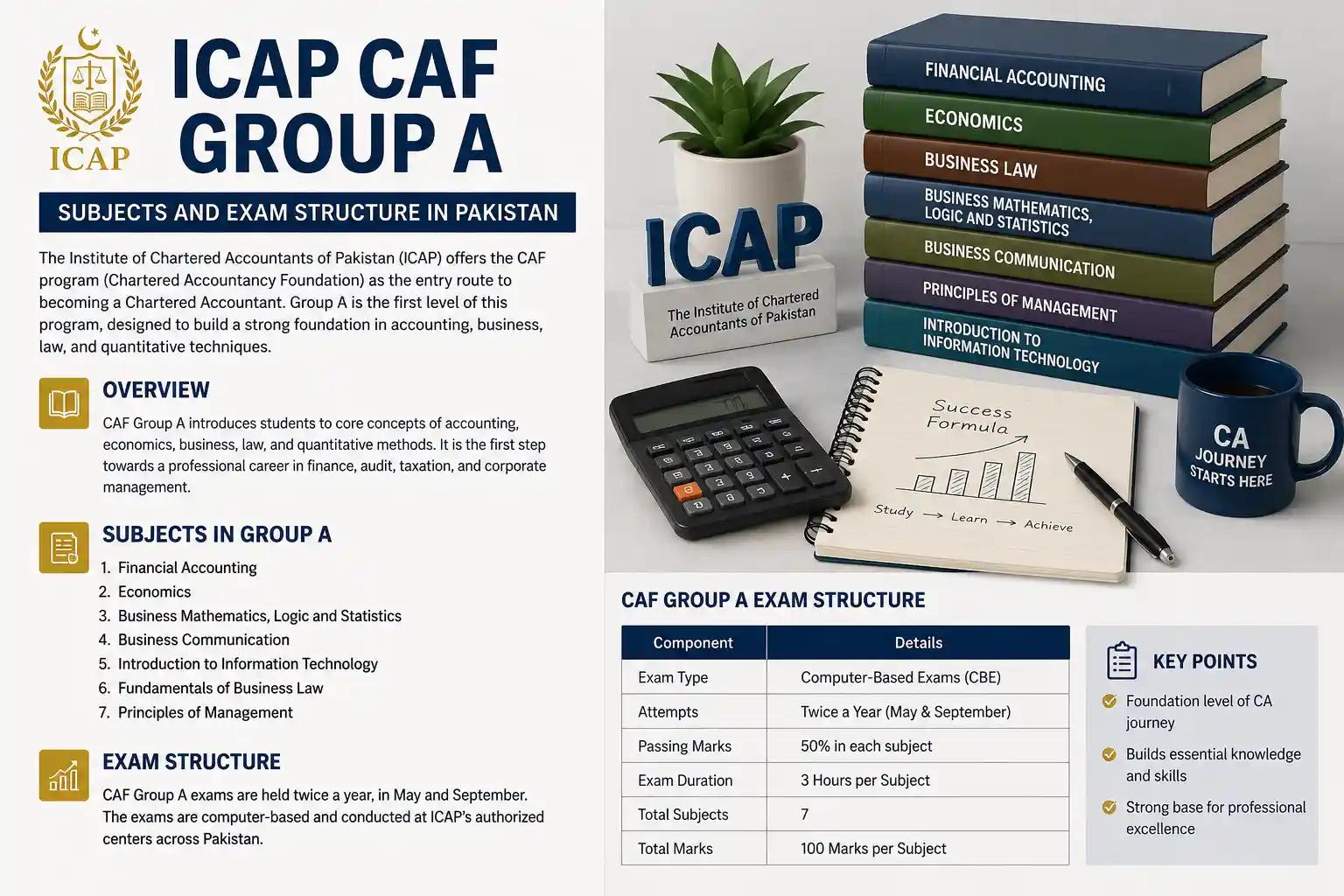
Most students think becoming a Chartered Accountant starts with difficult exams. It doesn't. It starts with one decision that quietly shapes your entire career—CAF Group A. The surprising part? Many students struggle not because the papers are impossible, but because they begin without understanding what these four subjects can mean for their future. Before you start your CA journey, there are a few things every student in Pakistan should know.
Quick Answer
CAF Group A is the first stage of the Certificate in Accounting and Finance (CAF) qualification offered by the Institute of Chartered Accountants of Pakistan (ICAP). It introduces students to the core principles of accounting, business, economics, and quantitative techniques, providing the foundation required to progress in the Chartered Accountancy pathway. Understanding the subjects, exam structure, and passing criteria is essential for building a strong start and successfully completing the CA journey in Pakistan.
Introduction
Starting your journey toward becoming a Chartered Accountant (CA) in Pakistan? The first major milestone is CAF Group A, the foundation level of ICAP's Certificate in Accounting and Finance (CAF) qualification. It is designed to build the essential accounting, business, and analytical skills needed for the higher stages of the CA program.
Whether you have recently completed Matric, Intermediate (FA, FSc, ICS, ICom), A Levels, or are planning a career change into accounting and finance, understanding the CAF Group A subjects, exam structure, paper pattern, and passing criteria is the best place to begin. A clear understanding of these fundamentals will help you prepare more effectively and improve your chances of passing the exams on your first attempt.
In this complete guide, you'll learn everything you need to know about CAF Group A, including the subjects, paper codes, examination structure, eligibility, preparation strategy, and practical study tips to help you start your CA journey with confidence.
1. What is CAF Group A?
CAF Group A is the first stage of the Certificate in Accounting and Finance (CAF) qualification offered by the Institute of Chartered Accountants of Pakistan (ICAP). It provides the academic foundation required for students who want to become Chartered Accountants (CA) in Pakistan by introducing the core principles of accounting, business, law, and quantitative analysis.
The CAF qualification is divided into two groups—Group A and Group B—comprising a total of eight papers. CAF Group A includes the first four papers (CAF-1 to CAF-4) and is designed to build the knowledge and analytical skills needed before progressing to the more advanced stages of the CA program.
Students study essential areas such as financial accounting, business law, cost and management accounting, business mathematics, and behavioral studies. These subjects create a strong academic base that supports success in CAF Group B, CFAP (Certificate in Finance, Accounting and Reporting), and the later stages of the ICAP CA qualification.
For students in Pakistan, CAF Group A is often the first major milestone in the CA journey. Many begin preparing after Matric, Intermediate (FA, FSc, ICS, ICom), or A Levels, allowing them to develop professional accounting knowledge alongside their academic education. Building a strong foundation at this stage not only improves exam performance but also makes the transition to advanced CA papers significantly easie
2. Why Is CAF Group A Is Important?
CAF Group A is much more than the first set of exams in the ICAP CA qualification—it is the foundation upon which your entire Chartered Accountancy journey is built. The concepts you learn in these four papers are applied repeatedly throughout CAF Group B, CFAP, and your professional training, making a strong understanding of this stage essential for long-term success.
From a career perspective, completing CAF Group A demonstrates that you have developed the core knowledge and analytical skills expected from an aspiring accounting professional. It gives you a solid understanding of financial accounting, business law, cost and management accounting, and quantitative techniques, which are valuable across accounting, auditing, taxation, banking, and corporate finance.
Another important advantage for students in Pakistan is that the ICAP CAF qualification can create opportunities beyond the traditional CA pathway. Strong performance at the CAF level may help students become eligible for exemptions in other internationally recognized accounting qualifications, making it easier to expand their professional credentials in the future.
Many students worry that CAF Group A is difficult, especially when starting immediately after Intermediate or A Levels. While the syllabus is challenging, it is designed to be completed step by step. With consistent study habits, regular practice, and a structured preparation plan, thousands of students successfully clear CAF Group A every year and continue progressing toward becoming Chartered Accountants.

CAF Group A Subjects
CAF Group A consists of four core papers, each designed to build the knowledge and practical skills required for success in the ICAP CA qualification. Together, these subjects introduce students to the fundamentals of accounting, business law, cost and management accounting, and quantitative techniques, creating a strong academic foundation for the higher stages of the CA program.
| Paper Code | Subject Name | Core Domain | Exam Type | Level |
|---|---|---|---|---|
| CAF-1 | Financial Accounting and Reoporting 1 | Financial Accounting Basics Icap | Written Subjective | Foundation |
| CAF-2 | Cost and managment Accounting | Cost Accounting Budgeting | Written Subjective | Foundation |
| CAF-3 | Business Law | Business Law CAF Syllabus Contract Law | Written Subjective | Conceptual |
| CAF-4 | Business Managment and Behavioral Studies | Organizational Behaviour Managment | Written Subjective | Conceptual |
Note: At present, CAF Group A examinations are conducted in the format prescribed by ICAP. As the examination system continues to evolve, ICAP may introduce changes to the assessment format in future examination sessions. Students are advised to regularly check the official ICAP website for the latest announcements, examination updates, and policy changes.
CAF-1 — Financial Accounting and Reporting I
CAF-1 is the foundation of the ICAP CA qualification and one of the most important papers in CAF Group A. It introduces students to the core principles of financial accounting, enabling them to understand how financial information is recorded, classified, and presented for businesses.
The syllabus covers topics such as the accounting equation, double-entry bookkeeping, journal entries, trial balance, financial statements for sole proprietors, partnerships, and companies, along with fundamental financial reporting concepts. A strong command of CAF-1 makes it easier to understand advanced accounting and financial reporting subjects in the later stages of the CA qualification.
CAF-2 — Cost and Management Accounting
CAF-2 develops the analytical and numerical skills required for management accounting. Students learn how businesses calculate costs, prepare budgets, measure performance, and use financial information to support management decisions.
Key topics include cost classification, job costing, process costing, marginal costing, budgeting, standard costing, and variance analysis. Since this paper involves extensive calculations and practical problem-solving, consistent practice is essential for achieving strong examination results.
CAF-3 — Business Law
CAF-3 introduces students to the legal framework governing businesses in Pakistan. Understanding business law is essential for every future Chartered Accountant, as legal knowledge plays an important role in accounting, auditing, taxation, and corporate compliance.
The syllabus covers the law of contracts, sale of goods, negotiable instruments, and the fundamentals of company law. Students are expected not only to understand legal concepts but also to apply them to practical business situations through case-based questions.
CAF-4 — Business Management and Behavioral Studies
CAF-4 focuses on the management and behavioral aspects of business organizations. It helps students understand how organizations operate and how effective leadership, communication, and decision-making contribute to business success.
The syllabus includes management theories, organizational structures, leadership, motivation, communication, and organizational behavior. Although the paper is largely theory-based, students who develop strong conceptual understanding and structured writing skills generally perform well in the examination.
The ICAP CAF Syllabus 2026 is designed to equip aspiring Chartered Accountants with the knowledge and practical skills required for today's accounting and business environment. While the overall structure of CAF Group A remains consistent, ICAP periodically updates its syllabus to reflect changes in accounting standards, business regulations, and professional practices. Students should always study from the latest ICAP-approved syllabus and study material to ensure they are preparing according to the current examination requirements.
CAF-1 – Financial Accounting and Reporting I
The CAF-1 syllabus focuses on building a strong foundation in financial accounting and reporting. Students learn how to prepare and interpret financial statements while understanding the principles that govern financial reporting.
Major topics include:
- Accounting principles and concepts
- Double-entry bookkeeping
- Preparation of financial statements
- Depreciation and provisions
- Accruals and prepayments
- Introduction to financial reporting standards
- Financial statement analysis
A solid understanding of CAF-1 is essential because the concepts introduced in this paper continue throughout the higher stages of the CA qualification.
CAF-2 – Cost and Management Accounting
The CAF-2 syllabus develops analytical and problem-solving skills by introducing techniques used in business planning and cost control.
Key topics include:
- Cost classification
- Job and process costing
- Marginal and absorption costing
- Budgeting techniques
- Standard costing
- Variance analysis
- Basic activity-based costing
Regular practice of numerical questions and past papers is one of the most effective ways to prepare for this subject.
CAF-3 – Business Law
The CAF-3 syllabus provides students with a practical understanding of the legal framework governing businesses in Pakistan.
The syllabus includes:
- Law of Contract
- Sale of Goods
- Negotiable Instruments
- Partnership Law
- Company Law fundamentals
- Relevant business legislation applicable in Pakistan
Since business laws are occasionally updated, students should always refer to the latest ICAP syllabus and approved study resources.
CAF-4 – Business Management and Behavioral Studies
The CAF-4 syllabus focuses on the management side of business and helps students understand how organizations function effectively.
Key areas include:
- Principles of Management
- Organizational Behavior
- Leadership Styles
- Motivation Theories
- Communication Skills
- Team Management
- Organizational Change
This paper develops the leadership and managerial perspective expected from future Chartered Accountants and complements the technical knowledge gained in the accounting papers.
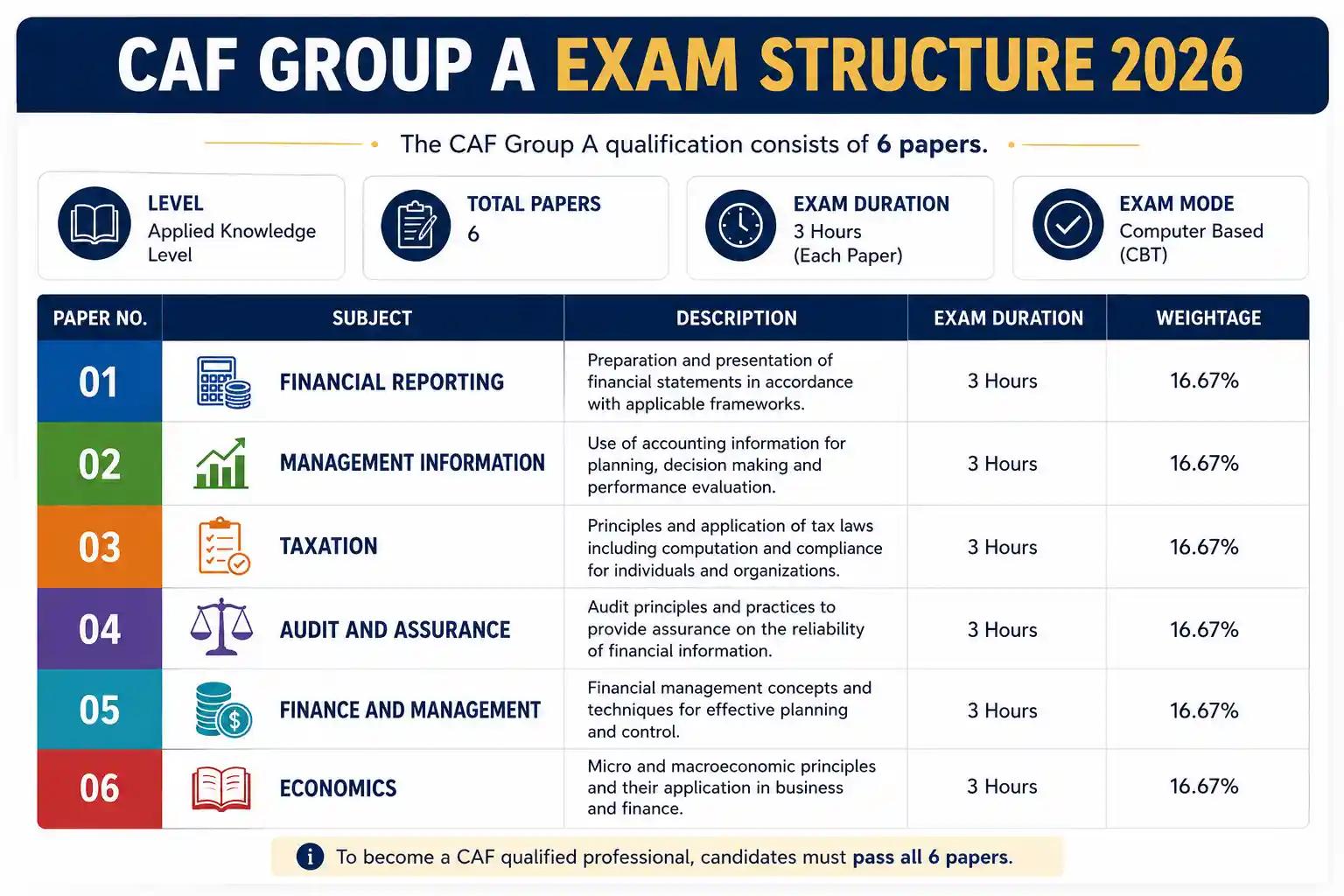
CAF Group A Exam Structure 2026
Before starting your preparation, it is important to understand how the CAF Group A examinations are structured. Knowing the exam pattern, total marks, duration, and assessment format helps students prepare more effectively, manage their time during the examination, and develop the right study strategy. A clear understanding of the exam structure also enables students to focus on the areas that carry the greatest weight in the assessment.
| Paper | Subject | Total Marks | Duration | Question Format | Session |
|---|---|---|---|---|---|
| CAF-1 | Financial Accounting and Reporting 1 | 100 | 3 hours | Subjective (cuompolsory+Choice | Spring and Autumm |
| CAF-2 | Cost and Managment Accounting | 100 | 3 hours | Subjective (cuompolsory+Choice | Spring and Autumm |
| CAF-3 | Business Law | 100 | 3 hours | Subjective (MCQS+Short /long Question | Spring and Autumm |
| CAF-4 | Business managment Behaviroal studies | 100 | 3 hours | Subjective (MCQS+Short /long Question | Spring and Autumm |
Each CAF Group A paper carries 100 marks and has an examination duration of 3 hours. ICAP generally conducts two examination sessions each year—the Spring Session and the Autumn Session—allowing students to attempt one or multiple papers based on their preparation and study plan.
The examination pattern is designed to assess both conceptual understanding and practical application. CAF-1 (Financial Accounting and Reporting I) and CAF-2 (Cost and Management Accounting) are more calculation-oriented and require strong numerical and analytical skills. In contrast, CAF-3 (Business Law) and CAF-4 (Business Management and Behavioral Studies) place greater emphasis on theoretical concepts, case-based analysis, and the practical application of knowledge.
In recent examination sessions, ICAP has increasingly focused on scenario-based questions that test a student's ability to analyze real-life business situations instead of relying solely on memorization. This makes conceptual understanding and regular practice more important than simply learning definitions.
Students should also keep track of important examination deadlines, including exam registration, fee submission, date sheet announcements, and admit card issuance. Since examination schedules and policies may change from session to session, candidates are advised to regularly check the official ICAP website for the latest updates and announcements.
CAF Group A Passing Criteria
One of the most common questions among CA students in Pakistan is, "What are the passing marks for CAF Group A?" Before attempting the examination, it is important to understand the ICAP passing criteria, as meeting the required standard in each paper is essential for progressing to the next stage of the Chartered Accountancy qualification.
The table below explains the official passing criteria for CAF Group A, including the minimum marks and any applicable requirements prescribed by ICAP.
| Criteria | Requirments | Notes |
|---|---|---|
| Minimum Passing Marks Par Paper | 50 out of 100 | Each Paper Should Be Pass Individually |
| Groups Exemption(Pass Credit | Pass All Papers In Group A | No Group Level Agregate |
| Maximum Attempts | No Offical Limit Par Paper | Students May Re Attempt Failed in Next Session |
| Carry Forward /Permanent Credit | Passed Paper are Permenantily Credited | No Expiry On Passed CAF Papers |
| Exemption(AFC/Other Qualifications | Possible For AFC-Qualified Students | Subject To ICAP Exemption Policy |
| Distinction | 75 Marks Or Above Per Paper | Noted On ICAP Results |
Understanding the CAF Group A passing criteria is just as important as preparing for the examinations themselves. Many students in Pakistan have questions about paper-wise passing, credit validity, result announcements, and distinctions. The following points will help you better understand how the ICAP assessment system works.
- Each paper is assessed independently. Passing one paper does not compensate for failing another. For example, if you pass CAF-1 but do not achieve the required passing marks in CAF-2, you will only need to reattempt CAF-2 in a future examination session.
- Passed papers remain valid permanently. Once you successfully pass a CAF Group A paper, you do not have to take that paper again, regardless of how long it takes you to complete the remaining stages of the ICAP CA qualification. This flexible structure allows students to progress through the program at their own pace.
- Results are announced after each examination session. ICAP generally publishes CAF examination results a few weeks after the exams. Students can access their subject-wise results, marks, and pass or fail status through the official ICAP student portal.
- High-performing students receive distinction. Achieving outstanding marks in a CAF paper demonstrates academic excellence and reflects a strong understanding of the subject. Consistently high scores can strengthen your academic profile and create a positive impression when applying for articleship opportunities or future career positions.
How to Prepare for CAF Group A
Preparing for CAF Group A requires more than simply reading textbooks—it demands a well-structured study plan, consistent practice, and a clear understanding of the examination pattern. Students who prepare strategically are far more likely to clear their papers on the first attempt than those who rely on last-minute revision. The following step-by-step strategy has helped many CA students in Pakistan prepare effectively for the ICAP CAF examinations.
Step 1 – Understand the Syllabus Before You Begin
Before starting your preparation, carefully review the latest ICAP CAF syllabus for each paper. Understanding the learning outcomes and topic weightage will help you identify high-priority areas and allocate your study time more effectively. A clear understanding of the syllabus prevents unnecessary effort on less important topics and keeps your preparation focused.
Step 2 – Study from Official Resources
Always begin with the official ICAP study texts, as they are prepared according to the current examination requirements. Once your concepts are clear, you can use supplementary notes and revision material to strengthen your understanding. The key is to study from updated resources that match the latest ICAP syllabus.
Step 3 – Practice Past Papers Consistently
One of the most effective ways to prepare for CAF Group A is by solving past examination papers. Practicing previous papers helps you understand question patterns, improve time management, and identify commonly tested topics. It also allows you to become familiar with the style of answers expected by ICAP examiners.
Step 4 – Plan Your Exam Attempts Wisely
You are not required to attempt all four papers in one examination session. Choose your subjects based on your preparation level, academic background, and available study time. A balanced study plan often produces better results than attempting too many papers at once.
Step 5 – Seek Expert Guidance When Needed
Although many students prepare independently, professional guidance can make a significant difference—especially in technical subjects such as Financial Accounting and Cost & Management Accounting. Learning from experienced teachers, participating in mock examinations, and receiving regular feedback can improve both conceptual understanding and examination performance.
Step 6 – Follow a Structured Three-Month Study Plan
If you have approximately three months before the examination, divide your preparation into clear phases:
- Month 1: Complete the syllabus and build strong concepts.
- Month 2: Revise every subject and solve chapter-wise questions.
- Month 3: Focus on past papers, mock exams, revision, and improving weak areas.
Following a structured schedule helps you stay consistent and reduces examination stress.
Step 7 – Improve Your Answer Writing Skills
Success in CAF Group A depends not only on knowledge but also on how effectively you present your answers. Practice writing complete solutions under timed conditions, organize your workings neatly in numerical papers, and develop clear, well-structured answers for theory-based questions. Good presentation often makes a noticeable difference in scoring.
Career Opportunities After CAF Group A
Passing CAF Group A is the first major milestone in the ICAP Chartered Accountancy journey. Although it is an academic stage rather than a professional qualification, it strengthens your profile for internships, trainee positions, and future articleship opportunities while preparing you for advanced ICAP examinations.
As you continue progressing through the CA pathway, you become eligible for careers in accounting, auditing, taxation, finance, and business advisory across Pakistan's public and private sectors.
Career Path After CAF
Students who successfully progress through the ICAP CA qualification can build careers in roles such as:
- Audit Associate
- Accounts Executive
- Finance Executive
- Tax Associate
- Internal Auditor
- Financial Analyst
- Cost Accountant
- Senior Accountant
- Finance Manager
- Financial Controller
- Chief Financial Officer (CFO)
These professionals are employed by Big 4 accounting firms, audit practices, commercial banks, multinational companies (MNCs), manufacturing organizations, FMCG companies, telecom companies, insurance firms, public sector organizations, and consulting firms throughout Pakistan.
Salary Expectations
Salary depends on your qualification stage, experience, employer, and location. Students beginning their careers after the early stages of the CA pathway generally start in trainee and junior finance roles, while professionals who complete the ICAP CA qualification and gain relevant experience can progress into senior finance and leadership positions with significantly higher earning potential.
Top Employers in Pakistan
CA professionals are commonly recruited by:
- Big 4 accounting firms
- Commercial and Islamic banks
- Multinational companies (MNCs)
- Manufacturing companies
- FMCG organizations
- Telecom companies
- Oil & Gas companies
- Insurance companies
- Government organizations
- Consulting and advisory firms
Universities That Commonly Lead Students into the ICAP Pathway
Many students who pursue the ICAP CA qualification come from institutions such as:
- Institute of Chartered Accountants of Pakistan (ICAP) affiliated educational route
- Institute of Business Administration (IBA)
- Lahore University of Management Sciences (LUMS)
- National University of Sciences & Technology (NUST)
- COMSATS University Islamabad
- University of the Punjab
- Government College University (GCU)
- Bahria University
- Air University
- Superior University
- The University of Lahore (UOL)
- Riphah International University
- International Islamic University Islamabad (IIUI)
These institutions, along with many other universities across Pakistan, provide strong academic foundations for students who later choose the ICAP Chartered Accountancy pathway.
Expert Guidance
One thing that consistently separates successful CAF Group A students from the rest is not the number of hours they study—it's how they study. Students who focus on understanding concepts, solving past papers regularly, and reviewing their mistakes usually perform much better than those who rely only on reading notes or last-minute preparation.
A practical approach is to complete each topic first, then immediately reinforce it with practice questions before moving to the next one. This builds confidence and helps you retain concepts for much longer. For calculation-based papers like CAF-1 and CAF-2, regular numerical practice is essential, while CAF-3 and CAF-4 require consistent revision and the ability to present well-structured written answers.
Another habit that high-performing students develop is treating past papers as part of their learning process rather than something to attempt only before the examination. Solving questions under timed conditions improves speed, accuracy, and exam confidence, while reviewing examiner expectations helps you understand exactly how marks are awarded.
If you stay consistent, revise regularly, and follow a structured study plan instead of rushing through the syllabus, CAF Group A is absolutely achievable on the first attempt. In professional qualifications like CA, steady progress and disciplined preparation almost always produce better results than studying for long hours without a clear strategy.
Why Choose ICT Business School for CAF Preparation?
ICT Business School is one of Pakistan's most trusted institutes for CA, ACCA, CIA, CMA, HND, and BTEC programs. Our experienced faculty, structured CAF coaching, regular mock exams, and student-first approach have helped hundreds of students clear CAF Group A with confidence across Pakistan. Learn more about us at https://www.ictbusinessschool.com/about and contact us today at https://www.ictbusinessschool.com/contact to enroll in the next available CAF batch.
8. FAQs About CAF Group A
Q: What subjects are in CAF Group A? CAF Group A contains four subjects: CAF-1 (Financial Accounting and Reporting I), CAF-2 (Cost and Management Accounting), CAF-3 (Business Law), and CAF-4 (Business Management and Behavioral Studies). All four are offered by ICAP — the Institute of Chartered Accountants of Pakistan — as part of the Certificate in Accounting and Finance qualification.
Q: How many papers are in CAF Group A? There are 4 papers in CAF Group A, coded CAF-1 to CAF-4. The full CAF qualification has 8 papers total, divided into Group A (CAF-1 to CAF-4) and Group B (CAF-5 to CAF-8). Students must pass all papers in both groups to complete the full CAF qualification.
Q: What is the passing mark in CAF exams? The passing mark for each CAF paper is 50 out of 100. Each paper must be passed independently — there is no group aggregate system. Once passed, a paper carries permanent credit with no expiry, regardless of when you passed it.
Q: Is CAF Group A difficult for beginners? CAF Group A has moderate difficulty. CAF-1 and CAF-2 require strong numerical and conceptual skills, while CAF-3 and CAF-4 are theory-based. With consistent study, quality coaching, and regular past paper practice, many students clear one or more CAF Group A papers in their first attempt. Enrolling in a structured institute like ICT Business School significantly improves first-attempt pass rates.
Q: Which subject is hardest in CAF Group A? Most students find CAF-1 (Financial Accounting and Reporting I) and CAF-2 (Cost and Management Accounting) the most challenging because they involve complex calculations, accounting concepts, and strict time management under exam conditions. CAF-3 (Business Law) can also be demanding due to the sheer volume of legal content that must be memorized and applied to scenarios.
Q: What is ICAP CAF qualification? ICAP CAF, which stands for Certificate in Accounting and Finance, is an intermediate professional accounting qualification issued by the Institute of Chartered Accountants of Pakistan. It consists of 8 papers in two groups and serves as a stepping stone between the foundational AFC level and the advanced CFAP level in the CA Pakistan pathway. CAF is widely recognized by employers in Pakistan and can also provide exemptions in ACCA.
Q: Can I pass CAF Group A in the first attempt? Yes, absolutely. Many students pass CAF Group A papers in their first attempt with the right preparation. The key is starting early, following a structured study plan, solving ICAP past papers with suggested answers, and attending quality coaching classes. ICT Business School's CAF preparation program is specifically designed to help students achieve first-attempt passes through guided learning and rigorous timed practice.
Q: What is the exam pattern of CAF Pakistan? Each CAF paper carries 100 marks and has a duration of 3 hours. Papers are currently in written, subjective format with compulsory and optional question sections. ICAP holds CAF exams twice a year — in the Spring session (March/April) and the Autumn session (September/October). ICAP is gradually transitioning CAF papers to Computer-Based Examination (CBE) format in a phased manner, so watch for official announcements.
Conclusion
CAF Group A is the foundation of your CA journey in Pakistan. By understanding the CAF Group A subjects, exam structure, ICAP syllabus, and passing criteria before you begin, you are already ahead of most students who walk into preparation without a clear plan. The four papers — Financial Accounting and Reporting I, Cost and Management Accounting, Business Law, and Business Management and Behavioral Studies — each build a distinct professional skill that you will use throughout your career in accounting and finance.
The CAF exam structure in Pakistan is fair, modular, and genuinely student-friendly. Permanent credits, twice-yearly exam windows, and the freedom to attempt papers at your own pace mean that success is within reach — provided you put in the required effort and get proper guidance from the start.
Whether you are in Karachi, Lahore, Islamabad, or anywhere across Pakistan, ICT Business School (https://www.ictbusinessschool.com/) stands as a trusted partner in your accounting certification journey. From CA (ICAP pathway) and ACCA to CIA, CMA, HND, and Pearson BTEC Level 3 and Level 7 programs, ICT offers a complete professional education ecosystem under one roof. Explore advanced corporate and taxation courses at ICT at https://www.ictbusinessschool.com/about and take the first step toward a rewarding accounting and finance career today.
Ready to start your CAF Group A journey? Enroll now at https://www.ictbusinessschool.com/contact or browse all available courses at https://www.ictbusinessschool.com/courses.