
BTEC Level 7 or MBA? Most people get confused—which one should you choose?
Quick answer:
BTEC Level 7 (RQF Level 7, Ofqual regulated) is a postgraduate diploma that's faster, more affordable, and career-focused, ideal for working professionals who want practical business management skills without a dissertation. An MBA is a full master's degree with deeper academic research, a stronger global brand name, and typically requires more time and money. If you want quick career progression and lower cost, BTEC Level 7 is the smarter choice. If you need a recognized master's-level degree for global corporate or academic roles, an MBA suits you better.
What Is an MBA?
MBA stands for Master of Business Administration.
An MBA is a full academic master's degree awarded by a university. It's designed to build strategic management, leadership, and business administration skills through case studies, coursework, and usually a final dissertation or research project. MBAs are globally recognized and often required for senior corporate leadership roles.
What Is BTEC Level 7?
BTEC stands for Business and Technology Education Council.
BTEC Level 7 is a Pearson-awarded, Ofqual-regulated postgraduate diploma under the UK's Regulated Qualifications Framework (RQF). It sits at the same academic level as a master's degree (RQF Level 7) but is a diploma, not a full degree. It focuses on practical business management, leadership, and strategic skills, and is designed for working professionals who want faster, applied learning without a dissertation.
Is BTEC Level 7 or an MBA Worth It?
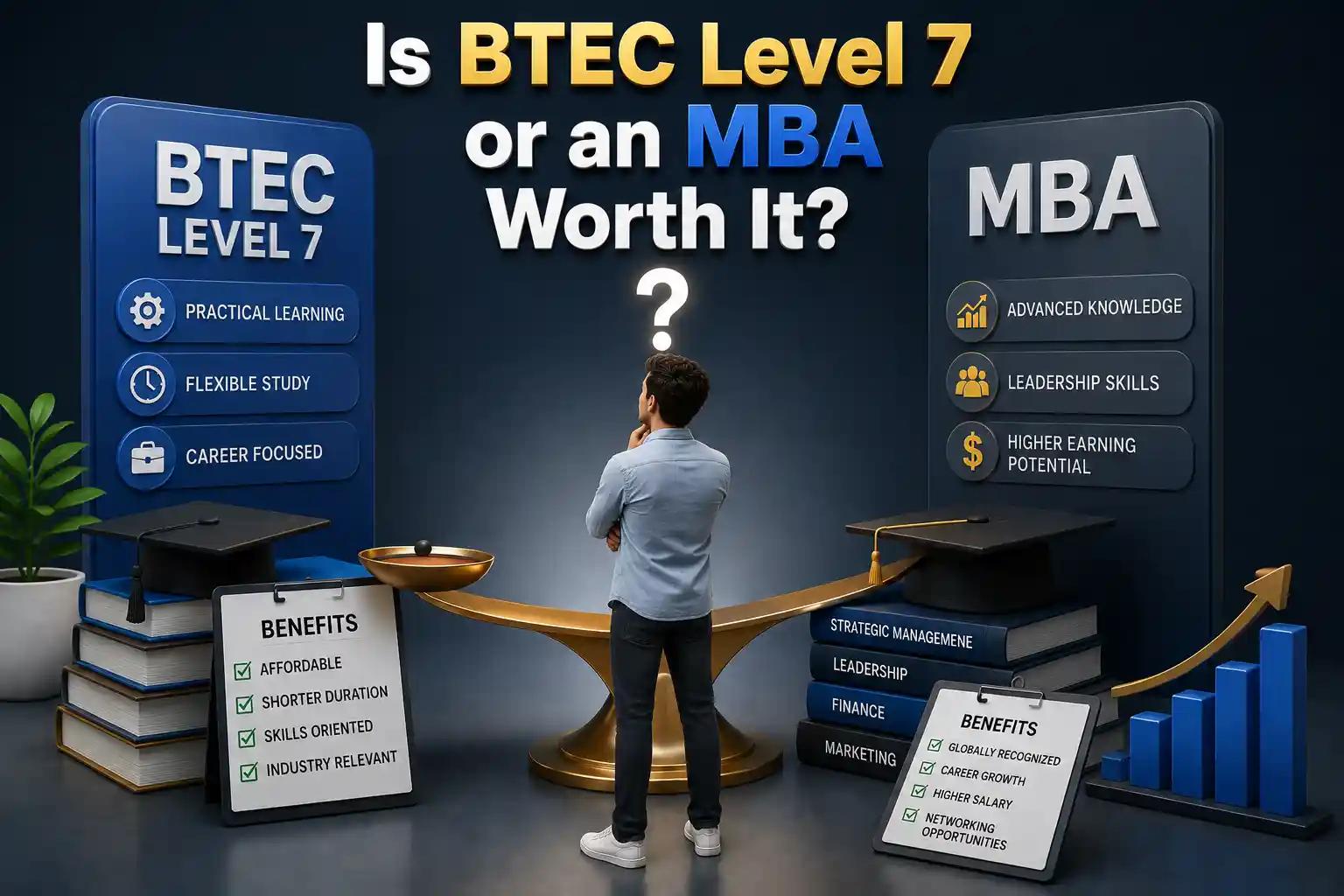
Both are worth it — but for different reasons.
- BTEC Level 7 is worth it if you want a quicker, budget-friendly qualification that gets you management-level recognition without stepping away from work for years.
- An MBA is worth it if you want a full master's degree with strong global brand value, deeper research training, and access to top-tier corporate or academic opportunities.
The real question isn't "which one is better" in general — it's which one matches your current experience, budget, and career timeline. For most working professionals in Pakistan looking for faster ROI, BTEC Level 7 offers strong value, especially when paired with a university top-up later.
What Is the Difference Between BTEC Level 7 and an MBA?
Both qualifications sit at postgraduate level, but they aren't identical.
BTEC Level 7 is a Pearson-awarded, Ofqual-regulated qualification under the UK's Regulated Qualifications Framework (RQF). It's a postgraduate diploma in business management, built for people who already have work experience and want to sharpen leadership and strategic management skills quickly.
MBA (Master of Business Administration) is a full academic master's degree awarded by a university. It usually includes a dissertation, research project, and broader business school exposure, and carries strong international recognition as a management qualification.
In short: BTEC Level 7 is a practical, fast-track business qualification. An MBA is a formal academic master's degree pathway.
Key Differences Between BTEC Level 7 and MBA
| Factor | BTEC Level 7 Diploma | MBA Degree |
|---|---|---|
| Awarding Body | Pearson (Ofqual regulated) | University (degree-awarding body) |
| Qualification Type | Postgraduate diploma | Master's degree |
| Duration | 9–12 months (average) | 1–2 years |
| Dissertation | Not usually required | Usually required |
| Cost | Lower / affordable | Higher tuition fees |
| Entry Route | Work experience + academic credits | Bachelor's degree + often GMAT/work experience |
| University Top-Up | Yes, can progress to a master's degree | Already a master's-level degree |
| Study Mode | Online, blended, distance learning | On-campus, online, or executive MBA |
| Best For | Working professionals, career switchers | Those wanting an internationally branded degree |
Entry Requirements and Admission Process
BTEC Level 7 entry requirements are generally flexible:
- A bachelor's degree or equivalent professional experience
- Relevant work experience (often accepted in place of a degree)
- English language proficiency for international students
- No entrance exam required in most cases
MBA entry requirements are usually stricter:
- A recognized bachelor's degree
- 2–5 years of managerial or professional work experience
- GMAT/GRE scores (required by many business schools)
- Strong academic transcripts and reference letters
This makes BTEC Level 7 a more accessible MBA alternative for professionals who don't meet strict MBA entry criteria but still want a postgraduate business qualification.
Duration and Study Format
- BTEC Level 7 diploma: Typically completed in 9 to 12 months, available online, blended, or distance learning — ideal for working professionals balancing a job.
- MBA degree: Usually takes 1 to 2 years full-time, or longer part-time. Executive MBA programs are designed for senior managers and take a similar timeframe with evening or weekend classes.
If speed matters, BTEC Level 7 vs MBA comparisons consistently show the diploma route is faster to complete.
Curriculum and Subjects
BTEC Level 7 curriculum covers:
- Strategic management and leadership
- Operations management
- Finance management
- Marketing management
- Human resource (HR) management
- Business analytics and entrepreneurship
MBA curriculum covers similar core areas but adds:
- In-depth research methods
- A final dissertation or capstone project
- Broader case-study-based business strategy modules
- Elective specializations (finance, marketing, international business)
Both qualifications build strategic decision-making and management theory knowledge, but the MBA goes deeper into academic research, while BTEC Level 7 focuses on applied, workplace-ready learning.
Career Opportunities
Both qualifications open doors to management-level roles, including:
- Operations manager
- Project manager
- HR manager
- Marketing manager
- Business analyst
- Business consultant
- Executive manager
Salary and recognition: MBA graduates from top global business schools often command higher starting salaries, especially in multinational corporations. However, a BTEC Level 7 diploma, combined with real work experience, is widely accepted by employers across Pakistan, the UK, UAE, and other regions — and many BTEC Level 7 graduates proceed to a university top-up to complete a full master's degree later, gaining the best of both worlds.
Courses at ICT Business School
ICT Business School offers a strong mix of internationally recognized qualifications designed for students and working professionals in Pakistan who want real career progression:
- Pearson BTEC Level 3 & Level 7 programs
- HND (Higher National Diploma) in Business
- CA (ICAP pathway)
- ACCA
- CIA (Certified Internal Auditor)
- CMA
- O/A Levels
If you're weighing a Level 7 business diploma against an MBA, explore the Level 7 Extended Diploma at ICT Business School to see how it fits your career goals. You can also check the Pearson BTEC Level 3 program or the HND in Business for a foundation before moving to Level 7.
To understand why choose ICT Business School, review the full course list, and don't forget to explore advanced corporate and taxation courses at ICT.
Job Scope & Salary
- BTEC Level 7 graduates commonly step into mid-to-senior management roles, with salaries improving significantly once combined with relevant experience.
- MBA graduates often see stronger salary growth in corporate leadership and consulting roles, particularly with degrees from internationally ranked business schools.
- Both qualifications support career advancement into strategic and leadership careers across finance, marketing, operations, and HR.
How to Learn (Free + Paid Options)
Free resources to build foundational business knowledge before enrolling:
- Google Digital Garage — free business and digital skills courses
- Coursera — audit business and leadership courses free
- IBM SkillsBuild — free business analytics and leadership training
Paid, structured options:
- Enroll directly in a Level 7 Extended Diploma at ICT Business School
- Pursue a full MBA through a recognized university
- Combine BTEC Level 7 with professional certifications like ACCA or CMA for stronger credentials
You can also review course details at ICT.edu.pk or compare programs through IDT Pakistan.
Which Is Better: BTEC Level 7 or MBA?
There's no single right answer — it depends on your goals:
- Choose BTEC Level 7 if you want a faster, more affordable route into management, already have work experience, and prefer practical, applied learning without a dissertation.
- Choose an MBA if you need a globally branded master's degree, plan to work in academia or highly competitive corporate environments, and can commit more time and budget.
- Choose both — many professionals complete BTEC Level 7 first, then use the university top-up pathway to convert credits toward a full master's degree later, reducing overall cost and time.
Expert Guidance
If you're currently working and want quick career movement, start with BTEC Level 7 — it's Ofqual regulated, accepted by many UK universities for master's progression, and won't pull you out of the workforce for two years.
If your long-term goal is a corporate leadership role at a multinational company or an academic career, invest in a full MBA from an accredited business school, even if it costs more upfront.
A practical middle path: complete Level 7 now, gain 1–2 years of applied management experience, then top up to a master's degree once you're confident in your specialization (finance, marketing, or operations).
Key Facts
- BTEC Level 7 is regulated by Ofqual and awarded by Pearson under the Regulated Qualifications Framework (RQF).
- BTEC Level 7 is considered master's equivalent in level, but is a postgraduate diploma, not a full degree.
- MBA is a formal master's degree, usually requiring a dissertation or research project.
- BTEC Level 7 typically takes 9–12 months; MBA typically takes 1–2 years.
- BTEC Level 7 is generally cheaper than most MBA programs.
- Many UK universities accept Level 7 diploma credits for direct entry into a master's degree (university top-up).
- Both qualifications are recognized by employers in the UK, UAE, Pakistan, India, and Saudi Arabia.
- ICT Business School offers the Pearson BTEC Level 7 Extended Diploma along with ACCA, CMA, CIA, and CA pathways.
Career Opportunities

Graduates of either pathway can pursue roles such as:
- Business Analyst
- Operations Manager
- Project Manager
- Marketing Manager
- HR Manager
- Executive Manager
- Business Consultant
Combining a Level 7 business diploma with a professional certification like ACCA or CMA — both offered at ICT Business School — strengthens employability further, especially in finance and audit-focused management roles.
Both BTEC Level 7 and MBA open strong doors into management careers, but the pace, sectors, and salary ceilings differ. Here's a deeper breakdown of what each path actually leads to.
Career Paths After BTEC Level 7
BTEC Level 7 is built for people who already have some work experience and want to move up quickly. Common roles include:
- Operations Manager – overseeing daily business processes, supply chains, and efficiency
- Project Manager – leading teams and delivering projects within budget and timeline
- HR Manager – handling recruitment, employee relations, and organizational development
- Marketing Manager – managing campaigns, brand strategy, and market research
- Business Development Executive – identifying growth opportunities and partnerships
- Team Lead / Department Head – supervising staff and reporting to senior management
- Entrepreneur / Business Owner – applying practical business skills to run or scale a company
Because BTEC Level 7 is workplace-focused, graduates often see faster promotions within their current organization, since the qualification directly builds on real job experience rather than starting from theory.
Career Paths After an MBA
An MBA is designed for people aiming at senior leadership, consulting, or corporate strategy roles, especially in larger or multinational organizations. Common roles include:
- General Manager / Senior Executive Manager – leading entire departments or business units
- Management Consultant – advising organizations on strategy, growth, and restructuring
- Finance Manager / Financial Controller – overseeing budgeting, investment, and reporting
- Business Analyst / Strategy Analyst – analyzing data to guide corporate decision-making
- Investment Banker – working in finance-heavy, high-stakes corporate environments
- Chief Operating Officer (COO) / Chief Executive Officer (CEO) track – long-term leadership pathway
- International Business Manager – managing operations across global markets
MBA graduates, particularly from well-ranked business schools, often move into corporate leadership and consulting faster because employers view the degree as proof of advanced strategic and analytical training.
Salary Growth Comparison
- BTEC Level 7 graduates typically see salary growth of 15–30% after completing the diploma, especially when moving into a management-level role from an executive or coordinator position.
- MBA graduates, especially from top-tier business schools, can see salary jumps of 40–100% or more, particularly when switching industries or moving into consulting, finance, or multinational corporate roles.
- The gap narrows significantly when a BTEC Level 7 graduate combines the diploma with professional certifications like ACCA or CMA, or later completes a university top-up to a full master's degree.
Long-Term Career Growth
- BTEC Level 7 offers a shorter path to your first management promotion, making it ideal if you want quicker ROI.
- MBA offers a longer-term ceiling for executive and C-suite roles, especially in large multinational corporations or if you plan to relocate internationally.
- Many professionals use BTEC Level 7 as a stepping stone, gaining 1–2 years of management experience, then completing an MBA or master's degree later for the strongest possible career outcome.
Frequently Asked Questions
Is BTEC Level 7 equivalent to an MBA? BTEC Level 7 is equivalent in academic level (RQF Level 7) but is a postgraduate diploma, not a full master's degree like the MBA.
Which is better, MBA or Level 7 diploma? It depends on your goals — Level 7 is faster and cheaper; MBA offers a formal master's degree and stronger global brand recognition.
Can I get a master's degree after BTEC Level 7? Yes, many UK universities accept Level 7 diploma credits for direct top-up entry into a master's degree program.
Is BTEC Level 7 recognized internationally? Yes, it's recognized by employers and universities across the UK, UAE, Pakistan, India, and Saudi Arabia.
Which qualification is cheaper, MBA or Level 7 diploma? BTEC Level 7 is generally more affordable than most MBA programs.
Is Level 7 diploma enough for senior management jobs? Yes, combined with relevant work experience, it's widely accepted for management and senior roles by employers.
Can I study Level 7 or MBA online? Yes, both are available through online, blended, and distance learning formats, offering flexibility for working professionals.
Which qualification is better for career growth in Pakistan? Both are respected, but BTEC Level 7 is often preferred locally for its lower cost, shorter duration, and strong employer recognition through institutes like ICT Business School.
Conclusion
Choosing between BTEC Level 7 vs MBA comes down to time, budget, and career goals. Level 7 gets you into management roles faster and more affordably, while an MBA offers a globally branded master's degree for long-term academic or corporate ambition. Many professionals get the best of both by starting with Level 7 and topping up to a master's degree later.
Ready to take the next step? Explore the Level 7 Extended Diploma at ICT Business School, check out the full course catalog, meet the faculty, or contact ICT Business School today to find the right qualification for your career. You can also read more career guidance on the ICT Business School blog.