Planning to startACCA but confused about where to begin? Many students struggle to understand the difference between the Applied Knowledge and Applied Skills levels. Choosing the right study path from the start can save you time, reduce exam stress, and help you progress through the ACCA qualification with confidence. In this guide, you'll learn the complete ACCA qualification structure, subjects, exam pattern, and the best study pathway for success.ICT Business School
QUICK ANSWER
The ACCA qualification consists of two foundation stages before the final Strategic Professional level. The Applied Knowledge level includes three on-demand computer-based exams (Business and Technology, Management Accounting, and Financial Accounting). The Applied Skills level consists of six session-based papers that develop practical knowledge in law, performance management, financial reporting, taxation, financial management, and audit. Together, these nine papers build the core knowledge and technical skills required to progress through the ACCA qualification.
If you are planning a career in accounting, finance, or business, theACCA qualification is one of the world's most respected and globally recognised professional accounting qualifications. Awarded by the Association of Chartered Certified Accountants (ACCA), it is recognised in more than 180 countries and prepares students for careers in audit, taxation, financial reporting, financial management, and corporate finance.
But where do you begin? Many students—especially those starting their ACCA journey in Pakistan—find the ACCA qualification structure, subjects, exam format, and study pathway confusing at first. This guide explains everything in a simple and structured way, helping you understand how the Applied Knowledge and Applied Skills levels fit into the overall ACCA qualification.
Whether you are starting with the ACCA Applied Knowledge level or preparing to progress to the ACCA Applied Skills level, this guide will help you understand the subjects, exam structure, and study pathway so you can confidently plan your ACCA ourney.
ACCA Qualification Overview
The ACCA qualification is structured into three progressive levels, with each stage building on the knowledge and skills gained in the previous one. Students begin with the Applied Knowledge level, progress to the Applied Skills level, and complete the qualification at the Strategic Professional level.
In total, the ACCA qualification consists of 13 exams, along with the mandatory Ethics and Professional Skills Module (EPSM). However, the number of exams a student needs to take depends on their academic background and any exemptions they may receive. Students with relevant degrees or professional qualifications may qualify for exemptions, allowing them to begin at a higher level and complete fewer papers.
Understanding the ACCA qualification structure is essential for planning your studies, selecting the right papers, and progressing confidently towards ACCA membership..ICT Business School
Key Facts About The ACCA Qualification Structure
- The ACCA qualification is divided into three progressive levels: Applied Knowledge, Applied Skills, and Strategic Professional.
- Students complete a total of 13 exams, along with the mandatory Ethics and Professional Skills Module (EPSM).
- The Applied Knowledge level consists of three on-demand Computer-Based Exams (CBEs).
- The Applied Skills level includes six session-based exams held four times a year.
- The ACCA qualification is recognised by employers and professional organisations in more than 180 countries worldwide.
- Students with relevant academic qualifications may be eligible for ACCA exemptions, depending on ACCA Global's exemption policy.
- The ACCA qualification develops practical knowledge in financial reporting, taxation, audit, financial management, business, and professional ethics.
ACCA Qualification Structure
| Level | Papers | Exam Type | Typical Duration | Difficulty |
|---|---|---|---|---|
| Difficulty | BT, MA, FA (3 papers) | On-demand CBE (anytime) | 3–6 months | Foundational |
| Applied Skills | LW, PM, FR, TX, FM, AA (6 papers) | Session-based CBE (quarterly) | 12–24 months | Intermediate |
| Strategic Professional | SBL, SBR + 2 optional (4 papers) | Session-based (written) | 12–18 months | Advanced |
What Is the ACCA Applied Knowledge Level?
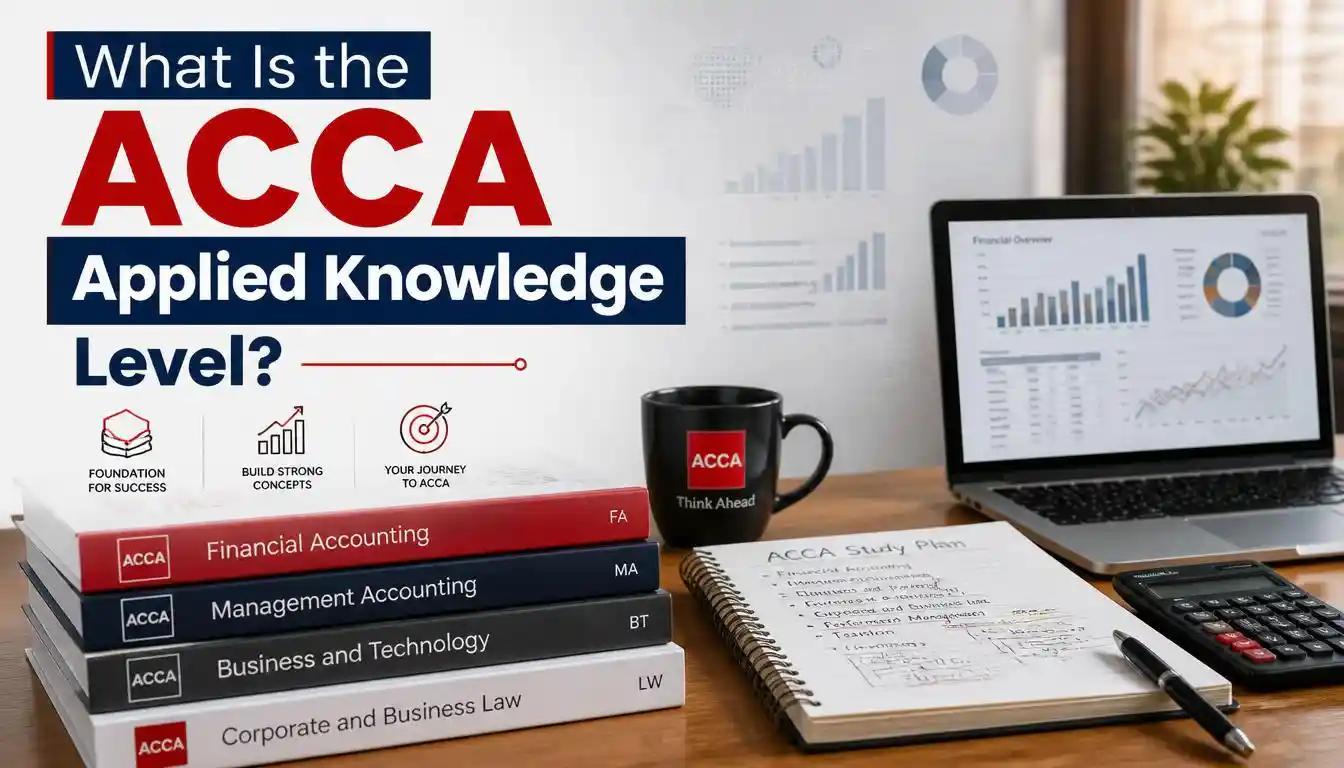
TheACCA Applied Knowledge level is the first stage of the ACCA qualification and serves as the foundation for a successful career in accounting and finance. It introduces students to the core principles of business, technology, management accounting, and financial accounting, helping them develop the essential knowledge required before progressing to higher levels of the ACCA qualification.
One of the biggest advantages of the Applied Knowledge level is its flexibility. All three papers are on-demand Computer-Based Exams (CBEs), allowing students to choose their exam date throughout the year instead of waiting for a scheduled exam session. This flexible approach makes it easier for students to balance their ACCA studies with school, university, or work commitments while progressing at a pace that suits their learning goals.
Applied Knowledge Subjects
TheACCA Applied Knowledge level consists of three subjects that introduce students to the core concepts of business, accounting, and finance. Together, these papers build the knowledge and confidence required to progress to the Applied Skills level.
BT — Business and Technology This subject introduces the fundamentals of business organisations, corporate governance, technology, ethics, and organisational behaviour. Students learn how businesses operate and understand the role of accounting professionals in supporting organisational success.
MA — Management Accounting Costing techniques, budgeting, variance analysis, and using accounting data to support management decisions. A practical, hands-on paper focused on internal business performance.
FA — Financial Accounting Financial Accounting teaches the principles of double-entry bookkeeping, the preparation of financial statements, and the fundamentals of financial reporting. It provides the essential accounting knowledge required before progressing to more advanced ACCA subjects.
Applied Knowledge Exam Pattern
The ACCA Applied Knowledge level is designed to provide maximum flexibility for students. All three subjects are assessed through on-demand Computer-Based Exams (CBEs), allowing you to take each exam whenever you feel fully prepared..ICT Business School
- Format: 100% Computer-Based Exams (CBEs) with objective-style questions.
- Duration: 2 hours for each paper.
- Availability:Available on demand at approved ACCA Computer-Based Exam centres throughout the year.
- Pass mark:50% for each paper.
- Results:Provisional results are displayed immediately after completing the exam, with official confirmation issued by ACCA.
- Exemptions: Students with relevant academic qualifications, such as BBA, BCom, or other recognised commerce degrees, may be eligible for exemptions based on ACCA Global's exemption policy.
Did You Know? ACCA Exemptions May Save You Time:
If you have completed a BCom, BBA, or another recognised accounting or business degree, you may be eligible for ACCA exemptions depending on your university, qualification, and academic record. Eligible students can skip certain ACCA papers and begin their studies at a more advanced level, helping them save both time and exam costs.
To find out exactly how many exemptions you qualify for, use the official ACCA Exemptions Calculator or speak with the academic advisors at ICT Business School for personalised guidance based on your qualifications.ICT Business School
What Is the ACCA Applied Skills Level?
The ACCA Applied Skills level is the second stage of the ACCA qualification and builds upon the knowledge gained in the Applied Knowledge level. At this stage, students develop practical accounting, finance, taxation, audit, and business skills that are essential for working in professional finance roles. The focus shifts from understanding concepts to applying them in real-world business and accounting scenarios.
Unlike the Applied Knowledge level, the Applied Skills exams are session-based and are held four times a year—in March, June, September, and December. These exams require stronger analytical thinking, problem-solving abilities, and professional judgement, helping students prepare for the final Strategic Professional level and their future careers in accounting and finance.
Applied Skill Subjects
The Applied Skills level contains six papers. These cover the core technical areas of professional accounting:
LW — Corporate and Business Law
The ACCA Applied Skills level consists of six subjects that develop the technical knowledge and practical skills required for a successful career in accounting and finance. These papers prepare students to solve real business problems, interpret financial information, and make professional decisions in different areas of accounting.
PM — Performance Management
Performance Management focuses on management accounting techniques, budgeting, performance measurement, decision-making, and business planning. Students learn how financial information supports effective management decisions.
FR — Financial Reporting
Financial Reporting develops the skills required to prepare, analyse, and interpret financial statements in accordance with International Financial Reporting Standards (IFRS). It is one of the most important technical papers in the ACCA qualification..ICT Business School
TX — Taxation
This subject covers the principles of personal and corporate taxation, tax planning, and tax compliance. Students gain practical knowledge that is directly applicable in accounting and taxation roles.
FM — Financial Management
Financial Management focuses on investment appraisal, capital structure, working capital management, business finance, and financial risk management. It develops the financial decision-making skills required in modern organisations.
AA — Audit and Assurance
Audit and Assurance introduces the principles of auditing, professional ethics, internal controls, audit procedures, and assurance services. It helps students develop analytical thinking, professional judgement, and effective reporting skills..ICT Business School
Applied Skill Exam Pattern
- Format: Session-based Computer-Based Exams (CBEs) consisting of objective questions, scenario-based questions, and constructed response questions, depending on the subject.
- Duration: Approximately 3 hours for each paper.
- Pass mark: 50%
- Recommended order: Many students choose to study LW → TX → FR → PM → FM → AA, although the best order depends on your academic background and guidance from your tuition provider.
- Results: Official results are typically released around six weeks after the exam session.
ACCA Applied Knowledge vs Applied Skills
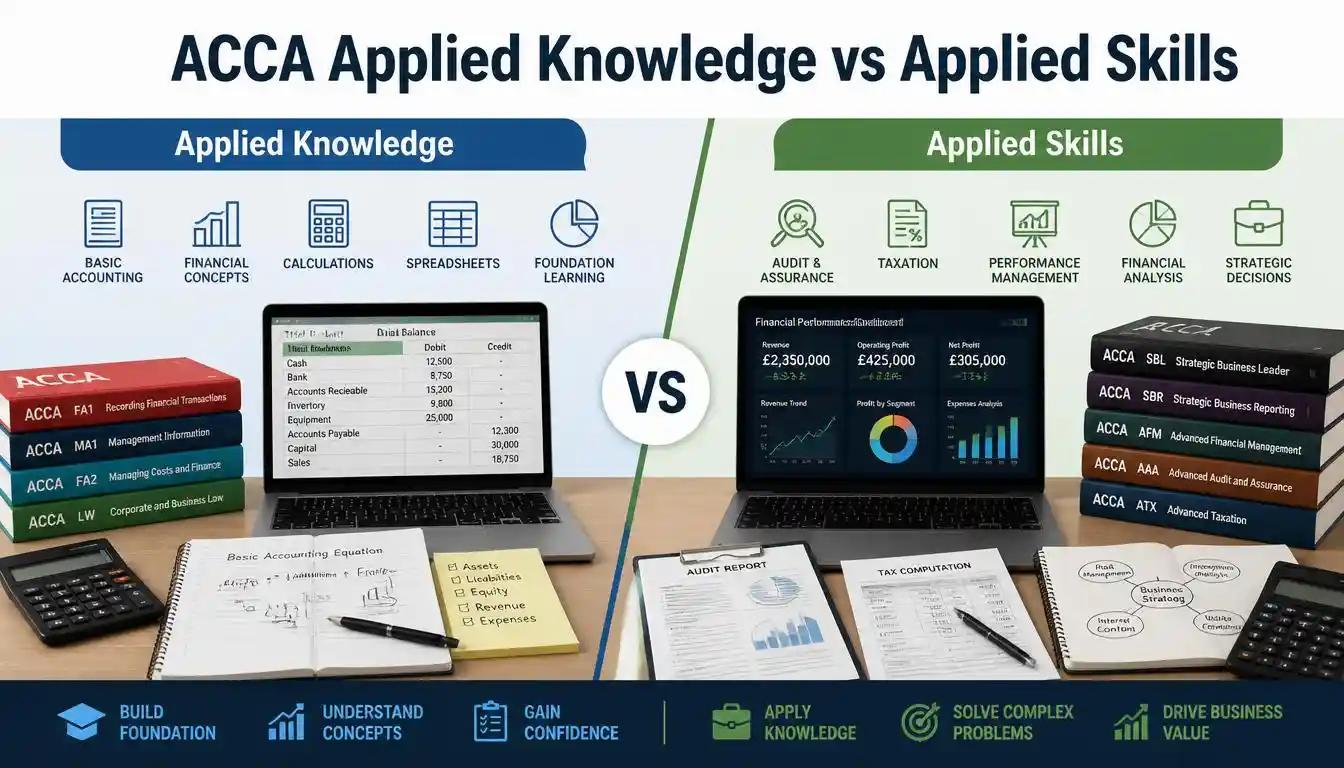
Many students wonder about the difference between theACCA Applied Knowledge and Applied Skills levels. While both are essential stages of the ACCA qualification, they differ in terms of subject complexity, exam format, and the level of practical knowledge required. The comparison below highlights the key differences to help you understand what to expect as you progress through your ACCA journey..ICT Business School
| Feature | Applied Knowledge | Applied Skills |
|---|---|---|
| Number of Papers | 3 papers (BT, MA, FA) | 6 papers (LW, PM, FR, TX, FM, AA) |
| Exam Type | On-demand CBE (anytime) | Session-based CBE (quarterly) |
| Exam Duration | 2 hours per paper | 3 hours per paper |
| Question Style | Mostly objective / MCQ | Scenario-based + written analysis |
| Difficulty Level | Foundational (easier) | Intermediate to challenging |
| Pass Rate (approx.) | 60–70% average | 40–55% average |
| Who Takes It | New entrants, school leavers, A-Level graduates | Students who completed Knowledge level or have exemptions |
| Exemptions Available | Yes (for commerce graduates) | Limited (for specific degree holders) |
| Focus Area | Foundational accounting & business principles | Real-world application of accounting, tax, audit, finance |
| Leads To | Applied Skills level | Strategic Professional level |
The key takeaway: Applied Knowledge is about learning; Applied Skills is about applying. You cannot sit for any Applied Skills paper without first completing (or obtaining exemptions from) the Applied Knowledge papers. The two levels are sequential by design.
Why Are ACCA Applied Knowledge and Applied Skills Important?
The Applied Knowledge and Applied Skills levels form the foundation of the ACCA qualification. Together, they develop the technical knowledge, practical skills, and professional competence needed for a successful career in accounting and finance. Here are some of the key reasons why these levels are important:
- Global Recognition:
The ACCA qualification is recognised by employers and professional organisations in more than 180 countries. Successfully completing the Applied Knowledge and Applied Skills levels demonstrates that you have developed the core accounting, financial reporting, taxation, audit, and business skills valued by employers in Pakistan and internationally. - Pathway to Strategic Professional:
Successfully completing the Applied Skills level allows you to progress to the Strategic Professional level, where you develop advanced leadership, strategic thinking, and professional decision-making skills required for senior finance and management roles. - Foundation for Exemptions:
The knowledge and practical skills gained during these two levels prepare students for a wide range of careers in accounting, finance, taxation, auditing, financial reporting, and business management. They also provide a solid foundation for lifelong professional development and future career opportunities..ICT Business School
Expert Guidance — From Ict Business School
Based on our experience of guiding ACCA students, one of the most common mistakes is rushing through the foundation level. Our faculty recommends building a strong understanding of Business and Technology (BT), as it introduces the core business concepts and professional knowledge that support many subjects later in the ACCA qualification.
Another important recommendation is not to delay the Applied Skills level unnecessarily. Many students wait until they feel completely prepared, but consistent practice with study materials, past papers, and mock exams is often the best way to build confidence and improve exam performance. Setting a clear study plan and exam schedule helps students stay focused and maintain steady progress.
We also recommend studying Financial Reporting (FR) before Audit and Assurance (AA) whenever possible. A strong understanding of financial reporting standards and financial statements makes it easier to understand audit concepts and perform better in the Audit and Assurance paper.
Use official ACCA study materials — Kaplan and BPP textbooks are the gold standard. Supplement with free resources from the ACCA Study Hub (https://www.accaglobal.com/uk/en/student/study-resources.html) and structured revision courses at your institute.
Study ACCA at ICT Business School — Pakistan's Trusted Institute
If you are looking for a structured, results-driven environment to prepare for your ACCA Applied Knowledge and Applied Skills exams, ICT Business School (https://www.ictbusinessschool.com/) is one of Pakistan's most respected educational institutes for professional qualifications. Based in Islamabad, ICT offers expert-led classroom and online coaching for a full suite of professional programs.
Here is what ICT Business School offers:
- ACCA (Applied Knowledge to Strategic Professional) — full pathway coaching with experienced faculty
- CA (ICAP Pathway) — for students pursuing chartered accountancy in Pakistan
- CIA (Certified Internal Auditor) — internal audit specialization
- CMA (Certified Management Accountant) — management accounting and strategy
- O Level and A Level Programs (https://www.ictbusinessschool.com/courses/o-level-program) — academic foundation for students planning to enter ACCA
- HND Higher National Diploma in Business (https://www.ictbusinessschool.com/courses/hnd-higher-national-diploma) — a Pearson-accredited business qualification
- Pearson BTEC Level 3 (https://www.ictbusinessschool.com/courses/pearson-btec-level-3) — ideal for students building academic credentials for UK university entry or ACCA
- Pearson BTEC Level 7 Extended Diploma (https://www.ictbusinessschool.com/courses/level-7-extended-diploma) — advanced business education aligned to Masters level
Why choose ICT Business School? (https://www.ictbusinessschool.com/about) The institute combines internationally aligned curricula with an understanding of the specific needs of Pakistani students — covering ACCA exam fees in Pakistan, local exam centre access, Urdu-medium support where needed, and career guidance post-qualification. Explore the full range of professional development courses at ICT Business School Courses .ICT Business School (https://www.ictbusinessschool.com/courses) or connect with their expert faculty at ICT Faculty (https://www.ictbusinessschool.com/faculty).
For students exploring advanced corporate and taxation courses at ICT, the ACCA Applied Skills pathway — particularly FR, TX, and AA — provides the most direct route to specialist roles in financial reporting and tax compliance in Pakistan's growing professional sector. Visit the ICT Education Portal (https://ict.edu.pk) for the latest enrollment information.
ACCA Career Path After Applied Skills Level
TheACCA career path after Applied Skills is broad and growing — particularly in Pakistan's expanding financial services sector. Here are the most common roles and directions students pursue:
Career & Salary Table (Pakistan)
| Role | Industry | Avg. Monthly Salary (PKR) |
|---|---|---|
| Junior Accountant | Corporate, Manufacturing | 60,000 – 90,000 |
| Audit Trainee / Associate | Audit Firms, Big 4s | 70,000 – 110,000 |
| Tax Associate | Tax Consultancy, Law Firms | 65,000 – 100,000 |
| Finance Analyst | Banking, Investment | 80,000 – 130,000 |
| Management Accountant | FMCG, Telecom, Retail | 90,000 – 150,000 |
| ACCA Affiliate (after all exams) | Any sector | 150,000 – 300,000+ |
| Fully Qualified ACCA Member | CFO, Director, Controller | 300,000 – 700,000+ |
Frequently Asked Questions (FAQs)
Q: What is ACCA Applied Knowledge? A: ACCA Applied Knowledge is the first level of the ACCA qualification. It consists of three computer-based papers — Business and Technology (BT), Management Accounting (MA), and Financial Accounting (FA). These on-demand exams can be taken anytime at an approved test centre and introduce students to the fundamentals of accounting and business.
Q: What is ACCA Applied Skills? A: ACCA Applied Skills is the second level of the ACCA qualification, made up of six session-based papers: Corporate and Business Law (LW), Performance Management (PM), Financial Reporting (FR), Taxation (TX), Financial Management (FM), and Audit and Assurance (AA). These exams are held quarterly and require applied, scenario-based thinking.
Q: How many papers are in ACCA Applied Knowledge? A: There are 3 papers in the ACCA Applied Knowledge level: BT (Business and Technology), MA (Management Accounting), and FA (Financial Accounting). All three are on-demand computer-based exams available year-round.
Q: How many subjects are in ACCA Applied Skills? A: There are 6 subjects in the ACCA Applied Skills level: LW, PM, FR, TX, FM, and AA. These session-based exams are held four times per year (March, June, September, December) at approved ACCA exam centres.
Q: Which ACCA level is the easiest? A: The Applied Knowledge level is the easiest. Its three papers — BT, MA, and FA — are designed for beginners and use objective-format CBEs with no written scenario questions. Pass rates average 60–70%, making them significantly more accessible than Applied Skills or Strategic Professional papers.
Q: Can I skip ACCA Applied Knowledge? A: Yes, if you hold a qualifying degree. Commerce graduates (BBA, BCom, or equivalent from an ACCA-accredited Pakistani university) may receive up to 5 exemptions, potentially covering all Applied Knowledge papers. Use the ACCA exemption calculator on the official ACCA website, or speak to a counselor at ICT Business School (https://www.ictbusinessschool.com/contact) for guidance.
Q: What comes after ACCA Applied Skills? A: After completing the Applied Skills level, students progress to the Strategic Professional level. This includes the compulsory Ethics and Professional Skills Module (EPSM), Strategic Business Leader (SBL), Strategic Business Reporting (SBR), and two optional papers from Advanced Financial Management (AFM), Advanced Performance Management (APM), Advanced Taxation (ATX), and Advanced Audit and Assurance (AAA).
Q: Is ACCA Applied Skills difficult for beginners? A: Applied Skills is noticeably harder than Applied Knowledge. Papers like FR, FM, and AA have pass rates of around 40–50%, meaning preparation must be systematic. Using official ACCA study materials, attending structured coaching at an institute like ICT Business School (https://www.ictbusinessschool.com/), and completing ACCA past papers regularly are the most effective ways to succeed.
Q: What jobs can I get after ACCA Applied Skills in Pakistan? A: After completing ACCA Applied Skills, you are qualified for roles including Junior Accountant, Audit Trainee, Tax Associate, Finance Analyst, and Management Accountant. ACCA jobs in Karachi, Lahore, and Islamabad are widely available in banking, FMCG, audit firms, and multinational corporations.
Q: How long does ACCA take to complete? A: The full ACCA qualification typically takes 3–4 years if studied continuously. Applied Knowledge can be completed in 3–6 months, Applied Skills in 12–24 months, and Strategic Professional in 12–18 months. Students with exemptions can finish faster. The timeline depends on study pace, exam attempts, and work commitments.
Ready to Start Your ACCA Journey?
ICT Business School offers expert ACCA coaching in Islamabad — from Applied Knowledge to Strategic Professional. Get structured guidance, past paper practice, and career support all in one place.
Explore ACCA Courses: https://www.ictbusinessschool.com/courses Contact ICT Now: https://www.ictbusinessschool.com/contact
Also offering: CA | CIA | CMA | O & A Levels | HND | BTEC Level 3 & 7
Conclusion
The ACCA Applied Knowledge and Applied Skills levels form the foundation of the ACCA qualification and prepare students for the Strategic Professional level. Together, these stages develop the technical knowledge, practical skills, and professional confidence needed to build a successful career in accounting, finance, taxation, and auditing.
Whether you are starting your ACCA journey after Intermediate, A Levels, or a university degree, understanding the qualification structure and choosing the right study pathway will help you progress more efficiently. With proper planning, consistent preparation, and guidance from experienced instructors, you can complete the ACCA qualification and open doors to career opportunities in Pakistan and around the world..ICT Business School
About This Guide:
This guide has been prepared by the academic content team at ICT Business School to help students understand the ACCA Applied Knowledge and Applied Skills levels in a simple and practical way. The information is based on the latest ACCA qualification structure and is intended for educational purposes to help students make informed academic and career decisions.
Disclaimer
The information provided in this guide is for educational purposes only. ACCA examination policies, exemptions, fees, syllabus, and qualification requirements may change over time. Students should always refer to the official ACCA Global website for the latest information before making any registration or academic decisions.